

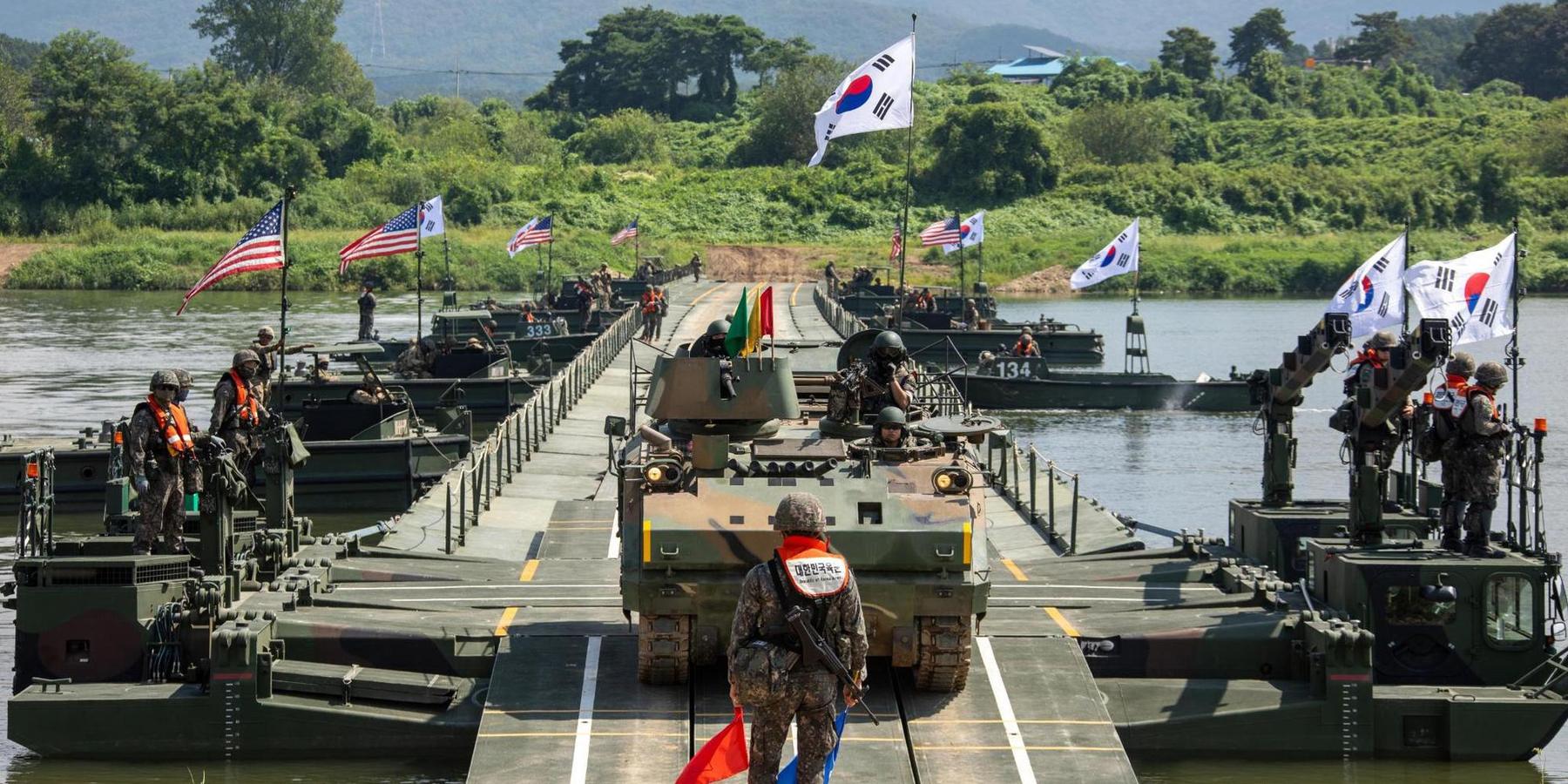
On Sunday, President Donald Trump abruptly announced that he had directed the Pentagon to “substantially reduce” major U.S.-South Korea military drills that began this week.
In a post on Truth Social, Trump provided several reasons why: the exercises are too “costly,” send a “totally inappropriate and hostile signal” to Pyongyang, and could strain his “very good relationship” with North Korean leader Kim Jong Un. Trump also hinted that he could consider suspending the exercises entirely if he had known about them sooner, stressing that he is “unhappy with the fact that the United States has, long ago, agreed to participate” in them, but it is “too late to cancel.”
Trump’s decision is sudden, but not shocking. Since his first term, Trump has always been pessimistic about U.S.-South Korea joint exercises and has shown a flexible — and unpredictable — tendency toward them.
He has often complained about how expensive the exercises are and has also acknowledged how provocative they can be to North Korea. Such thinking was reflected in Trump’s abrupt announcement to indefinitely suspend U.S.-South Korea joint exercises immediately following his first summit with Kim Jong Un in June 2018. Trump then argued that “we’ll be saving a tremendous amount of money. Plus, I think it’s very provocative.”
The impacts of Trump’s decision remain to be seen, but there are both potential positive and negative implications.
While it remains to be seen what a “substantial reduction” in joint exercises will look like, scaling down the U.S.-South Korea joint exercises program aligns with Washington and Seoul’s broad interest in stabilizing the situation on the Korean Peninsula and reviving diplomacy with Pyongyang.
As Trump noted, the joint exercises have long provoked North Korea, which views them as hostile “invasion rehearsals.” Indeed, the resumption of the exercises was an overlooked factor in the collapse of Trump-Kim diplomacy in 2019.
After the February 2019 Hanoi Summit, Trump and Kim continued to exchange letters and explored opportunities to re-engage, eventually meeting again in June 2019 at the Korean demilitarized zone. During their conversation, Kim raised a strong objection to the resumption of U.S.-South Korea joint exercises scheduled for that August, and Trump promised to suspend them. However, the exercises resumed, and Kim’s final letter to Trump reportedly expressed resentment over Trump’s unkept promise regarding the exercises.
The suspension of U.S.-South Korea joint exercises is not the only condition Pyongyang would like to see before agreeing to resume dialogue. The most decisive condition is probably whether Washington and Seoul would give up on demanding “denuclearization,” as Kim himself has repeatedly emphasized. But there is little doubt that reining in the exercises would reduce Kim’s perception that Washington is pursuing a “hostile policy” against the regime.
Therefore, if Washington and Seoul can coordinate to downsize and adjust the joint exercises in ways that minimize their offensive and provocative aspects and make them overall more defensive, such efforts could send a credible de-escalation signal to Pyongyang, although an indefinite suspension may eventually be necessary.
Although Trump’s decision to reduce U.S.-South Korea joint exercises could be a positive step toward resuming dialogue with North Korea, the decision to unilaterally announce the changes may prove counterproductive, causing more distrust between Washington and Seoul.
Seoul has publicly welcomed Trump’s announcement, saying it hopes U.S.-North Korea friendship will help promote dialogue. Internally, President Lee Jae-myung’s administration has debated the need to scale back joint exercises, and if Washington had raised the issue through bilateral coordination, Seoul likely would have supported it, given its keen interest in improving inter-Korean relations.
Nevertheless, whether Seoul supports it or not, announcing changes to a major element of alliance cooperation in such an abrupt and casual manner, without prior bilateral coordination, cannot be good for U.S. credibility as an ally, which has already been eroded by Trump’s unilateral approach to U.S. alliances.
Because the decision was made unilaterally by Trump rather than through bilateral coordination, it will likely cause a preventable political divide in Seoul. Reacting to Trump’s announcement, South Korea’s main opposition party — traditionally hawkish toward North Korea — and conservative media were quick to condemn and blame the Lee administration for causing a “security crisis” and damaging the U.S.-South Korea alliance.
Also concerning is the possibility that Trump’s decision is driven by a desire to punish Seoul rather than by a genuine diplomatic motive toward Pyongyang. In his social media announcement of the joint exercises’ reduction, Trump expressed regrets about Seoul’s refusal to support U.S. efforts to denuclearize Iran — while acknowledging that these are “somewhat unrelated.” Nobody but Trump knows the actual motive behind his decision, but this is something to be monitored carefully.
Ultimately, Trump's decision could represent a positive step toward reducing tensions with North Korea — so long as Trump is willing to coordinate with Seoul to make the most of it.
- Who is Lee Jae-myung, Yoon's potential replacement? ›
- Don't be fooled by the new China-North Korea love fest ›
- US diplomatic incompetence is tanking hopes for Korean peace ›
- Why South Korea won’t send military to Strait of Hormuz | Responsible Statecraft ›