

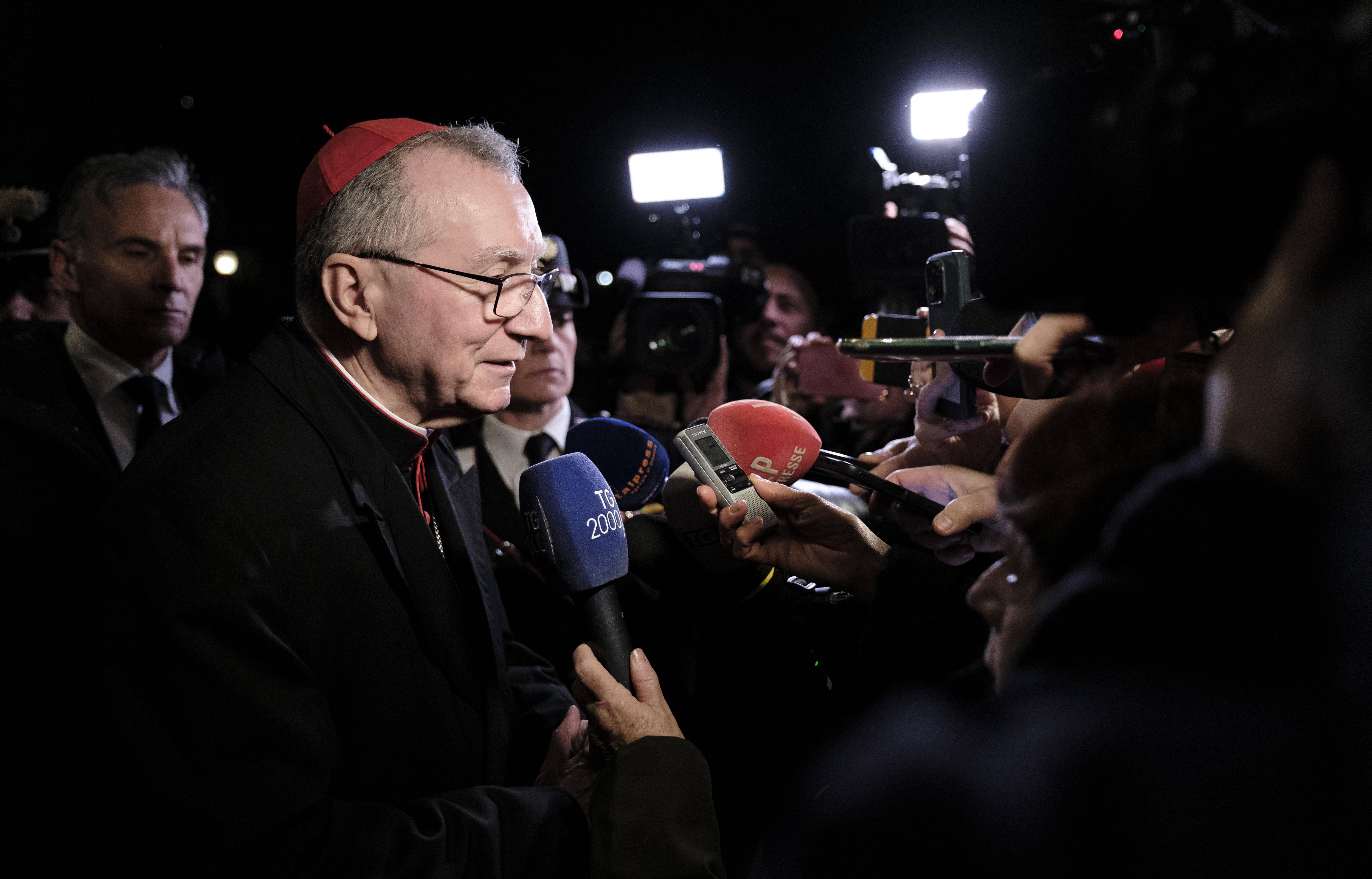
As the Trump administration and its allies ramp up pressure on Havana following deadly bombing campaigns in Caracas and Tehran, an interlocutor that for decades has mediated turbulent U.S.-Cuba ties is re-emerging as a potential facilitator of a bilateral deal: the Vatican.
On Thursday, Cuba’s foreign ministry announced the release of 51 prisoners in anticipation of Holy Week, crediting the “close and fluid relations between the Cuban state and the Vatican.” The move came just days after Vatican Secretary of State Pietro Parolin said the Holy See had taken the “necessary steps” to ensure a “negotiated solution” between the two countries, and just over a week after Cuban Foreign Minister Bruno Rodríguez Parrilla was received by Pope Leo XIV. These talks followed a recent meeting in Rome between a senior U.S. diplomat and the Holy See’s equivalent of a foreign minister.
Then, on Friday morning, Cuban President Miguel Diaz-Canal confirmed that his government is speaking with U.S. officials. He said the talks are in their early stages and credited "international actors" for facilitating them, without specifying the players involved.
The news of a potential Vatican-mediated backchannel, which neither the U.S. nor Cuba has officially confirmed, comes as President Trump has been floating a “friendly takeover” — “or not” — of Cuba. Meanwhile, as USA Today revealed, the White House is preparing a "surprise economic deal” with Cuba that could include a relaxation of restrictions on Americans' ability to travel to the island, as well as deals related to ports, energy, and tourism infrastructure. Limited sanctions relief is also reportedly on the table, according to sources who spoke with USA Today.
In exchange, Cuba could provide an offramp for Díaz-Canel — whom U.S. officials see as an obstacle to ongoing talks — to potentially step aside while allowing members of the powerful Castro family to remain on the island. These provisions, which Cuban officials appear open to, could lower bilateral tensions and advance the Trump administration’s interests in the Caribbean.
The possibility of an agreement, which would avoid bloodshed, state collapse and mass migration, comes at a fortuitous moment. Secretary of State Marco Rubio, who has long sought regime change in Havana, has seemingly backed off from pushing for immediate political changes on the island. Late last month, he said that gradual economic reform could offer a path forward to improve bilateral ties.
Other positive signs include a recent decision to allow fuel sales to Cuba’s private sector amid a de facto oil blockade, as well as the delivery of $9 million in humanitarian aid through the Catholic Church. While these moves are far from enough to mitigate the devastating impacts of Trump’s maximum pressure squeeze, they underscore the administration’s apparent concerns about provoking a humanitarian disaster and regime collapse just off the coast of Florida in an election year.
In recent weeks, Cuban authorities have seemingly responded positively to the Trump administration’s signals by legalizing public-private partnerships and floating serious economic reforms and an increased role for the country’s private sector.
Meanwhile, the State Department’s Coordinator for Cuban Affairs recently visited the island to meet with Catholic leaders and discuss the distribution of humanitarian aid, though it remains unclear if he held talks with his Cuban government counterparts as part of what the Miami Herald reported was an expected “formal meeting between Cuban government officials and officials in the U.S. State Department” on February 28.
Cuban officials have emphasized their readiness to engage in a more formal setting. President Trump, for his part, says on a near-daily basis that Secretary Rubio is talking to high-ranking Cuban leaders. At a recent summit in Florida, Trump told a group of heads of state that “they are negotiating with Marco, and myself, and some others.”
According to the Miami Herald and Axios, Rubio’s State Department advisers have met with the grandson of former Cuban president Raúl Castro, most recently on the sidelines of last month’s CARICOM Summit in St. Kitts and Nevis, as well as with others in Castro’s inner circle, which Cuban authorities have not denied, but called “speculation.”
At that summit, many Caribbean countries expressed their preference for a negotiated solution, with Jamaican Prime Minister Andrew Holness saying, “This moment calls for…constructive dialogue, particularly between Cuba and the United States, to ease tensions and promote reform and stability.” Some regional leaders, such as Mexico's Claudia Sheinbaum, have offered to serve as mediators for U.S.-Cuba talks, while others, notably Colombia’s Gustavo Petro, have apparently tried to send oil to the island. But upcoming elections in both Colombia and neighboring Brazil, along with Trump’s penchant for retaliation, have subdued any greater regional efforts to deter further escalation in tensions with the U.S.
This fear was on full display last week, when—despite Holness’ message of reconciliation—both Jamaica and Guyana caved to U.S. pressure by canceling a decades-old program to contract Cuban medical professionals, a major component of those countries’ healthcare systems and a source of revenue to Cuba’s that the U.S. considers “state-sponsored human trafficking.”
In that sense, it remains unclear what the administration’s strategy is toward Cuba—if there even is one. On the one hand, it supposedly seeks to make the island dependent on the U.S. by controlling the levers of fuel, dollars and other resources entering the country’s private sector, while simultaneously looking into the possibility of leveling criminal charges against the island’s authorities and choking off revenues to a public sector responsible for healthcare, education, public transportation, trash collection, and electricity generation.
Yet broad U.S. sanctions and internal divisions within the Trump administration have deterred U.S. executives from endorsing the administration’s plans. “Everyone's deathly afraid that the administration will be supportive in the morning and by lunchtime will be criticizing them,” John Kavulich of the U.S.-Cuba Trade and Economic said.
For now, a Vatican-led mediation may be the best off-ramp for both governments to resolve their differences while keeping the well-being of the Cuban people front and center.
During the final days of the Biden administration, the Vatican helped facilitate an agreement that led to the release of 533 prisoners from Cuban jails, the removal of Cuba from the U.S. state sponsor of terrorism list, the elimination of a State Department “Cuba Restricted List,” and the suspension of a provision in a 1996 law that allowed U.S. firms to sue in U.S. court any entity allegedly trafficking in property nationalized following the Cuban Revolution.
The Vatican also played a key role in the Obama administration’s secret negotiations with Cuba in 2013-14, with Pope Francis in particular encouraging President Obama to pursue reconciliation with Havana and advance dialogue at the urging of two Catholic cardinals, Archbishop of Havana, Jaime Ortega, and Archbishop of Boston, Sean O’Malley.
Pope Francis’ personal involvement helped break an impasse during those negotiations, and a U.S. official later said that a meeting at the Vatican coordinated by Secretary Parolin to finalize the breakthrough deal was fundamental in building confidence in both sides to overcome lingering distrust and sustain their respective ends of the bargain.
After that, Pope Francis visited the island in 2015, which was welcomed by the Cuban people and helped consolidate a more constructive relationship between the Cuban government and the Catholic Church.
Despite Pope Francis’ death last April, his successor—who has visited the island in the past and possibly even has Cuban roots—appears willing to pick up where Francis left off.
“I [invite] all those responsible to promote sincere and effective dialogue, in order to avoid violence and any action that could increase the suffering of the beloved Cuban people,” Pope Leo XIV said last month.
Editor's note: This article has been updated to include new remarks from the Cuban president on Friday morning.
- Is Rubio backing off Cuba regime change for his own political good? ›
- A deal that Cuba (and Trump) cannot refuse? ›