

It has been a rollercoaster, but President Donald Trump vowed to end the war in Ukraine and spent 2025 putting his stamp on the process and shaking things up far beyond his predecessor Joe Biden. Here’s the Top 10.
Tears in Munich
We didn’t have to wait long after President Trump assumed office for one of the more bizarre moments of 2025. In closing the Munich Security Conference on February 16, outgoing Chairman, Christoph Heusgen burst into tears. Taking issue with Vice President J.D. Vance’s speech two days before, he lamented: “we have to fear that our common value base, is not that common any more.”
Vance hadn’t even mentioned Ukraine, had heaped praise on the city of Munich, and offered heartfelt prayers following the February 13 terrorist attack. His crime? Advancing the cause of democracy and free speech in Europe, which he argued was under attack, a theme explored in the new U.S. National Security Strategy. In my view, this little vignette characterizes Europe’s fragility more than its leaders’ efforts to maintain the war in Ukraine.
Dressed-down in the Oval Office
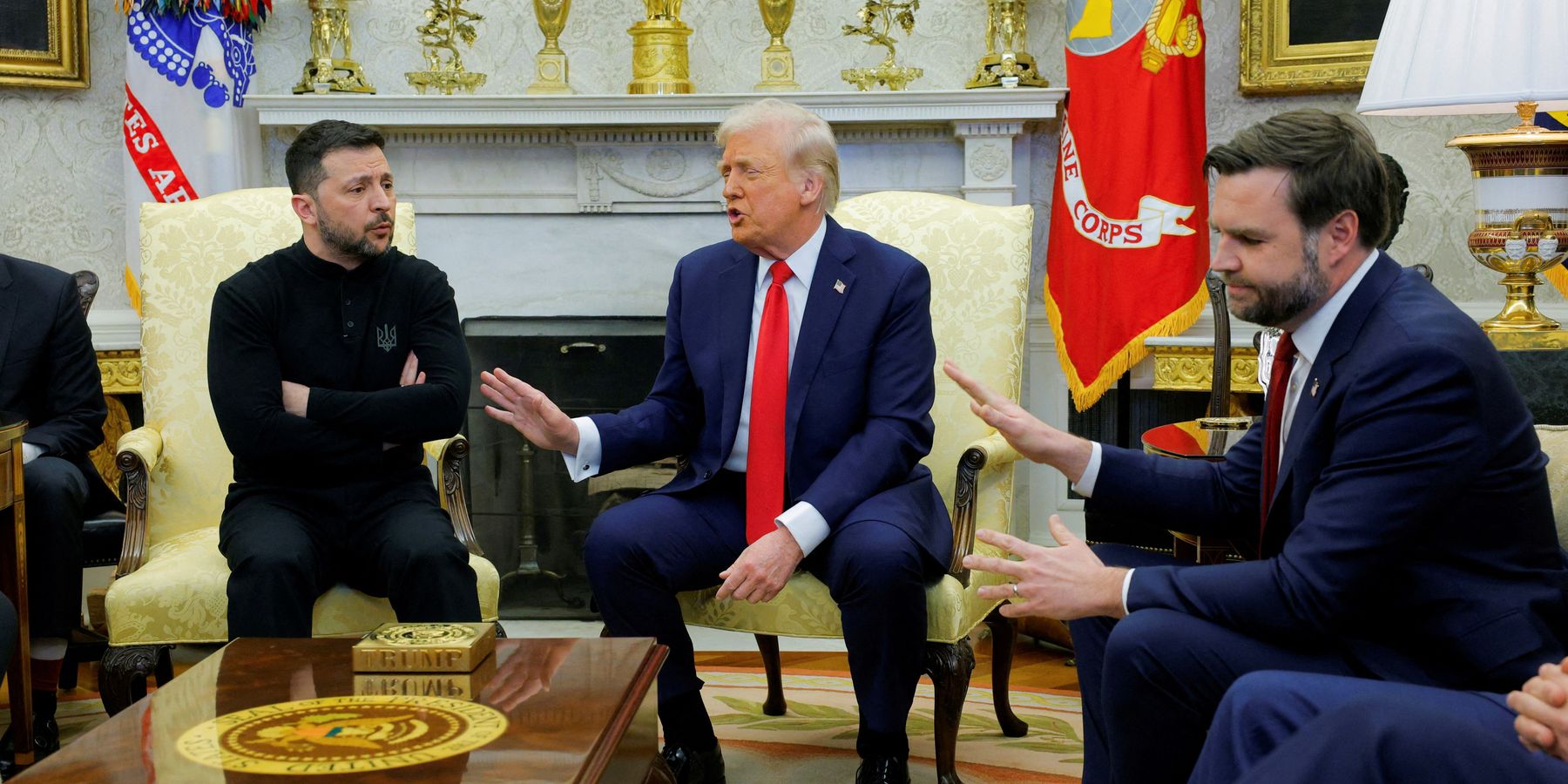
Ukrainian President Volodymyr Zelensky had not previously taken criticism for his signature dress-down wartime style until asked by a reporter why he wasn’t wearing a suit in the Oval Office on February 28. The conversation sped down-hill from there with the now infamous dressing down by President Trump.
That was a pivotal moment in how this year has played out. Zelensky had previously been untouchable, calling the policy shots in D.C. and across Europe for ever increasing military and financial support for his beleaguered country. To quote from Vice President Vance’s Munich speech, it was the moment when President Trump made it clear that there was a “new sheriff in town.”
Starmer launches the coalition of the (not very) willing
Days later in London, British Prime Minister Keir Starmer hosted Zelensky and other European leaders to unveil the “coalition of the willing.” Starmer was trying to achieve the impossible: reposition himself as an interface between the U.S. and Europe after a history of his political party criticizing President Trump, and to maintain an unchanged European stance on the Ukraine War. He has failed. Starmer’s willingness to back a peace deal with British “boots on the ground and planes in the air” fell apart within weeks, when it became clear that Europe would struggle to muster 25,000 troops. The Europeans have continued to block any U.S.-led peace initiative to the point where they have increasingly been left out of the talks.
Meet me in Turkey, if you dare!
With President Trump piling on the pressure for peace talks, President Zelensky challenged President Vladimir Putin to meet him in Istanbul on 15 May for peace talks. This was pure performance, of the type we have become accustomed with Zelensky. Putin was never going to turn up for a summit with no prior talks having taken place.
True to form, he sent a negotiating team who waited around with no sign of the Ukrainians. President Erdogan pressured Zelensky to send a delegation for negotiations which finally took place on May 16. Little progress was made towards peace, beyond helpful steps for both sides to exchange dead bodies and prisoners. Further pressure would be needed from the U.S. administration to edge talks forward.
Zelensky starts to lose his luster
For the first time since the war started, July witnessed widespread protests to Zelensky’s rule after he made a failed bid to shackle independent anti-corruption bodies as they closed in on investigations of members of his inner circle. Zelensky backed down under pressure from the West, but his image has not recovered, and even the western mainstream media seems to have slowly cooled on him.
More shocking revelations of his administration's complicity in corruption would later be revealed by the New York Times. In parallel, growing concerns about manpower shortages in the Ukrainian military and the increasing use of forced conscription of young men into the army has built a sense that Zelensky is increasingly the problem, not the solution.
Who's the daddy?
Undaunted by President Trump’s increasing persistence to pursue a peace deal in Ukraine, European leaders pivoted to a new strategy: flattery. This reached peak weird on June 25 at the Hague NATO Summit, when NATO Secretary General Mark Rutte referred to the U.S. President as “daddy.”
While holding the line that Ukraine should receive unlimited financial assistance until Russia is defeated, the Europeans had hoped that by saying nice things to President Trump he might not notice that they were blocking his efforts. This then led to the moment in August in which European leaders and Zelensky, now in a sports jacket, presented themselves in the Oval Office before daddy, sour-faced and looking like "unruly schoolchildren.”
Trump brings President Putin in from the cold
The schoolchildren moment happened hot on the heels of President Trump bringing President Putin in from the cold, at the Alaska Summit for Peace on August 16. That event was pivotal in breaking the diplomatic isolation that the U.S. and European nations had imposed on Putin since the start of the war (and which, arguably, has been building since 2014).
However, it was also key in outlining the contours of the peace plan that we appear to be slowly edging towards. One in which NATO membership is finally taken off the table in return for security guarantees, where some concessions are made on territory in Ukraine.
Yermak is sacked and says he'll go to the front line (but doesn't)
The former Head of Zelensky’s Administration, Andriy Yermak, was called the second most powerful man in Ukraine. But he increasingly came to be seen as at the heart of a growing authoritarianism in Ukraine. Having resisted pressure to sack him after the July corruption protests, Zelensky was left with no choice when the corruption investigation reached Yermak’s door in November.
Having started life as a film producer, Yermak theatrically announced his plan to join the army and go to the frontline. He does not appear to have done so, but rather still holds 10 advisory and consultative positions linked to the Ukrainian leadership. His official position as Head of the Presidential Administration has yet to be filled, adding to a sense of Zelensky’s increasing domestic isolation.
Shootout in Brussels
It has been clear for some considerable time that Ukraine was bankrupt and would eventually run out of money to continue the war. Europe’s response, expropriate sovereign Russian assets and find a legally defensible way to give them to Ukraine. However, an immovable obstacle stood in the way of the European Commission’s cunning plan: Belgium. The lowlands country, led by Bart de Wever, was never going to agree to this, given the huge financial and legal risks involved. At a chaotic European Council meeting in Brussels on December 18, he stood firm under considerable pressure, forcing Europe to borrow Euro 90 billion to keep Ukraine’s finances afloat.
This now leaves European taxpayers on the hook to keep the war going (as I predicted).
Pokrovsk is slowly dying and Ukraine continues to lose territory
The Ukrainian army has fought valiantly for eighteen months to hold the heavily fortified military hub of Pokrovsk in Donetsk. The city now appears to be fully encircled, although fighting continues in the slow death of a city that Russia has prioritized capturing. The military strategic value of Pokrovsk is questioned, but its complete loss to Russia would be another political blow to the Zelensky regime that is finding it increasingly hard to shore up western support.
In any case, Ukraine continues to lose land at “one of the fastest rates since the war began.” The Russian Ambassador to London, Andrei Keilin, told me last week that Russia intends to take the whole of Donetsk by military means if Zelensky does not commit to a US-brokered peace plan. I have seen nothing to make me doubt that.
The passing of time will only make any deal that Ukraine strikes more unpalatable. As we roll into 2026, some of President Trump’s remarks to President Zelensky in the Oval office from February will jangle ever louder: “you’re not winning this.”
Others will increasingly become less likely: “you have a damn good chance of coming out okay because of us.”
- Ukraine's own pragmatism demands 'armed un-alignment' ›
- Trump's '28-point plan' for Ukraine War provokes political earthquake ›