

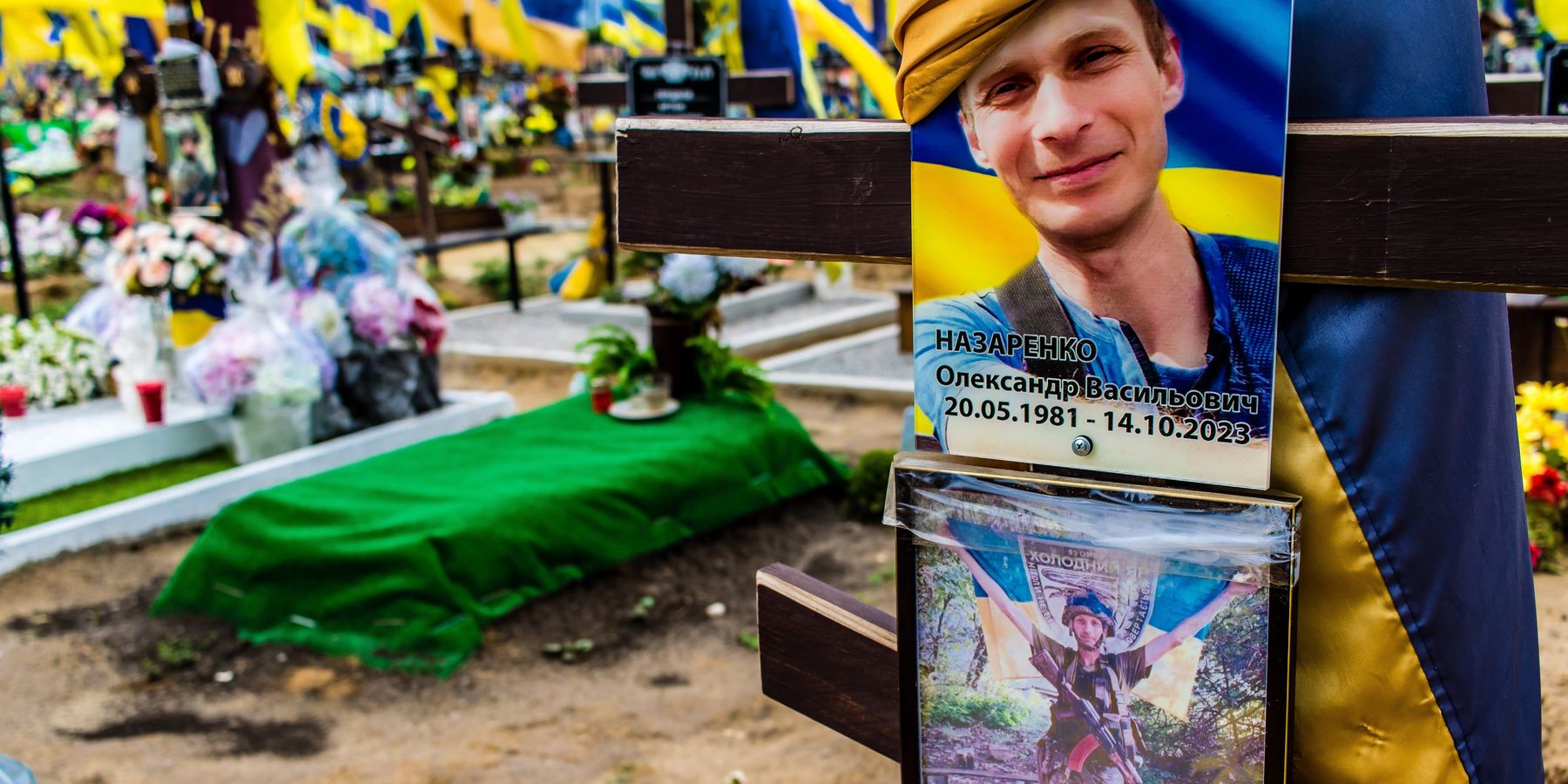
A spat over the return of 6,000 Ukrainian bodies lays bare the unforgiving economic and political challenge that Ukraine faces in bringing home its fallen, and the political storm that President Zelensky will face when the war finally ends.
The second round of the Istanbul peace talks on June 2 led to an agreement for Russia and Ukraine to exchange 6,000 bodies. On Sunday, June 8, a convoy of Russian refrigerated lorries arrived at the agreed meeting point in Belarus, with over 1,000 bodies, but the Ukrainian side did not show up. It is not clear that June 8 was the agreed date for the body swap to start, and Ukraine claims that the exchange was due to take place three days later, on June 11. The exchange has now happened, with 1212 Ukrainian soldiers’ bodies exchanged for the bodies of 27 Russians.
A war of words has erupted about who’s to blame. Russia is trying to paint the Ukrainian side as trying to deceive its public on the true scale of battlefield losses, while Ukraine accuses its opponent of playing political games.
Families on both sides will want their deceased relatives back to lay them to rest. I personally recall the huge media backlash in Britain over the delay in repatriating bodies of the 131 Britons killed in Thailand by the Boxing Day tsunami in 2004, having been personally involved in the recovery effort.
Ukraine’s challenge is greater by many magnitudes; it will take years, not months, to identify every fallen Ukrainian service man and woman. The victim identification process for the 3,000 western tourists killed in Thailand in 2004 took well over a year. That involved a huge international team of police and forensic experts, collecting samples from the corpses. There was an equivalent network of professionally qualified police family liaison officers gathering ante-mortem data (fingerprints, hair strands, dental records, etc.) from the homes of those thought to be deceased and keeping worried relatives up to date with progress.
It’s clear from the Russian negotiator’s statement that not all of the 6,000 bodies due for exchange have identifying documents, such as dog tags, most likely related to the terrible nature of their injuries: after the 2002 Bali bombing, many of the 202 killed had missing body parts, massively complicating the identification process.
Even when the bodies are intact and have been stored well, a reliable visual identification will be impossible. It is very common for searching relatives to identify a corpse and claim it as their family member out of emotional desperation. I had a colleague at the British Embassy in Bangkok who was killed with his three children by the 2004 tsunami. He was survived by his wife who tragically misidentified one of the children at an open-air mortuary site.
I’ve seen no evidence that Ukraine has the institutional capacity or resources to mount a body identification operation at this scale for the bodies already in their possession. And the assistance of western police and forensic specialists will be impossible while war rages.
In October 2024, the Economist revealed that Ukraine’s Commissioner of Missing Persons had a list of over 48,000 who are still missing together with 2,552 bodies that had yet to be identified. Those numbers will be higher today, eight months down the track.
Some commentators have seized on the enormous cost in compensation to the families of the deceased. There have been widespread social media posts that Ukraine will have to pay around $2.1 billion in compensation to the families of the 6,000, but this figure is, in fact, too low. Ukraine’s Cabinet of Ministers agreed in September 2024 to increase the one-off payment to the families of the fallen to around $544,000. So the compensation figure for the 6,000 soldiers will run to $3.6 billion in an already overstretched Ukrainian state budget which is being subsidized by western nations. And this marks just the tip of the iceberg.
Western intelligence officials suggested in late 2024 that around 80,000 Ukrainian troops may have been killed. Assessments in alternative media tend to be higher. But if we use the number circulating in mainstream media and fast forward six months to today, let us speculate that 100,000 Ukrainian troops have died so far. If you take the 50,000 Ukrainians considered missing or unidentified and the 43,000 troops that Zelensky said had been killed in December, that number feels close to the mark. One hundred thousand dead represents a total cost in one-off compensation payments to families of $54.4 billion.
And the problem runs deeper than that. Intelligence officials from the same source also claimed up to 480,000 injuries to soldiers. Let’s say that figure is 550,000 today. Ukraine also pays between $180,000 and $290,000 for injury and disability. If only 20% of the reported injuries attracted the lowest tariff of one-off disability payment, that would add an extra $19.8 billion to the compensation bill. If it were 50%, $40.5 billion, and 80%, $79,2 billion.
So, even if the war were to end today, Ukraine could be staring down the barrel of a compensation bill, even on a conservative estimate, of over $130 billion. To put that into context, Ukraine is expected to generate $48.2 billion in tax revenue in 2025. Anyone who believes that Ukraine will not ask western donor nations for support in meeting this bill is fooling no one but themselves.
The vastly inflated cost of compensating victims and families of the fallen may reflect a wider effort to encourage more to take up military service. All this against a background of still severe recruitment shortages and desperate tactics used by recruitment officers, including dragging men off the streets.
In a bid to encourage men to fight, the most junior soldiers in the firing line are paid well over ten times the average salary in Ukraine. That includes a basic salary of almost $4,593 per month for troops on the front line, and all troops receive a payment of around $1,700 for every cumulative 30 days spent in combat. The latter sum also, terrifyingly, talks to the short life expectancy of those on the front line. Early in 2023, a former U.S. Marine claimed that the average life expectancy for recruits on the frontline was four hours. And, of course, extremely high rates of pay while war rages pose a major political challenge when the fighting stops and front-line soldiers take a near 89% reduction to non-combat pay of $494 per month.
Some commentators have argued that Ukraine might be incentivized to slow the identification of bodies to delay payments to relatives. That is an oversimplification that misses the true scale of the task that Ukraine faces.
The living nightmare for heartbroken relatives waiting to lay their loved ones to rest seems certain to continue for years to come. This may impose a devastating political cost on President Zelensky far greater than the towering and unaffordable economic cost of fighting a losing war.
- Tom Massie: Washington purposely blacking out Ukraine casualty data ›
- The danger of downplaying the Ukrainian battlefield toll ›