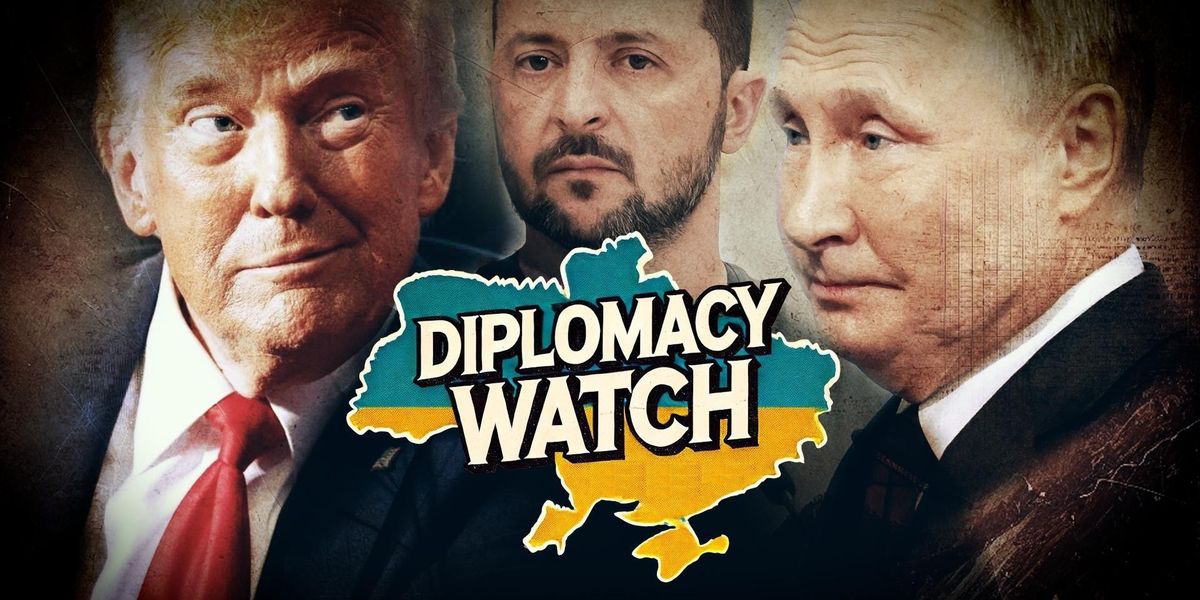
As the Ukraine war drags on and the U.S. role in negotiations appears increasingly tenuous, the European Union is working to garner support for yet another round of sanctions on Russia.
The EU unveiled the new sanctions package — its 18th round — on Tuesday, which includes a ban on transactions with the Russian-owned, non-operational Nord Stream gas pipelines, sanctions on 22 Russian banks, and dropping the oil price cap down from $60 to $45 per barrel. The sanctions also target two Chinese banks, which the EU alleges have worked to foster banned trading with Russia; China opposes the measures.
“Despite weeks of diplomatic attempts, despite [Ukraine’s] President [Volodymyr] Zelensky’s offer of an unconditional ceasefire, Russia continues to bring death and destruction to Ukraine. Russia’s goal is not peace, it is to impose the rule of might. Therefore, we are ramping up pressure on Russia,” the President of the European Commission Ursula von der Leyen explained, citing what she perceives as unsuccessful diplomatic efforts between Russia and Ukraine. She asserted that “strength,” through such sanctions, “is the only language that Russia will understand.”
Ultimately, the EU needs support from all 27 members for the sanctions package to pass. And some proposals, like the oil price cap, may need some broader support from international partners if they are to be effective.
In this respect, officials and observers believe that upcoming diplomatic engagements, including the Group of Seven (G7) summit, slated to take place in Alberta, Canada this weekend, might serve as a temperature check.
Indeed, citing legislative pushes for sanctions on Russia in Washington, a German official said Thursday that “in Canada, it will be a matter of seeing how far it is possible to achieve parallel movement” with Washington regarding punitive measures against Russia.
“Brussels seems optimistic that the eighteenth sanctions package will pass. However, aspects of the sanctions package will need G7 support. This includes the proposal to reduce the price cap,” Kimberly Donovan, director of the Economic Statecraft Initiative at the Atlantic Council’s GeoEconomics Center, told the Atlantic Council. “Further, support from Washington or lack thereof could sway how countries such as Hungary and Slovakia vote on the sanctions package.”
Kaja Kallas, High Representative of the Union for Foreign Affairs and Security Policy, however, has argued the EU may not need American support to effectively lower the price cap on Russian oil. "If you think about the oil going through the channels, it's mostly Europe, it's via the Baltic Sea, it's via the Black Sea. So even if the Americans are not on board, we can still do it and have an impact," Kallas posited on Wednesday at the German Marshall Fund's Brussels Forum 2025.
The sanctions package has other European leaders, weary of Europe’s persistent war-related energy woes, resistant.
"Slovakia will not support the upcoming 18th sanctions package against Russia unless the European Commission provides it with a real solution to the crisis situation that Slovakia will find itself in after the complete cessation of gas, oil and nuclear fuel supplies from Russia," Slovakian Prime Minister Robert Fico said Wednesday, responding to the package.
Hungarian Prime Minister Viktor Orban has repeatedly said he wouldn’t support more sanctions packages targeting Russian energy.
If anything’s certain, it’s that the EU’s new sanctions venture has some support in Washington.
Indeed, South Carolina Senator Lindsey Graham, who has amassed bipartisan support for his own Russia sanctions bill, cheered on the EU announcement on X Tuesday: “I am very pleased that our European partners -- through the EU commission -- are leveling a new round of sanctions against Russia for their barbaric invasion of Ukraine.”
“This round is different because it is going after Chinese companies that prop up Putin’s war machine. Without China and India buying 70% of Russian oil, Putin’s war machine would come to a grinding halt,” Graham wrote, citing China and India’s significant wartime consumption of Russian oil.
In other Ukraine war news this week
Reuters reported that Russia’s new ambassador to the U.S., Alexander Darchiev, who formally presented his credentials to President Donald Trump on Wednesday, has expressed hope for improved U.S.-Russia relations. "It was a great honor for me, as Russian ambassador, to speak with President Trump and I assured him that I and this embassy under my direction will do everything to restore Russian-American relations and bring them back to normality and common sense,” he said.
"Russia and the United States are destined, as great powers, to have non-confrontational peaceful existence," Darchiev said at a Russian Embassy reception post-White House visit.
The United States recognized June 12 as Russia National Day, which celebrates the establishment of the Russian Federation, for the first time since the start of the war in Ukraine. In a State Department Press statement, Secretary of State Marco Rubio expressed hope for improved relations with Russia and a chance for “constructive engagement” to negotiate a peace between Russia and Ukraine.
NATO secretary general Mark Rutte called for increased European defense spending on Thursday, according to the Guardian. “We are safe now. We are not safe three to five years from now, so we have to spend more,” he explained, citing his fear that Russia could eventually directly test NATO's ability to defend its territory.
From State Department Press Briefing June 10
“The president and the secretary have been saying for a while that the only real solution can come with the parties talking directly, and that is what we’ve been seeing here at least in this regard. And we, of course, remain in close contact with both parties at the highest levels,” State Department spokesperson Tammy Bruce said of ongoing negotiations between Russia and Ukraine. “And we welcomed the success, the movement of, again, more prisoner exchanges – in this case, of course, the seriously wounded and young prisoners under the age of 25 – as well as repatriating fallen soldiers, which in that instance was about 6,000 each, horribly.”
“This was negotiations, conversations between the two parties [Russia and Ukraine] involved, and that’s all I can tell you is that we welcome that progress in the meantime,” Bruce explained.