
Follow us on social

google cta
Donald Trump Davos 2026

Trump: We got a $1.5 trillion military budget. He’s (kinda) right.

His boast to Davos today wasn't off the mark if he combines these overflowing pots of national security funding

Analysis | QiOSK
google cta
google cta

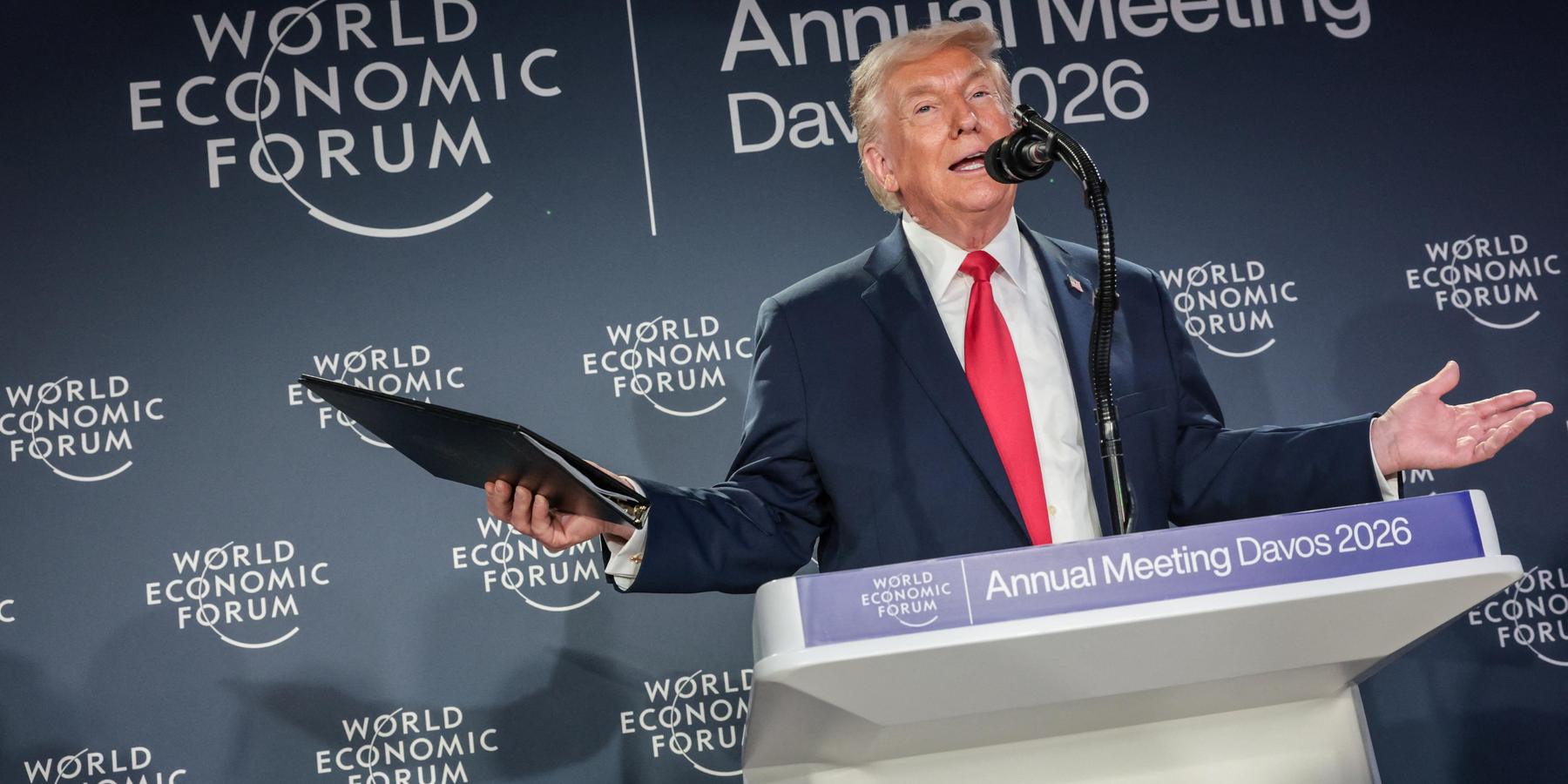
“I rebuilt the military in my first term and continue to do so today. We have a budget of $1.5 trillion,” claimed President Donald Trump in a provocative, meandering, and at times outright baffling speech at the Davos Economic Forum today.

While fact-checkers eviscerated scores of Trump’s misleading statements in the speech, this $1.5 trillion military budget claim went largely uncontested. Yet, this would seemingly have been one of the easiest myths to debunk. After all, the Pentagon currently has a trillion dollar budget (wow, someone should really write a book about that!) and it was just two weeks ago that Trump announced, via Truth Social post, that he’d be seeking (read: did not currently have) a $1.5 trillion military budget.

Critics, myself included, pointed out the enormous amount of taxpayer money this would waste, while doing little, if anything, to make the average American any safer. At the very least, it would contribute $5.8 trillion over the next ten years to the already skyrocketing U.S. national debt, according to the Committee for a Responsible Federal Budget.

But, there’s another way of looking at the numbers, and, from this point-of-view, Trump is absolutely right — the U.S. is already spending more than $1.5 trillion on defense. The fact is that most Americans —and even most foreign policy wonks — grossly undercount the amount of money our government spends on the national security state. This is precisely what some of the most ardent critics of wasteful U.S. military spending have been arguing for years.

For example in 2024, Winslow Wheeler, who previously analyzed the budget process for both parties in the Senate and at the Government Accountability Office, put the “real” national security budget closer to $2 trillion dollars, when including things like veterans care and defense spending’s impact on the national debt. By a similar accounting, the Institute for Policy Studies found that nearly two-thirds of the entire federal government’s discretionary budget — which doesn’t include big-ticket items like Social Security and Medicare/Medicaid — is spent on militarism and war.

Using today’s budget figures and this more accurate accounting of “defense” spending, it’s very easy to prove Trump right. Outside of the trillion dollar defense budget, even if you only add in what we spent in 2025 on clearly national security focused agencies — like the Department of Veterans Affairs ($401 billion), the Department of Homeland Security ($111 billion), and the Director of National Intelligence ($73 billion) — you arrive at a nearly $1.6 trillion budget for U.S. national security.

So, Mr. President, you were right — the U.S. already has a national security budget well above $1.5 trillion dollars. Congratulations! Now there is no need to give any additional taxpayer dollars to a Pentagon bureaucracy that has never once passed a full financial audit, right?...Right?


Top photo credit: U.S. President Donald Trump speaks during a reception with business leaders, at the 56th annual World Economic Forum (WEF), in Davos, Switzerland, January 21, 2026. REUTERS/Jonathan Ernst
google cta
Analysis | QiOSK
G7 Summit
Top photo credit: May 21, 2023, Hiroshima, Hiroshima, Japan: (From R to L) Comoros' President Azali Assoumani, World Trade Organization (WTO) Director-General Ngozi Okonjo-Iweala, Australia's Prime Minister Anthony Albanese and India's Prime Minister Narendra Modi at the G7 summit in Hiroshima, Japan. (Credit Image: © POOL via ZUMA Press Wire)

Middle Powers are setting the table so they won't be 'on the menu'

Asia-Pacific

The global order was already fragmenting before Donald Trump returned to the White House. But the upended “rules” of global economic and foreign policies have now reached a point of no return.

What has changed is not direction, but speed. Canadian Prime Minister Mark Carney’s remarks in Davos last month — “Middle powers must act together, because if we’re not at the table, we’re on the menu” — captured the consequences of not acting quickly. And Carney is not alone in those fears.

keep readingShow less
Vice President JD Vance Azerbaijan Armenia
U.S. Vice President JD Vance gets out of a car before boarding Air Force Two upon departure for Azerbaijan, at Zvartnots International Airport in Yerevan, Armenia, February 10, 2026. REUTERS/Kevin Lamarque/Pool

VP Vance’s timely TRIPP to the South Caucasus

Washington Politics

Vice President JD Vance’s regional tour to Armenia and Azerbaijan this week — the highest level visit by an American official to the South Caucasus since Vice President Joe Biden went to Georgia in 2009 — demonstrates that Washington is not ignoring Yerevan and Baku and is taking an active role in their normalization process.

Vance’s stop in Armenia included an announcement that Yerevan has procured $11 million in U.S. defense systems — a first — in particular Shield AI’s V-BAT, an ISR unmanned aircraft system. It was also announced that the second stage of a groundbreaking AI supercomputer project led by Firebird, a U.S.-based AI cloud and infrastructure company, would commence after having secured American licensing for the sale and delivery of an additional 41,000 NVIDIA GB300 graphics processing units.

keep readingShow less
United Nations
Monitors at the United Nations General Assembly hall display the results of a vote on a resolution condemning the annexation of parts of Ukraine by Russia, amid Russia's invasion of Ukraine, at the United Nations Headquarters in New York City, New York, U.S., October 12, 2022. REUTERS/David 'Dee' Delgado||

We're burying the rules based order. But what's next?

Global Crises

In a Davos speech widely praised for its intellectual rigor and willingness to confront established truths, Canadian Prime Minister Mark Carney finally laid the fiction of the “rules-based international order” to rest.

The “rules-based order” — or RBIO — was never a neutral description of the post-World War II system of international law and multilateral institutions. Rather, it was a discourse born out of insecurity over the West’s decline and unwillingness to share power. Aimed at preserving the power structures of the past by shaping the norms and standards of the future, the RBIO was invariably something that needed to be “defended” against those who were accused of opposing it, rather than an inclusive system that governed relations between all states.

keep readingShow less
google cta
Want more of our stories on Google?
Click here to make us a Preferred Source.

LATEST

QIOSK

Newsletter

Subscribe now to our weekly round-up and don't miss a beat with your favorite RS contributors and reporters, as well as staff analysis, opinion, and news promoting a positive, non-partisan vision of U.S. foreign policy.