

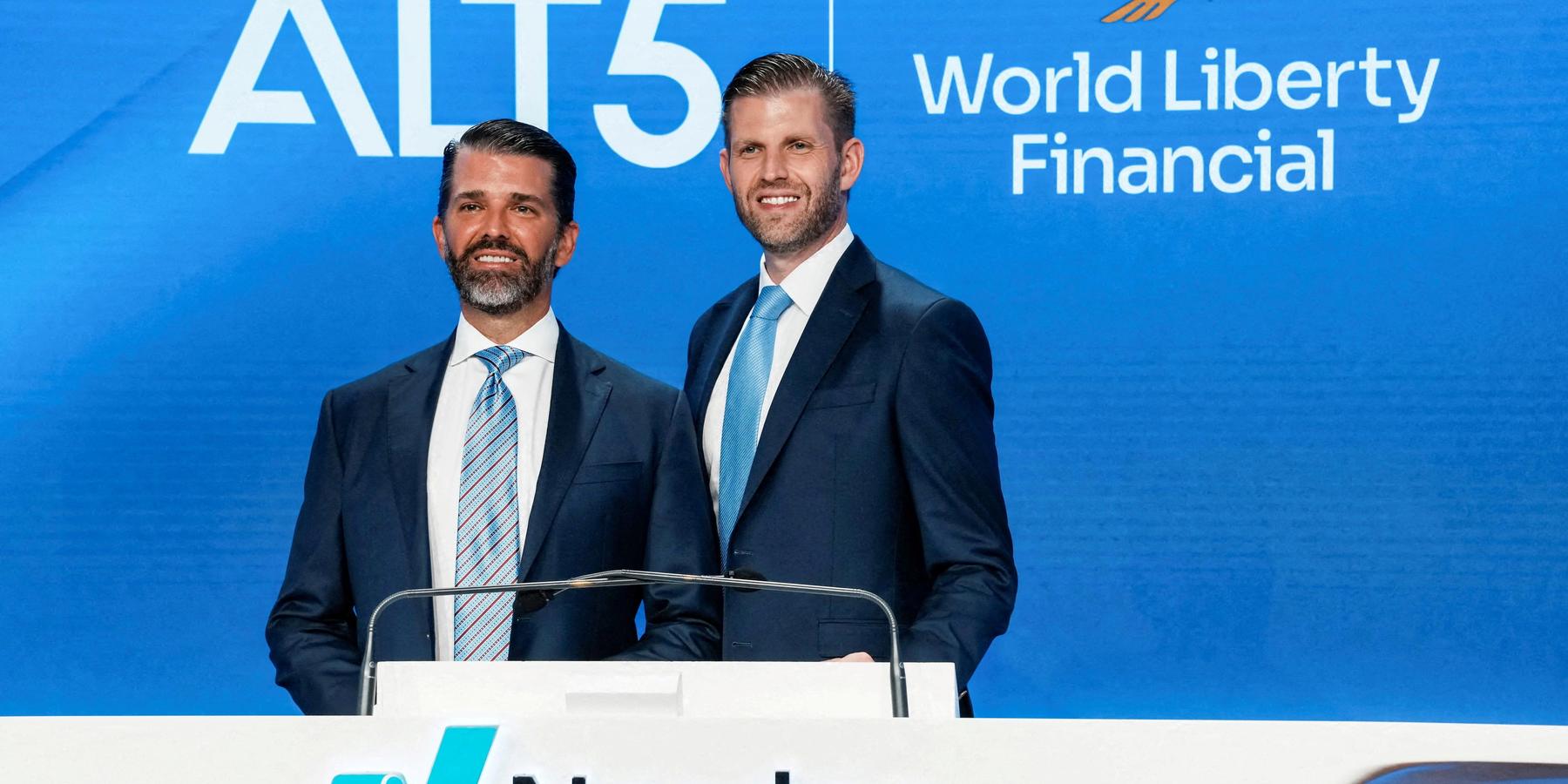
The U.S. military desperately needs drone capabilities for President Donald Trump’s war in Iran, and fast. Coincidentally, his sons Eric and Donald Trump Jr., are on the case.
Indeed, the Trump brothers are pumping money into defense-tech oriented firms that have already secured Pentagon contracts, or have already put battle-tested products to market. For example, they've invested in Powerus, a new drone company aiming to harness its “strong relationship with Ukraine” as a means to acquire and leverage war-tried Ukrainian drone technologies in a competitive U.S. market. Having bought out several competitors, Powerus already does business with the U.S. military.
In other words, the Trump family stands to benefit financially from the war, and already are.
Eric Trump also invests in Israeli drone firm and DoD contractor Xtend, whose “low cost-per kill” attack drones have been used by the IDF in Gaza. Expanding to the U.S., the company opened an office near Tampa last summer.
Donald Trump Jr. has a $4 million stake in, and sits on the board of Unusual Machines, a drone parts startup. In December, it secured a $620 million DoD loan — the largest loan in the history of the Pentagon's Office of Strategic Capital — to make drone parts.
And Trump Jr. is a partner at 1789, a “patriotic capitalist” venture capital firm which backs a number of defense-tech startups. The firm, which Trump Jr. joined in November 2024 — right after his father was re-elected to the presidency — has since seen explosive growth: the assets it manages jumped in value from $150 million to more than $2 billion by the end of last year.
Suggesting the firm influences U.S. policy outright, Trump Jr. explained at a Future Investment Initiative event last year that 1789 “understand[s] what the administration wants to do, because [the firm] helped craft some of the messaging.”
Conflicts of interest percolate
As William Hartung, a Quincy Institute senior research fellow, tells RS, the Trump family’s defense-tech pursuits can be linked to a larger network of technology firms and venture capitalists that has significant influence within the Trump administration.
“The emerging military tech sector has deep ties to the administration, starting with vice-president J.D. Vance's relationship with Palantir founder Peter Thiel, who employed Vance and helped fund his Senate run,” Hartung said. “The fact that Donald Trump Jr. — not only the president's son but a close political advisor and unofficial spokesperson — will now profit personally from the fate of specific military tech firms adds an even more profound conflict-of-interest.”
To this end, 1789’s portfolio includes a number of defense-oriented companies, such as Anduril, Hadrian, SpaceX, and Vulcan Elements, a DOD contractor that makes rare-earth magnets, which are also backed by controversial venture capitalist Peter Thiel or his VC firm Founders Fund. A Silicon Valley kingmaker and Palantir co-founder to boot, Thiel has simultaneously worked to influence U.S. politics, bankrolling Congressional campaigns while many in his orbit now occupy major positions in the Trump administration.
Notably, Trump Jr. also sits on the advisory board of controversial prediction market Polymarket — which 1789 and Thiel’s Founders Fund also back — fostering an environment where people with insider awareness regarding the outcomes of world events could theoretically profit from that knowledge.
Hartung warns such political access — and, in the case of 1789, venture capital funding — can give certain defense-tech startups an unwarranted edge.
“Venture capital allows firms to stay in the market longer before they score their first big government contract, be it with the Pentagon, an intelligence agency, or the Department of Homeland Security,” Hartung told RS. “But once these influential firms have sunk substantial funds in a startup, they may use their influence to get that firm a contract whether or not its technology is ready for prime time, just to get a return on funds invested up to a given point in time.”
“If they can recruit the president's son to join in boosting a particular firm, whether or not its product has been proven effective, they have a whole new level of influence, which can be wielded to serve their financial interests rather than the public interest,” Hartung said.
Jumping to profit
Leveraging powerful family ties to break into the weapons industry, Trump’s sons appear poised to profit even more as their father’s administration ramps up spending for militarized drone technologies — for the conflicts it pursues abroad, but also at home.
Xtend’s attack drones have already been deployed to Iran, under a contract for a "government defense customer in the Middle East” worth up to $25 million. As Anduril Executive Chairman Trae Stephens told Bloomberg TV earlier this month: Anduril has “all sorts of primarily counter-air systems that are present in conflict zones,” where the company is “actively working day to day” with the DOD. Anduril received a ten-year U.S. Army contract this weekend worth up to $20 billion.
Meanwhile, the Pentagon is pursuing a $1.1 billion “unleashing drone dominance” initiative, which aims to field over 200,000 American-made attack drones by 2027. Trump brothers-backed companies have actively pursued that funding: Xtend was among 25 companies invited to participate in the program’s first competition rounds for some of that funding, although it did not advance.
Beyond the battlefield, law enforcement and border security agencies are increasingly adopting war-tested, dual-use drone technologies — which could create further opportunities for drone-sector defense contractors the Trump siblings bankroll. As RS has highlighted, the Department of Homeland Security (DHS) has put forth hundreds of millions toward procuring drone and counter-drone technologies to secure the upcoming World Cup from the threat of unauthorized drones or cyberattacks.
Par for the military industrial complex course
As experts tell RS, the potential conflicts of interest on display in the Trump brothers’ defense ventures are par for the course in Washington, where such entanglements have long defined the relationship between government and the weapons industry — and altogether drive prospects for conflict.
“The revolving door between corporations and government has been undermining democracy and accountability in the U.S. for generations. This helps explain why the U.S. is always at war: no one gets rich when the U.S. doesn't sell weapons, or doesn't launch an invasion, or doesn't bomb civilians,” Shana Marshall, a non-resident fellow at the Quincy Institute, told RS. “But there's a massive network of lobbyists, think tank 'experts,' strategic consultants, corporate executives, asset managers and investors who get very rich when these things do happen.”
The Trump brothers’ “extreme graft is only possible because the more subtle profiteering in every preceding administration went unpunished too,” Marshall said.