

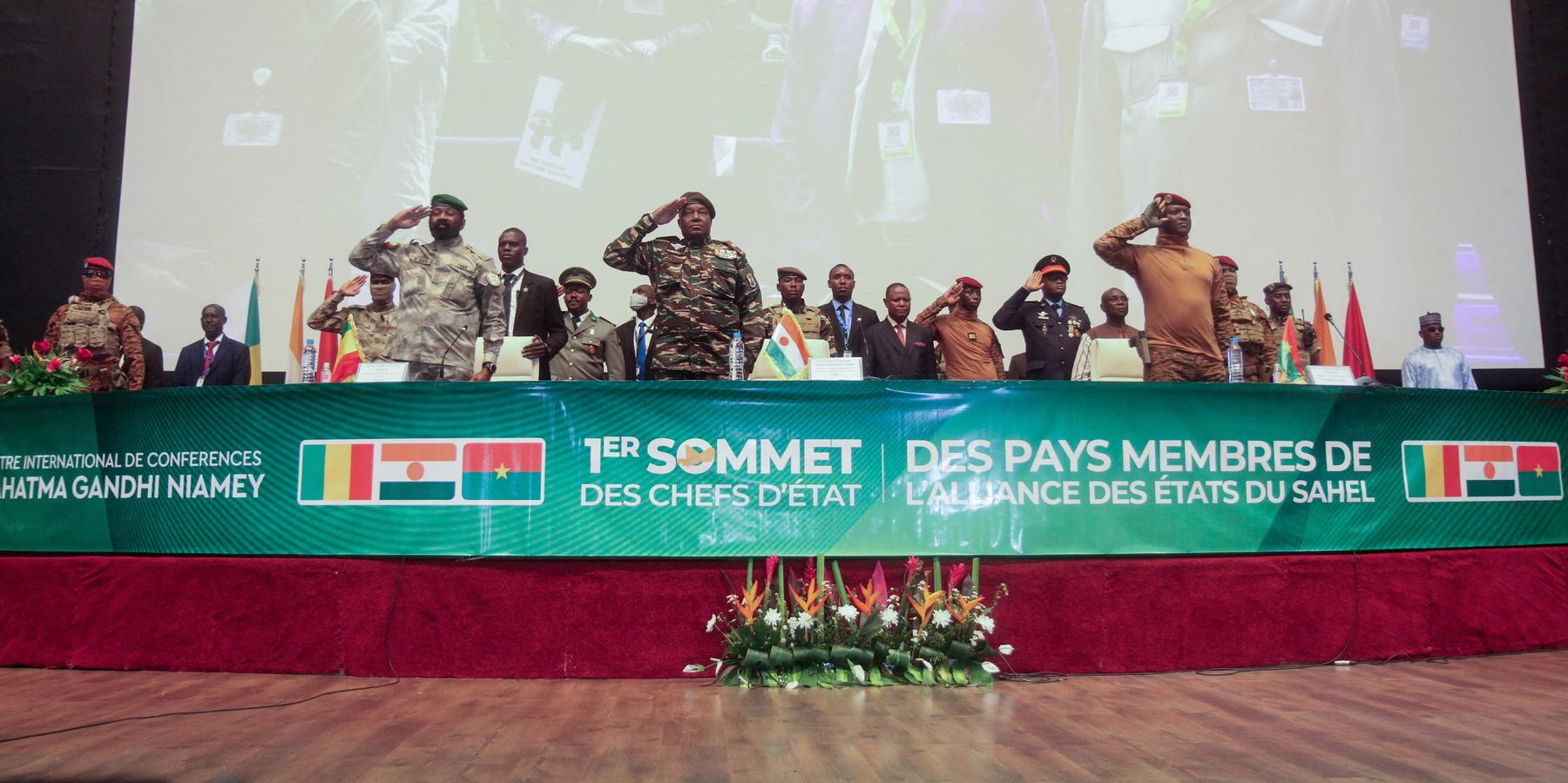
The State Department is conducting a new wave of outreach to three military-ruled Sahelian countries — Mali, Burkina Faso, and Niger. This outreach appears aimed at moving past concerns about democracy and restoring a kind of status quo ante in the U.S.-Sahel security relationship, combined with a blunter focus on critical minerals.
Thematically and rhetorically, there is not much new here: administration officials conducted an earlier round of outreach to the central Sahelian countries last summer, in what the analyst Djiby Sow calls “security-for-minerals visits.” The difference now is that some policy changes are occurring: an intelligence cooperation deal is reportedly near at hand with Mali, and in late February, the administration removed sanctions on three senior Malian officers, including Defense Minister Sadio Camara. The administration may also feel some urgency to obtain Sahelian governments’ help in seeking the release of a hostage.
These changes may be enough to get Washington back in the good graces of Sahelian countries, but are unlikely to open major investment opportunities, displace Russian or Chinese influence, or to produce security gains. Washington can hope for broadened security cooperation, but it will likely resemble the failed models of the past.
In the 2010s, before a spate of coups in 2020-2023 disrupted Sahelian countries’ relationships with Western powers, there was intensive cooperation: but American surveillance, training, and murky ground presence all yielded little amid a long-running Sahelian jihadist insurgency.
A Reinvigorated Sahel Strategy?
The administration appointed a new “senior bureau official” (meaning a lead but not a Senate-confirmed assistant secretary) to head State’s Africa Bureau in January. Former CIA analyst Nick Checker said, in an interview with Semafor, that he is seeking to implement what he calls Secretary of State Marco Rubio’s “back-to-basics approach in terms of diplomacy.” For Checker, in the context of Africa, this means “commercial diplomacy,” oriented in large part towards “dislodging China from certain sectors.”
“With a lot of African countries [we went] in and were lecturing, moralizing about different things,” Checker commented further. “And that’s not what they want to hear. Security, economic growth – that’s what they want. That’s what they care about. These are issues where we can actually find a lot of common ground.”
In an email to Africa Bureau staff in January, Checker was even blunter: “Africa is a peripheral – rather than a core – theater for US interests that demands strategic economy.”
Checker’s trips to the Sahel have built on the themes of guns and money. Visiting Mali on February 3 and then Burkina Faso on March 12-13, Checker met primarily with civilian officials such as the foreign ministers of both countries as well as with Niger’s Prime Minister Ali Lamine Zeine. The visits, according to the Africa Bureau, emphasized security cooperation and trade.
Signaling that promoting democracy is not on the agenda, the Africa Bureau has repeatedly used the Sahelian governments’ most cherished political mantra – sovereignty. A readout of Checker’s phone call with Niger’s Zeine, in February, pointedly used the word. One post from the Bureau on X, in advance of Checker’s trip to Burkina Faso and Niger, read, “He looks forward to reaffirming the United States’ respect for the sovereignty of Burkina Faso, and to discussing next steps for enhancing cooperation and consultation on shared security and economic interests.”
For the Sahel’s military rulers, sovereignty is a political ideology that has been invoked to justify military rule, to expel French (and, from Niger, U.S.) forces, and to claim greater rights and royalties in sectors such as gold, uranium, and oil.
Emphasizing Sahelian sovereignty may be yielding fruits for the administration. Niger, for its part, appeared somewhat receptive to Checker’s interest in reviving security cooperation, with the Ministry of Foreign Affairs stating, “The exchanges proceeded in a climate of calm and mutual respect. The two parties expressed their desire to relaunch cooperation on a new basis and to work to reestablish trust.”
The rhetoric is far changed from the tense exchanges under the administration of Joe Biden, when Niger and the U.S. argued over security cooperation, and Nigerien officials balked at a hectoring U.S. tone and approach – exactly the kind of “lecturing” that Checker warned against. Checker’s problem, however, is that it is easier to woo the Sahelian regimes, and to give them what they want, than it will be to forge deep diplomatic or economic ties or to “dislodge” China or, for that matter, Russia.
The View from a Sahelian Presidential Palace
The U.S. outreach is, for the moment, clear and intensive. Transactions are on offer, including a serious degree of diplomatic normalization in exchange for security cooperation and trade.
But put yourself in the shoes of a Sahelian military ruler. Mali’s Assimi Goïta, Burkina Faso’s Ibrahim Traoré, and Niger’s Abdourahamane Tiani plan to stay in power for years — all of them have secured authority from pliant legislatures and councils to remain at the helm through the end of this decade. They face grinding insurgencies and, periodically, humiliating defeats. Yet they also see significant opportunities: they retain considerable popularity (according to the limited polling that exists), their economies are growing, and their bids to claim greater royalties in gold and other sectors are at least partly succeeding.
Meanwhile, they are courted by many players: Russia, China, Turkey, the United Arab Emirates, India, and even a reluctant Europe that cannot ignore the Sahel.
The United States is not merely one player among many in this competition; it is also somewhat economically secondary from the juntas’ point of view. Washington is simply not a prominent trading partner for the Sahelian countries, whose commercial ties are much stronger with France, China, the Emirates, India, and countries in their own neighborhood. The multinational firms that operate in the gold sector in Mali and Burkina Faso are based largely in Canada, the United Kingdom, and Australia. The key uranium firm in Niger is French, while the key oil firm there is Chinese. The Sahelian leaders have had fierce disputes with some of these foreign firms, from Mali’s dispute with Barrick Gold to Niger’s disputes with Orano over uranium, but the companies have generally seemed committed to remaining in business there.
One wonders how exactly the U.S. plans to expand trade and investment in an environment where rivals and competitors are already so firmly established.
That leaves security cooperation but, again, the Sahel’s rulers may look somewhat skeptically at Washington. While Goïta, Traoré, and Tiani dig in for the long term (although they remain vulnerable to overthrow, including by their own militaries), officials in Washington come and go, even within the Trump administration itself. Various figures with overlapping portfolios and unclear relationships with the president seek to speak for his administration.
Meanwhile, the Sahelian leaders may well welcome new equipment, new security assistance, and even some training, surveillance, and intelligence-sharing. The U.S. has resources that cannot be ignored – although again, those resources have all been offered and deployed before, with little ultimate effect on actual security conditions. And Russia, Turkey, and others offer greater consistency and predictability. Washington’s “commercial diplomacy” can promise normalization, but cannot deliver transformation.
- US moves from counterterrorism to great power rivalry in the Sahel ›
- Trump returns to a failed playbook in Africa ›