

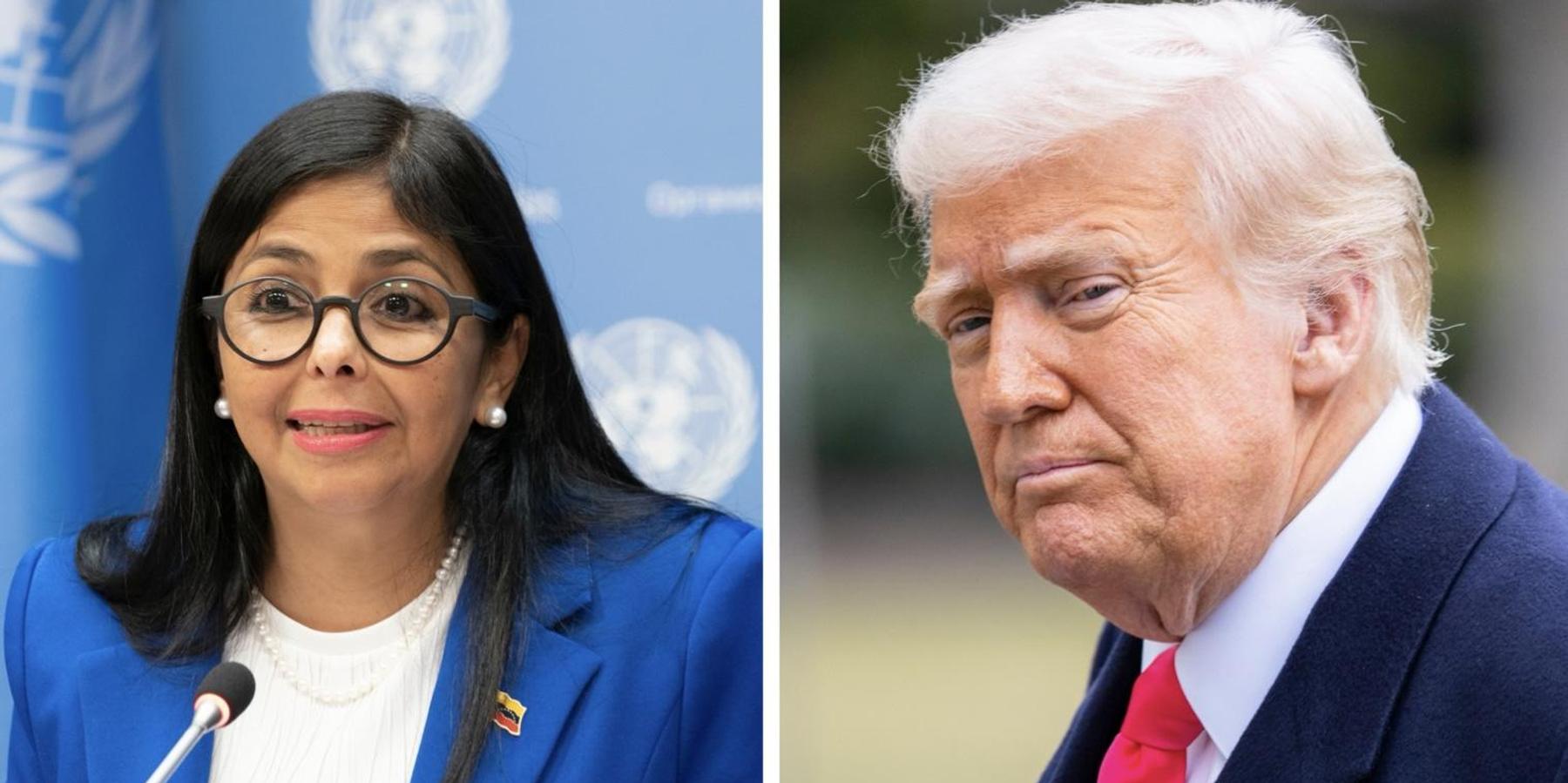
President Donald Trump announced Friday that the United States “has just entered into an Agreement” with Venezuela covering more than 65 billion barrels of proven oil reserves, secured “at no cost to the American Taxpayer.”
He then proceeded to name Secretary of State Marco Rubio, Defense Secretary Pete Hegseth, and acting Venezuelan President Delcy Rodriguez as the chief negotiators.
The White House then released a fact sheet late Monday evening, without the underlying legal text. It offers one of three accounts of the deal, one that clashes with both Rodriguez’s version and the Pentagon’s own prior statements.
The number of oil barrels will get the most attention over the next weeks. However, the financing structure is the key element because it determines who bears the costs of this arrangement and under what authority.
Rodriguez described her interpretation of the deal on Telegram and expanded on it Saturday night on state television. Hers is a 25-year, bilateral project across 17 strategic fields and eight greenfield blocks, targeting more than 1.5 million barrels a day, drawing $100 billion in investment and returning roughly $209 billion to the Venezuelan state at a benchmark price of $65 per barrel, which would give the government about $19 of revenue per barrel. She insisted it preserves Venezuelan sovereignty over natural resources.
Trump, for his part, claimed there will be majority American ownership of the reserves, which would be illegal under Article 12 of Venezuela’s constitution. A U.S. official told the Associated Press that Washington would control 55% of the output of a new private company called North American Blue Energy Partners (NABEP), the second largest oil producer in Venezuela, with an ownership stake and the right to buy crude at cost for the Strategic Petroleum Reserve and the military.
The White House fact sheet later broke that figure down: a 35% equity stake for the Pentagon's Office of Strategic Capital, plus the State Department gets the right to buy 20% of output at cost.
This framing appears at odds with that of Rodriguez; it’s hard to imagine, after all, that Caracas will get $19 per barrel if the U.S. is buying large amounts of it at cost.
The Pentagon's Office of Strategic Capital could oversee and help fund the oilfield licenses, according to the Washington Post. The Biden administration created the office in December 2022, and Congress codified it a year later, establishing a pilot program to extend loans, loan guarantees, and technical assistance to companies developing dual-use technologies across 34 categories listed in the statute. The office made its first direct loan in August 2025: $150 million to a rare earths processor in California. Its pilot authority expires on October 1, 2028.
Lifting heavy crude from Venezuela’s Orinoco Belt is not one of the 34 categories, and nothing in the law contemplates financing foreign upstream oil development. Pentagon spokesman Sean Parnell said the office’s role is confined to loans and guarantees and that it cannot take an ownership stake in private companies, which means the instrument available to the Pentagon cannot deliver the 35% the administration just described in the fact sheet.
Three consequences follow from that mismatch.
First, a loan guarantee costs nothing on the day it is issued and costs whatever the default costs on the day it is called. That is how a phrase like “no cost to the American Taxpayer” survives contact with a structure whose stated purpose, in the Post’s account, is to absorb risk that private firms have already declined to take. Francisco Monaldi of Rice University told the Post that oil companies will ultimately be hesitant, and ExxonMobil's chief executive called the country “uninvestable” in January. The guarantee is only being contemplated because neither of those judgments has changed.
Second, the fact sheet now puts the lease at 100 years, two days after Rodriguez said 25 years. Either way, the financing authority floated to support the arrangement could sunset in 2028, unless Congress acts to reauthorize it. Whatever gets signed would outlive the legal instrument used to underwrite it, and no one has explained what would replace that authority or who would appropriate funds for it.
Third, as the Congressional Research Service notes, information about the Pentagon’s loans and guarantees need not be made public. So, the administration has selected the federal credit facility carrying the least mandatory transparency to underwrite the largest resource claim in the hemisphere, which puts the claim about taxpayer cost beyond anyone’s ability to scrutinize.
Venezuelan law raises a separate set of problems that no announcement has addressed. Article 12 of the constitution makes hydrocarbon deposits property of the government — property that is inalienable and non-transferable. Article 302 reserves the petroleum industry to the state, and Article 303 requires the state to hold all shares of PDVSA, as the state oil company is known.
January's hydrocarbons reform loosened rules about joint ventures but stopped well short of authorizing a 55% foreign ownership stake, and constitutional changes may be required before the agreement can be finalized. Ricardo Hausmann, who ran Venezuela’s planning ministry in the early 1990s, wrote that Rodriguez “has no legitimacy or constitutional power to commit Venezuela to any such deal,” and that no major American oil company will treat it seriously because it will not last.
According to the White House the U.S. would have veto power over who sits on the NABEP board. It would include "reputable U.S. auditors, lawyers, and advisors and the U.S. government’s agreement with NABEP is governed by U.S. law and is subject to the jurisdiction of U.S. courts." Right now it is controlled by Alejandro Betancourt, whom Swiss prosecutors sought to arrest on suspicion of financial crimes and whom Washington has declined to surrender. He has not been formally charged, and his attorney denies the allegations.
Betancourt has also been the administration’s principal intermediary in Caracas. So, just about every party to this deal carries an unresolved question about its authority to sign.
Venezuela has already run a version of this experiment on itself, in these same fields. In 2007, when the government converted the Orinoco projects into joint ventures, with PDVSA holding 60%, ConocoPhillips and ExxonMobil rejected the terms and were expropriated. Both companies eventually won. Conoco secured awards totaling roughly $10.7 billion, including an $8.7 billion ruling by an international trade court in 2019, and Exxon collected a $907 million award from the International Chamber of Commerce.
More than 20 claims from that wave of litigation remain largely unpaid because tribunals cannot seize assets within Venezuela, and enforcement abroad has been slow and mostly fruitless. Any company that ends up holding a repudiated contract in these same fields would win a judgment it could not collect; a federal guarantee would shift this risk onto the U.S. Treasury.
Within a day of its announcement, opposition to the deal surfaced across the entire Venezuelan political spectrum. Venezuelans protested in Caracas on Saturday; opposition figures called the arrangement a betrayal of the country’s resources; and Chavista hardliners attacked Rodriguez for conceding what the movement had spent 25 years claiming to defend.
Indeed, it was just two years ago that, as then-President Nicolas Maduro’s vice president, Rodriguez accused opposition leader Maria Corina Machado of taking orders from her “master,” referring to the United States, to “hand over the oil, gas, and gold.”
Rodriguez might be calculating that a deal of this size reduces Washington’s appetite for early elections. Ratification requires a legislature, and the only chamber capable of acting is the 2025 National Assembly, led by Delcy’s brother Jorge Rodriguez; that body’s constitutional legitimacy remains unsettled.
However the situation shakes out, the upshot for the U.S. is concerning. Any claim arising from that unsettled status would default to whoever actually holds the risk, and under the instrument the Trump administration has chosen, that is ultimately the U.S. Treasury.
- Under Team Trump eye, Venezuela makes move toward elections ›
- When Trump's big Venezuela oil grab runs smack into reality ›
- Hegseth has been a disaster. It's time for Trump to fire him. | Responsible Statecraft ›