

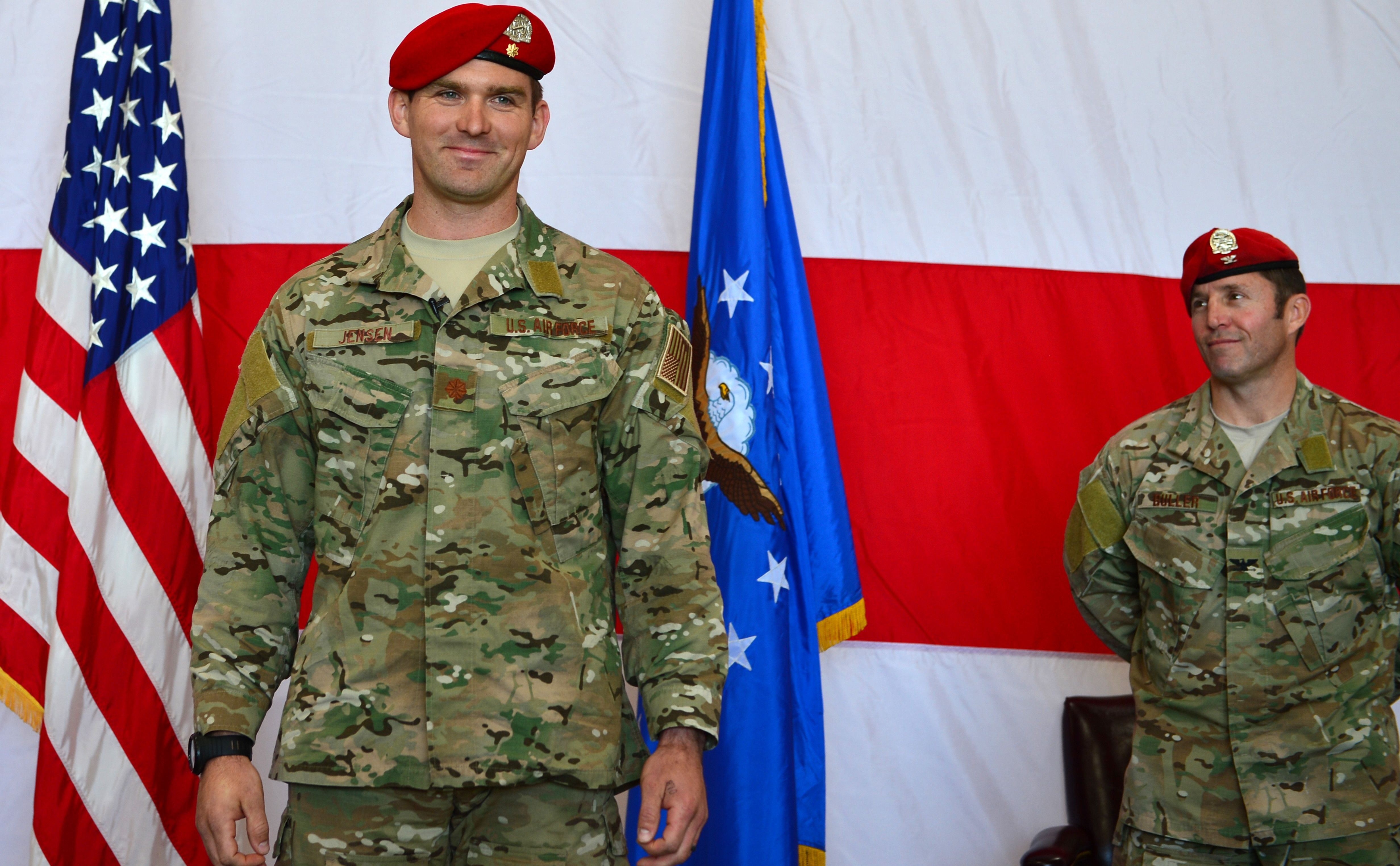
After months of speculation, Reuters reported earlier this month that retired Air Force lieutenant colonel Michael Jensen has been appointed as senior director for the Western Hemisphere at the National Security Council (NSC), according to two U.S. officials.
Jensen’s appointment marks the first time in recent memory that a president has nominated a special forces operative — let alone a career military officer — to oversee U.S. policy toward Latin America at the NSC.
A review of the last 20 years of Democratic and Republican appointees to the NSC senior director role for the region reveals that the vast majority of Jensen's predecessors have hailed from the Departments of State and Treasury, USAID, Capitol Hill, or the Intelligence Community — not the Pentagon.
Jensen’s new role comes as Trump administration officials have publicly floated sending U.S. troops or executing drone strikes in Mexico to weaken the country's drug cartels, six of which were recently designated as foreign terrorist organizations. Mexican President Claudia Sheinbaum has rebuffed Trump’s offer, yet the former head of the Drug Enforcement Agency (DEA) has said that the recent revelation of foreign mercenaries fighting alongside the cartels could justify U.S. actions in Mexico.
Jensen’s appointment also comes amid a drastic restructuring of the National Security Council staff under interim national security adviser Marco Rubio. White House spokeswoman Anna Kelly said the NSC was being “right-sized to facilitate more streamlined processes and greater coordination between the White House and the federal agencies.”
Sources briefed on the matter told Reuters that the NSC overhaul is part of a broader strategy to reduce the size and scope of the policymaking body which has doubled in size since the Bush II and Obama administrations, transforming it back into a smaller entity tasked with implementing, rather than shaping, the president’s agenda.
Last month, former national security adviser Michael Waltz was ousted reportedly because he was having private conversations about war with Iran with Israeli Prime Minister Benjamin Netanyahu.
In April, Politico reported that Victor Cervino, the Republicans’ top Latin America staffer on the Senate Foreign Relations Committee and a former Rubio aide, had been named to the top NSC post on Latin America, but redacted its claim less than a week later, saying he never assumed the role for unknown reasons.
The White House has not formally announced Jensen’s appointment, and his counterpart at the State Department — the assistant secretary of state for Western Hemisphere affairs — has still not been announced. The duties of the State Department role are currently being filled by Senior Bureau Official Amb. Michael Kozak, a veteran State Department Latin America hand.
Under the first Trump administration, Mauricio Claver-Carone, the recently departed Special Envoy for Latin America at the State Department and a close Rubio ally, held the NSC post for two years, during which he led a “maximum pressure” campaign intended to dislodge the governments in Cuba and Venezuela.
Rubio, Jensen’s new boss, has signaled that the Western Hemisphere will receive renewed focus in Trump's second term, on everything from reducing irregular migration to fighting drug trafficking and curbing China's regional presence. He has already visited the region twice — to Central America and the Caribbean — and announced plans to visit again in the coming weeks.
Yet a glaring hole in Jensen’s background is his apparent lack of experience in the region he's now reportedly been charged with overseeing, according to his LinkedIn profile and other publicly available information.
In February, Jensen was nominated to the top Pentagon post in charge of special operations and low-intensity conflict, but that nomination was withdrawn last month, presumably to pave the way for his job at the NSC.
Over his 20-plus year military career, Jensen has held leadership positions in multiple special tactics groups at the Air Force Special Operations Command, specializing in counterterrorism operations and global defense strategy.
While much of Jensen’s Air Force career is not well known, an Air Force public affairs officer wrote in 2008 that Jensen helped oversee a five-and-a-half-hour “high-value target hunt” in Afghanistan, guiding “31 close air support and surveillance aircraft…which disrupted al-Qaeda operations.”
Jensen also served as lead strategist for the Air Force’s Checkmate office at the Pentagon, “advising the defense secretary and playing a key role in restructuring the Air Force’s approach to warfare.” He also commanded the 26th Special Tactics Squadron “following his leadership responsibility for special operations on four continents.”
Jensen's special ops expertise has also extended to the private sector, including after retiring from military service in 2021 to become chief strategy officer for the air utility transport vehicle company SkyRunner, about which he wrote his postgraduate thesis.
SkyRunner CEO Stewart Hamel brought on Jensen to “oversee strategic partnerships” and “optimize the warfighting configuration of its special light-sport aircraft,” which has been FAA-certified to support DOD and combat search and rescue missions, though its contracts to date with the Pentagon and State Department have been limited.
While President Trump has undoubtedly made the Western Hemisphere a focus for his administration, some critics worry about a militarized approach to the region, with Republicans and some administration officials saber rattling at times about invading Mexico, taking over the Panama Canal, and neutralizing the purported Chinese threat.
“Trump’s gladiator approach to conflict resolution is not improving things in Ukraine, the Middle East, or California, and the same approach in Mexico would not be any different,” said John Lindsay-Poland, an expert on U.S. arms trafficking in Mexico and author of two books on militarization in Latin America.
Though the administration has largely focused — so far — on deportations, making deals over cartels and cracking down on Cuba to please the Republicans’ South Florida base, Jensen’s appointment could fuel fears of increased militarization of U.S. policy in the region. Yet without a clear policy from the top, it remains to be seen how Jensen’s background will align, or conflict, with Rubio’s.
“Jensen’s experience in ‘high-value target operations’ is relevant in Colombia, where, according to a Washington Post investigation, U.S. Air Force special operations units trained Colombian special forces and provided Raytheon-manufactured precision-guided munitions (PGNs) to kill 45 FARC guerrilla leaders from 2006 to 2013, deploying a similar methodology as the one used to target and kill al-Qaeda leaders,” Lindsay-Poland said.
Amid ongoing personnel shake-ups at the highest levels of the Trump administration, Jensen’s background and appointment make increasingly clear the lens through which the president views the issues most plaguing the Western Hemisphere.