

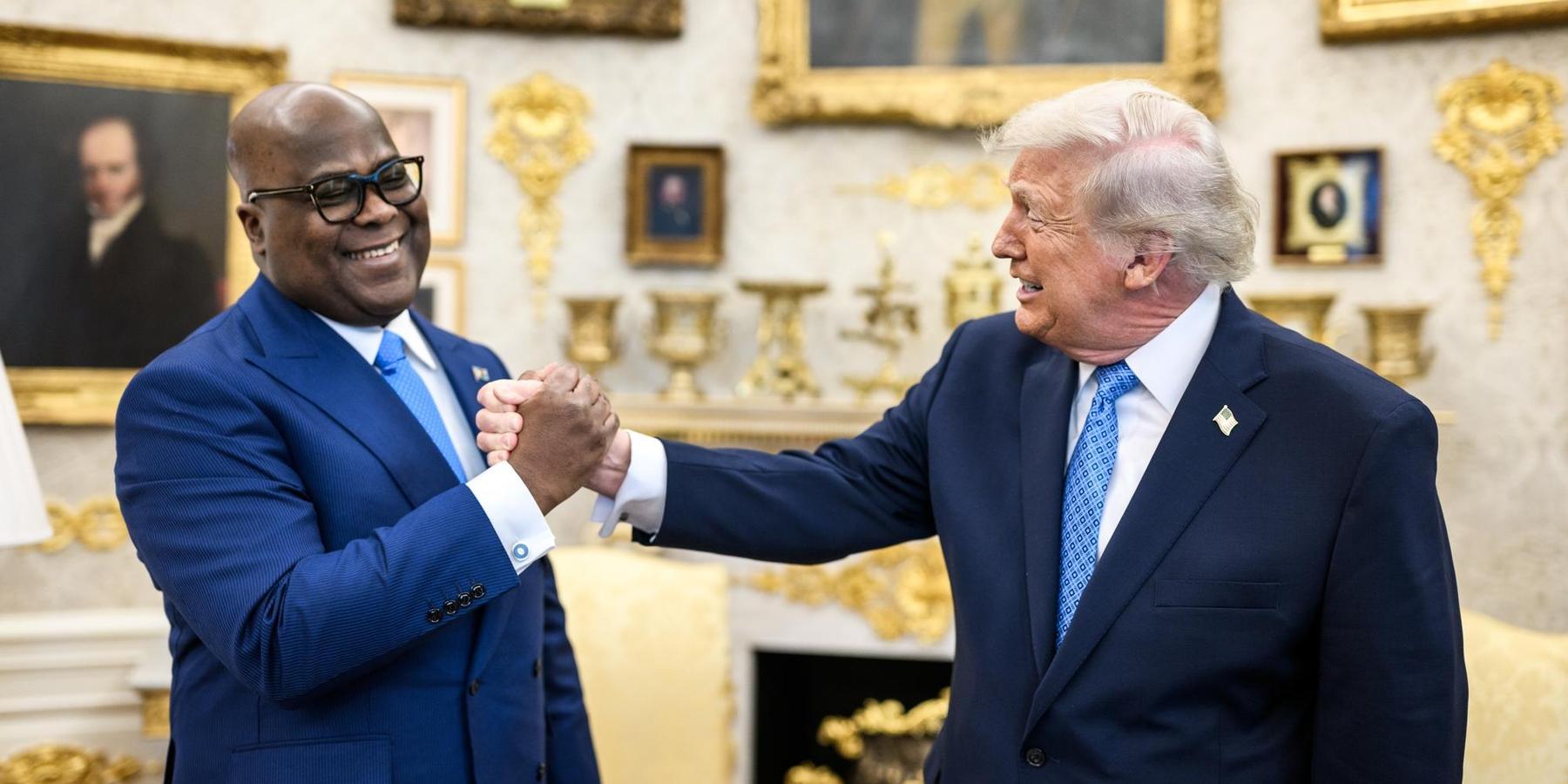
The recent imposition of U.S. sanctions against the former president of the Democratic Republic of Congo, Joseph Kabila, marks the latest move by the administration of President Donald Trump in support of the government of President Felix Tshisekedi in its conflict with the M23 militia in eastern Congo.
The sanctions, leveled against a powerful rival of Tshisekedi for his alleged role as a leader of the M23-allied Congo River Alliance, will almost certainly fuel hopes in Kinshasa for an even greater U.S. commitment to the government which last December concluded peace and economic agreements that, among other things, gave Washington preferential access to the DRC’s vast mineral resources.
While Washington’s engagement has so far produced limited changes on the ground, it has generated powerful expectations in Kinshasa — expectations that are reshaping both the conduct of the war in the east and the dynamics of domestic politics in the DRC itself.
Expanding expectations and limited gains
Thus far, Washington has benefited from its efforts primarily through last December’s strategic minerals partnership, which gives it greater access in principle to the DRC’s vast mineral resources. In addition to large deposits of copper, the DRC holds more than half of global cobalt reserves ; both minerals are central to clean-energy technologies and military hardware.
In early February, it was announced that the U.S.-based Orion Critical Mineral Consortium will sign a memorandum of understanding, worth $9 billion, to acquire a 40% stake in the Congolese mines owned by the Anglo-Swiss Glencore. In late March,the U.S. company Virtus Minerals acquired the Congolese group Chemaf for $700 million.
For now, these deals are still in their very early stages. And they still pale in significance compared to Chinese mining investments in the DRC. Chinese companies have stakes in 15 of the DRC’s largest copper and cobalt mines, including Tenke Fungurume, the world’s largest cobalt mine. Under a 2007 minerals-for-infrastructure agreement, Chinese firms secured rights to mineral deposits valued at approximately $93 billion in exchange for $3 billion in infrastructure commitment.
At this point, therefore, U.S. mining advances remain too limited, and in some respects, too opaque and ill-prepared to dislodge China’s entrenched position in the sector.
For Kinshasa, the most visible return has been greater U.S. pressure on Rwanda and its allies — most prominently through a series of unprecedented U.S. sanctions against Kigali. But these moves have not yet altered fundamental realities on the ground. Rwanda and its ally in eastern Congo, the M23 militia, have not retreated from the region.
Still, these signals have reinforced a belief within Kinshasa that Washington now stands firmly on its side. The expectation is not only that sanctions will intensify, but that broader forms of backing may follow. This has translated into growing confidence among both political and military Congolese elites, confidence that manifests itself in two ways.
Reading U.S. support as strategic backing
First, the perception that increased U.S. backing for the DRC will enable its forces to decisively defeat the M23 and its Rwandan supporters has encouraged those in Kinshasa who seek a military solution to the conflict. Recent successes, including the killing of M23 spokesperson Willy Ngoma, have reinforced this confidence, even as talks and agreements with M23 continue.
In some circles in the Congolese capital, this confidence extends to hopes of a more direct U.S. intervention. Our sources have pointed to the perceived unpredictability of President Donald Trump, with some even suggesting the possible deployment of U.S. troops to the region. Even if overstated, such perceptions are shaping decision-making, as reflected by the Congolese army’s launch of a renewed offensive in late February. As one well-placed government official told us in March: “Five months ago, we wouldn’t have done this [a renewed army offensive]. Now we think we have Trump next to us.”
Moreover, Kinshasa has continued to court the Trump administration by aligning itself with Washington’s broader priorities, including a recent agreement to accept third-country migrants deported from the U.S. In some Congolese political circles, this has fed far-fetched expectations that the presence of third-country migrants on Congolese soil could give Washington a more direct stake in the country’s stability, especially in eastern Congo, potentially leading to direct U.S. military intervention. These expectations, while unrealistic, are nonetheless politically consequential.
Shrinking political space
Second, U.S. backing has provided fertile ground for the government to consolidate power internally. In late 2024, Congolese President Felix Tshisekedi raised the possibility of amending what he called the “outdated” 2006 constitution, which requires him to step down when his mandate expires in 2028. As the war in the east raged and the regime faced a broader crisis of legitimacy, however, Tshisekedi shelved the idea. But after last December’s Washington agreements gave Kinshasa clearer U.S. backing through the minerals-for-security partnership, the idea resurfaced more forcefully.
Tshisekedi’s allies have used public rallies to revive calls for an amendment, and thus a third term for the president. At the same time, there have been worrisome reports about the activities of the government’s cybercrime unit and its crackdown on internal dissent. In this overall context, the government’s appetite and tolerance for an inclusive political dialogue, which is essential to achieve any sustainable peace in the east, appear to have diminished.
A mutually reinforcing relationship
In this sense, the U.S.-DRC deals have produced a mutually reinforcing dynamic between Kinshasa and Washington. For Kinshasa — and particularly the Tshisekedi government — they offer a form of political insurance: alignment with Washington becomes a strategy for regime survival. For Washington, they open access to strategic minerals under favorable terms. The U.S. has largely enjoyed the upper hand in these talks. A number of our political sources described how, in political and economic negotiations with the U.S., Congolese officials often appeared reactive and susceptible to pressure and willing to accept suboptimal terms.
In this context, the logic of engagement has been shifting. For Kinshasa’s political elite, the central strategic question is no longer only how to reach a political accommodation with M23, but how to secure and maintain a favorable relationship with Washington. Assuring access to critical minerals constitutes a key part of this recalibration and increasingly determines the government’s political and military calculations.
At the same time, however, this overall impact should not be overstated. The actual scale of U.S. economic investment remains limited, and those companies that have shown interest are relatively small. Several sources noted that some of these companies have limited operating experience in the DRC and only a modest track record in mining, making them reliant on non-U.S. partners for technical and operational support. So the future of meaningful U.S. investment in the sector remains very much up in the air.
China’s response
Nonetheless, these dynamics have also affected China’s position. Long dominant in the Congolese mining sector, Beijing has shown concern and unease, with several sources pointing to unusually direct expressions of dissatisfaction from Chinese diplomats with the DRC-U.S. agreements.
Concretely, various international sources state how Chinese diplomats have criticized the U.S. minerals deal and described it as structurally “unfair” in both bilateral and multilateral meetings . Their concern is tied to the U.S.-DRC agreement’s “right-of-first-offer” clause, which gives U.S. companies first priority over strategic mining assets.
This discontent has spilled over into other areas, notably in the selection of the heads of U.N. peacekeeping forces in both the DRC (MONUSCO) and in South Sudan (UNMISS). Beijing reportedly blocked U.S.-backed candidates to head MONUSCO while it promoted a Chinese national to be appointed as the force commander in UNMISS. The fact that the two appointments were announced on the same day was seen by several observers as indicative of a broader deal-making process linking different theaters.
Kinshasa has not turned away from China, nor can it afford to given the huge investments Beijing has made in the country. In March, Congo’s Minister of Mines Louis Watum traveled to Beijing, where the two sides signed a new mining cooperation agreement. Even as Kinshasa courts Washington, it is also trying to reassure Beijing.
Taken together, the effects of U.S. engagement in the DRC to date lie far less in what it has actually delivered than in the expectations it has generated, reshaping both military calculations and domestic political ambitions in Kinshasa.
- Trump's 'commercial diplomacy' runs into violent reality ›
- No, Trump did not 'end' the war in the Congo. It's as bloody as ever. ›
- Could Trump's Congo-Rwanda mineral deals actually save lives? ›
- DRC president claims Trump deal requires he seize another term | Responsible Statecraft ›