

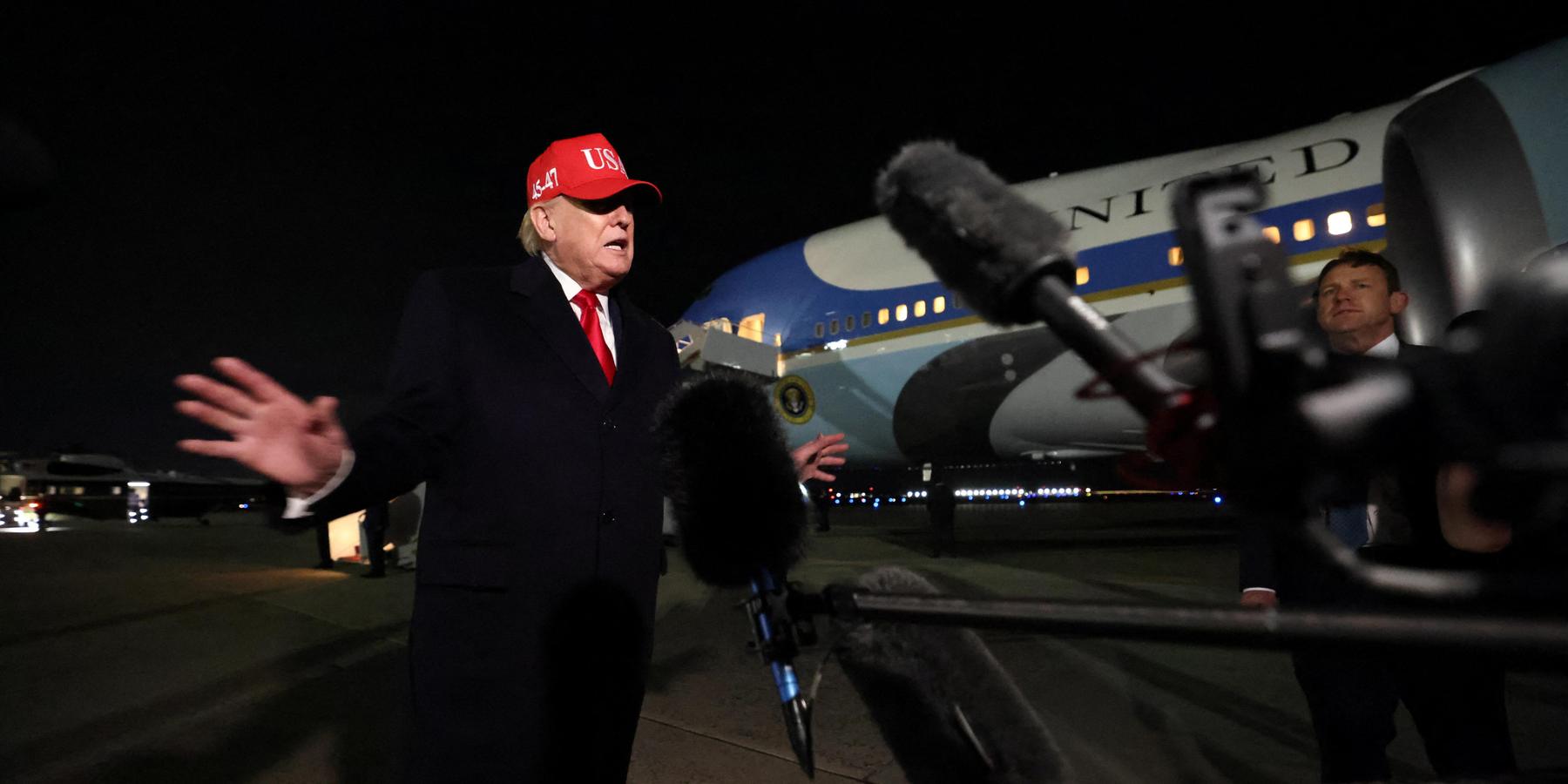
As soon as the negotiations between the U.S. and Iran ended without an agreement, President Donald Trump fired a volley of angry tweets venting his frustration. As a concrete step to force Iranian concessions, he announced a blockade of Iranian ports along the Persian Gulf.
Cut off Tehran’s oil exports, the logic goes, and the regime will have no choice but to bend to Trump’s will.
This thought process is being echoed and amplified by influential Washington voices who should know better. Take Dennis Ross, a former Middle East peace negotiator, who argued that “the blockade always made more sense than seizing Kharg Island. It stops Iran’s exports, its revenues, is a counterpoint to their closing the Straits.” He also thinks that the measure will “put pressure on China to pressure Iran.”
Meanwhile, Richard Haass, the former president of the Council on Foreign Relations, praised the announcement and suggested the U.S. should “also propose a new governance authority for the Strait in which Iran participates but doesn't control.”
This is wishcasting disguised as strategy. A blockade is not a clever alternative to military strikes. It is, in fact, an act of war — and one that carries serious risks.
The very idea of an American blockade ignores the legal reality: under international law, Article 3(c) of the U.N. General Assembly’s Definition of Aggression (1974) considers a naval blockade of a sovereign state’s coasts an act of armed aggression. That entitles Iran to use all necessary means to defend itself.
You cannot propose a “governance authority” while your warships are blockading a nation’s lifeline. Haass’s suggestion of a structure where Iran “participates but doesn't control” is therefore a non-starter. Tehran will never surrender control of its sovereign waters to an arrangement designed by the same power that just declared a blockade.
In practical terms, Trump has made it clear he would not permit any vessel that had coordinated with Tehran to pass. This sweeps aside the new, fragile status-quo where some traffic continued under Iranian acquiescence.
Iran’s own blockade of Hormuz — in response to Trump’s war — has already put the global economy in peril: around 20% of the world’s oil and liquefied natural gas usually passes through the strait. Trump’s blockade would further strengthen this chokehold, with severe consequences for global fuel, fertilizer, and commodity markets. The U.N. warns that millions of people could face hunger as a result. Ross claims a blockade merely “puts greater pressure on Iran.” In reality, it would hammer every economy reliant on Gulf energy, from Asia to Europe. And the blame would fall squarely on Washington.
Yet the deeper problem is whether the U.S. Navy can actually enforce such a blockade. Since the war began, only two U.S. vessels briefly entered — and left — the Gulf without coordination with Iran. A credible blockade would require a large, permanent naval presence — stationed directly inside the range of Iran’s shore-based missiles and drone swarms. Ross suggests Iran “may attack Gulf oil facilities,” but that, bad as it is, understates the threat. Iran could and almost certainly would attack U.S. warships.
That is a recipe for continued escalation. And for the Trump administration, a resumption of a shooting war with Iran would be far less popular and far more costly than Ross or Haass seem to acknowledge.
But there is an even more dangerous scenario that no supporter of the blockade addresses. Major buyers of Iranian oil — most notably China — could decide to escort tankers with their own naval vessels. Beijing has a strong economic incentive to call Washington’s bluff. Ross claims a blockade “puts great pressure on China to pressure Iran,” but what if China pressures the U.S. instead? What would the U.S. Navy do then? Fire on Chinese warships? Let the convoys pass, effectively ending the blockade? Risk a direct confrontation with a nuclear-armed power over oil lanes in Hormuz?
The stakes could not be higher as Trump prepares to embark on a visit to China for a summit with Chinese leader Xi Jinping. Trump has already postponed the meeting once because of the war with Iran. Postponing it for the second time, or going to Beijing with, using Trump’s own language, weak cards, would be an embarrassing blow to American standing.
So is Trump’s blockade threat a serious policy or bluster? That remains unclear. But one thing is certain: the mere threat of a U.S. blockade is enough to drive oil prices higher and inject dangerous volatility into global markets. On Monday, when the blockade is expected to enter into force, the oil price bounced back to over $100 per barrel. The view that a blockade is a clean, low-risk pressure tool is a dangerous illusion.
The administration should think carefully about the implications of its policies. Once the U.S. Navy blocks that strait, Iran won’t be the only one under pressure. The entire world will feel the squeeze, and other countries could see a need to respond.
Trump would do well to abandon this threat and use the remaining truce time — until April 20 — to recalibrate his whole Iran strategy. That means pursuing serious negotiations with an Iranian delegation that is clearly representative and fully mandated to strike a deal. For starters, Trump should match the seriousness of the Iranian counterparts with his own by replacing inexperienced political appointees like Steve Witkoff and Jared Kushner with real experts.
That team should be prepared to engage in multiple rounds of negotiations, covering all matters of concern — the nuclear issue, ballistic missiles, sanctions, Iranian assets, Hormuz, and regional proxies. This is how serious diplomacy is done. Unfortunately, nothing in this administration’s track record suggests that it is ready to embark on such a path.
- Trump's ‘move fast and break things’ war slams into economy ›
- Trump: US to block Hormuz, shooting ourselves & allies in foot ›