

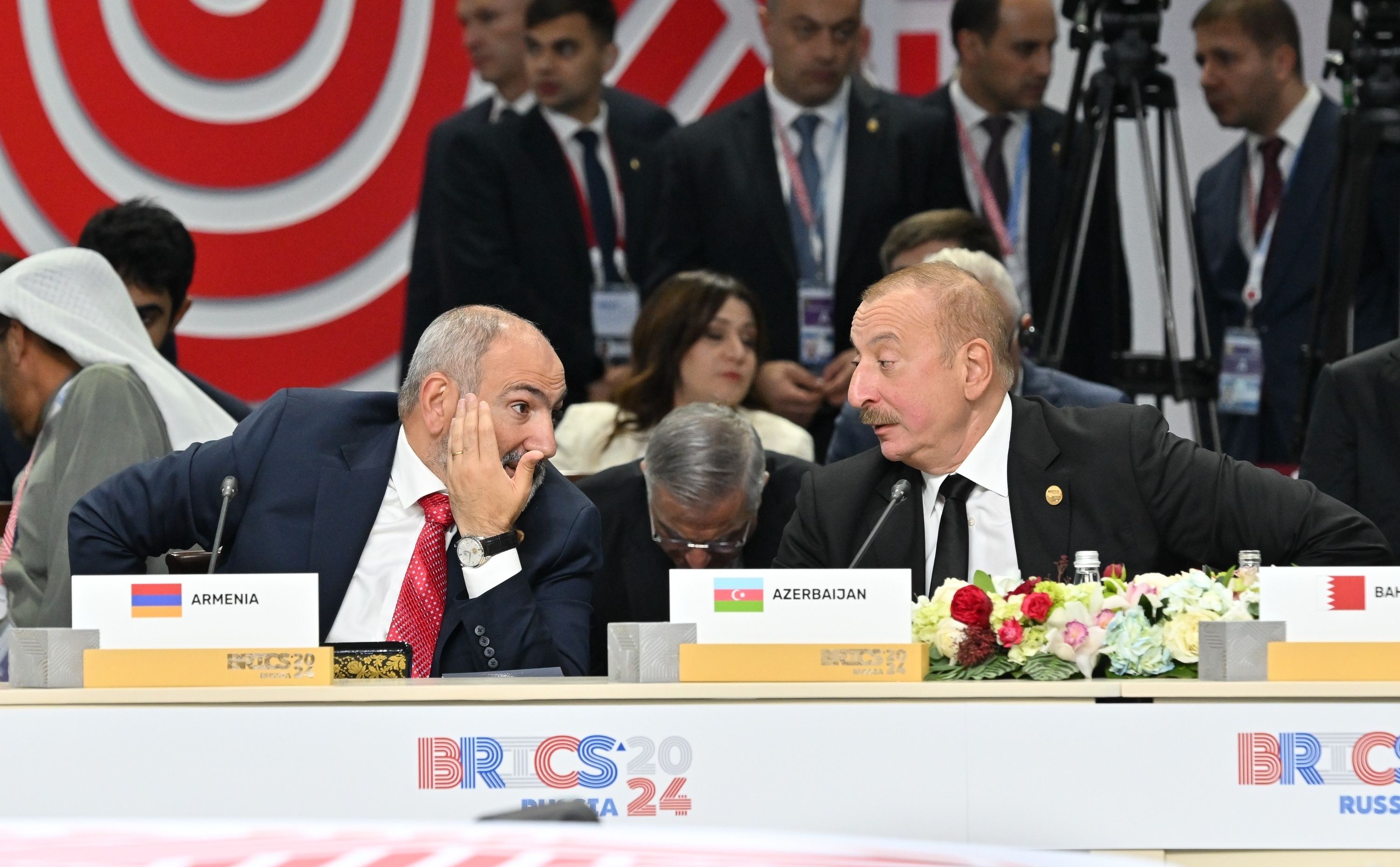
Last week, U.S. President Donald Trump claimed that a peace agreement between Armenia and Azerbaijan — two longstanding foes in the South Caucasus who fought bloody wars in the 1990s and again in 2020 — was imminent.
He credited his administration’s diplomatic efforts: “Armenia and Azerbaijan. We worked magic there and it’s pretty close — if not, it’s already done,” he declared during a dinner with Republican senators.
His remarks referenced a U.S. proposal to lease a 43-kilometer road through Armenia’s southern Syunik province to an American private company for 100 years, as revealed by U.S. Ambassador to Turkey Thomas Barrack. The plan is depicted as a creative fix for the deadlock over Baku’s demands for the so-called Zangezur corridor — a land route that runs through Armenian territory to connect with Azerbaijan’s Nakhichevan exclave and Turkey. Under U.S. management, the logic goes, all sides could use the road, moving beyond the “tribal viewpoints” that fuel the conflict.
Yet, reactions in both Armenia and Azerbaijan have so far been tepid — despite the fact that both nations currently seek to reduce Russia’s influence in the region, which should, in theory, make them more receptive to U.S. involvement.
The core sticking point remains sovereignty. Armenian Prime Minister Nikol Pashinyan stressed that Armenia must retain control over the route. At the same time, Azerbaijani President Ilham Aliyev, speaking in Khankendi/Stepanakert (the former capital of the now-dissolved Nagorno-Karabakh Republic, with its indigenous Armenian population violently expelled from the region in 2023, insisted on unilateral access to Nakhichevan and Turkey, dismissing any foreign presence. “There will be no operators, no leases, no rentals on our territory,” he asserted — an implicit rebuke to Washington.
Given Aliyev’s past claims that Syunik is “ancient Azerbaijani land” and his threats to seize it by force, Armenia rightly sees his demands as a precursor to annexation.
Still, Aliyev praised Trump’s “vision and efforts to promote peace” after Trump shared a clip of his speech on Truth Social — in what appeared to be an attempt to flatter the U.S. president.
Complicating matters further, the proposed corridor would cut through Armenian territory bordering Iran. Tehran has fiercely opposed any extraterritorial arrangement, fearing it would sever its link with Armenia, boost Turkish-Azerbaijani influence at its own expense, and leave its trade routes Russia and Europe vulnerable to Baku’s whims. Iran even conducted military drills near Azerbaijan’s border in 2022 as a warning.
Adding to Tehran’s unease is Azerbaijan’s military cooperation with Israel, along with suspicions that Israeli drones entered Iran via Azerbaijani airspace during their 12-day war last month — a claim that Baku vehemently denies. Iran also suspects Baku and Tel Aviv of stoking separatist sentiments among its Azeri population. Notably, Brenda Shaffer from the Washington-based neoconservative Foundation for Defense of Democracies (a vocal advocate for Azerbaijani irredentism with close ties to Baku’s government) framed Armenia-Azerbaijan peace almost solely as a means to isolate Iran and create a “NATO corridor” from Turkey to Central Asia.
Given U.S. support for Israeli strikes on Iran and its own attacks on Iranian nuclear sites, an American-run corridor near its border would only heighten Tehran’s fears of encirclement. Despite its weakened state, Iran retains enough leverage to sabotage a deal it deems a threat to its core national interests.
Aliyev, meanwhile, appeared to placate Tehran by accusing, albeit without evidence, the EU’s Armenia border mission of spying on Iran in an apparent attempt to deflect Tehran’s scrutiny over Baku’s ties with Israel. Still, his rhetoric aligned with Iran’s opposition to extraregional meddling, meaning the U.S. and EU, just as Armenia pivots toward the West.
Russia, like Iran, views the U.S. proposal as an attempt to push it out of the South Caucasus — a perception Yerevan seems to be doing its best to encourage. Yet Moscow still holds considerable leverage: it guards Armenia’s border with Iran, retains a military base in Armenia, and dominates broad sectors of its economy and infrastructure, even as Yerevan’s pro-Western pivot so far is heavier on rhetoric than on tangible actions. How would Russian border troops coexist with an American-run corridor? Would Washington deploy forces to protect it, risking a clash with Russian forces in Armenia? And does the U.S. even have the staying power and political will to enforce such a deal in a region of only marginal strategic importance to its interests?
While a U.S.-brokered peace between Armenia and Azerbaijan is welcome in principle, the current proposal ignores too many regional complexities. At best, it’s a rough draft that requires intensive negotiation with all the regional players, including Iran and Russia. At worst, it’s another headline-grabbing stunt in Trump’s elusive quest for a Nobel Peace Prize.
- Too optimistic? Azerbaijan-Armenia peace deal looms at last ›
- Azerbaijan exploiting Ukraine distraction to press advantage in Armenian conflict ›
- Trump's gambit for the elusive South Caucasus peace deal | Responsible Statecraft ›
- With this devil in the details, Azerbaijan wins | Responsible Statecraft ›
- How the failure of Trump's Caucasus corridor helped spare Armenia | Responsible Statecraft ›