
Follow us on social

google cta
Larry Ellison Tik Tok Israel

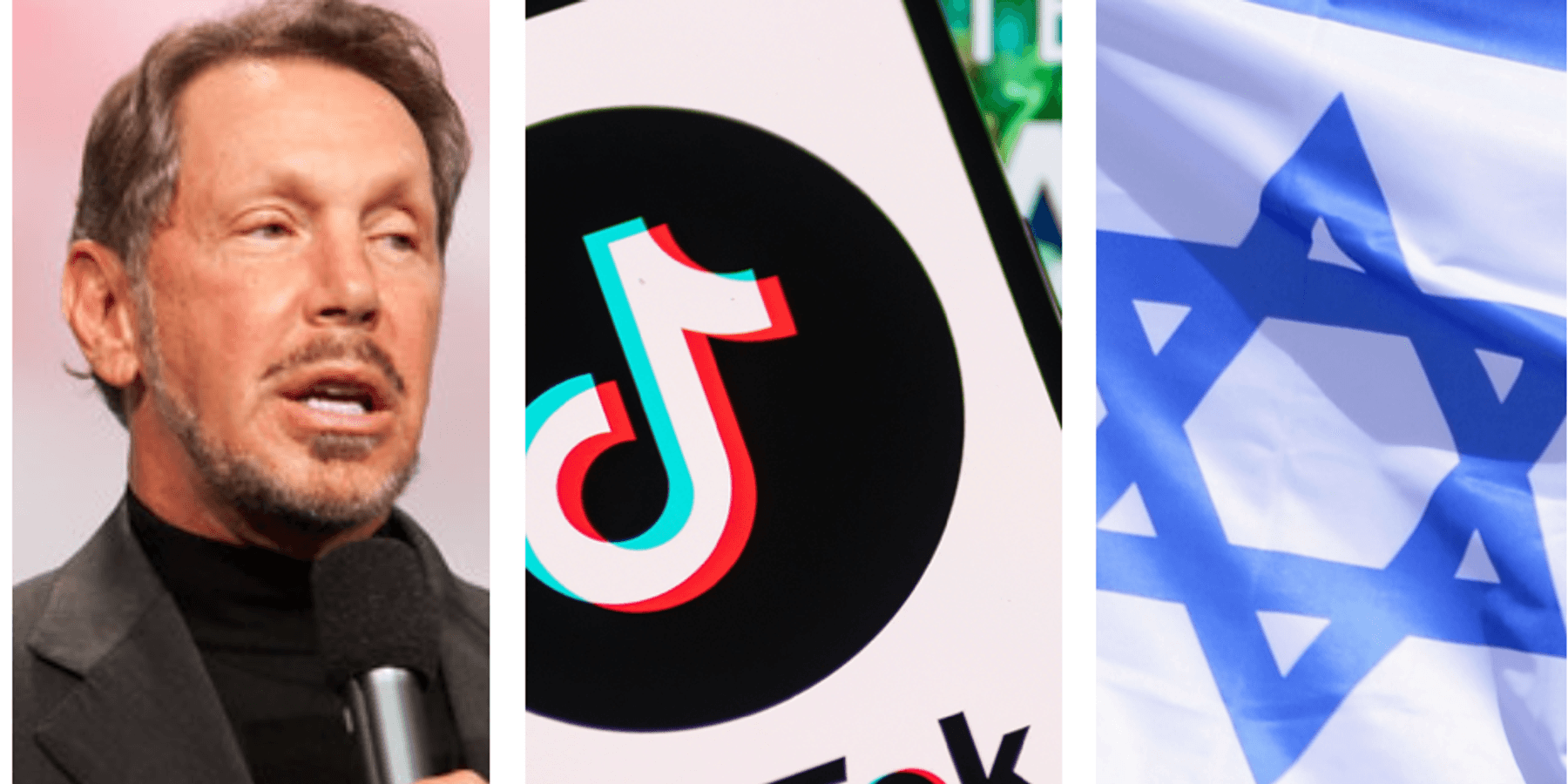
From CBS to TikTok, Pro-Israel Ellisons now in the driver's seat

Sale of the social media giant finally sealed, with Oracle on the board and with 15% share

QiOSK
google cta
google cta

There were two campaigns driving the ultimate sale of TikTok today. One featured claims that the Chinese government was using the wildly popular social media app as a back door to Americans' personal data and was a national security threat. The second: that it was propagating anti-Israel messaging in regards to the Gaza war among millions of young people, especially Americans.

As former Secretary of State Hillary Clinton famously said of her reportedly wrongheaded Columbia University students just a few months ago, "They were getting their information from social media, particularly TikTok...That is where they were learning about what happened on October 7th, what happened in the, you know, days, weeks, and months to follow. That’s a serious problem."

Well that might not be a problem anymore. There are new owners of TikTok in town, and a majority chunk are the kind that if they have their druthers, won't let that kind of "information" — what did Sarah Hurwitz say, the "wall of dead children"? — continue to flow in the same way.

Last night the Chinese owner of ByteDance said it had struck a deal with a consortium of investors in which ByteDance will now have less than a 20% stake in the app going forward. The deal was a mandate: Congress had passed a law last year that said TikTok could no longer be majority owned by a company linked to the Chinese government. So 80% will be owned by investors including software giant Oracle (co-founder is Larry Ellison); MGX, an Emirati investment firm; and Silver Lake, another investment firm. They will each have a 15% stake.

Ellison, as I wrote here, is the single biggest private investor in the Friends of the IDF (Israeli Defense Forces), and a major Republican donor. He has referred to the state of Israel as his own. He and his son David Ellison own and control a head spinning galaxy of news, television, and Hollywood media companies, mainly through the recent Paramount Skydance Corporation takeover. Ellison the younger just gave Free Press founder Bari Weiss, a pro-Zionist activist, control of newly-acquired CBS. Ellison the elder also is a major stakeholder in X and Tesla.

It is not clear yet that other pro-Israel figures, including Oracle Vice Executive Chair and former CEO Safra Catz (who traveled to Israel on behalf of the company several times in the last two years to ensure it fidelity to Israel's cause), Fox News mogul Rupert Murdoch (who once said Israel is "alone on the front line of Western democratic civilization") or Republican mega-donor Jeff Yass who has funding ties to IDF and AIPAC, are included in the roster of investors, as reported earlier.

It is also not clear how and when the content users will see will changes, as the algorithm is reportedly staying in ByteDance's control with leasing rights to the new investors. Analysts also question whether "national security" concerns will be placated with the sale as well.

But for all of us watching how Israel has been behaving over the last year: paying influencers enormous sums, messing with Chat GPT, training Evangelical pastors to be their "ambassadors" in the U.S., this is yet another, albeit, powerful tool to control what we hear and see of their policies in Gaza and in the West Bank. This isn't paranoia. Prime Minister Benjamin Netanyahu said it himself, that social media is “the most important weapon … to secure our base in the U.S." and TikTok was “the most important purchase going on right now,” with its control "consequential."

No doubt the Ellisons and Hillary Clinton feel the same way today.


Top photo credit: Larry Ellison (hartmann Studios/flikr) ; Shutterstock
Israel wins TikTok
google cta
QiOSK
G7 Summit
Top photo credit: May 21, 2023, Hiroshima, Hiroshima, Japan: (From R to L) Comoros' President Azali Assoumani, World Trade Organization (WTO) Director-General Ngozi Okonjo-Iweala, Australia's Prime Minister Anthony Albanese and India's Prime Minister Narendra Modi at the G7 summit in Hiroshima, Japan. (Credit Image: © POOL via ZUMA Press Wire)

Middle Powers are setting the table so they won't be 'on the menu'

Asia-Pacific

The global order was already fragmenting before Donald Trump returned to the White House. But the upended “rules” of global economic and foreign policies have now reached a point of no return.

What has changed is not direction, but speed. Canadian Prime Minister Mark Carney’s remarks in Davos last month — “Middle powers must act together, because if we’re not at the table, we’re on the menu” — captured the consequences of not acting quickly. And Carney is not alone in those fears.

keep readingShow less
Vice President JD Vance Azerbaijan Armenia
U.S. Vice President JD Vance gets out of a car before boarding Air Force Two upon departure for Azerbaijan, at Zvartnots International Airport in Yerevan, Armenia, February 10, 2026. REUTERS/Kevin Lamarque/Pool

VP Vance’s timely TRIPP to the South Caucasus

Washington Politics

Vice President JD Vance’s regional tour to Armenia and Azerbaijan this week — the highest level visit by an American official to the South Caucasus since Vice President Joe Biden went to Georgia in 2009 — demonstrates that Washington is not ignoring Yerevan and Baku and is taking an active role in their normalization process.

Vance’s stop in Armenia included an announcement that Yerevan has procured $11 million in U.S. defense systems — a first — in particular Shield AI’s V-BAT, an ISR unmanned aircraft system. It was also announced that the second stage of a groundbreaking AI supercomputer project led by Firebird, a U.S.-based AI cloud and infrastructure company, would commence after having secured American licensing for the sale and delivery of an additional 41,000 NVIDIA GB300 graphics processing units.

keep readingShow less
United Nations
Monitors at the United Nations General Assembly hall display the results of a vote on a resolution condemning the annexation of parts of Ukraine by Russia, amid Russia's invasion of Ukraine, at the United Nations Headquarters in New York City, New York, U.S., October 12, 2022. REUTERS/David 'Dee' Delgado||

We're burying the rules based order. But what's next?

Global Crises

In a Davos speech widely praised for its intellectual rigor and willingness to confront established truths, Canadian Prime Minister Mark Carney finally laid the fiction of the “rules-based international order” to rest.

The “rules-based order” — or RBIO — was never a neutral description of the post-World War II system of international law and multilateral institutions. Rather, it was a discourse born out of insecurity over the West’s decline and unwillingness to share power. Aimed at preserving the power structures of the past by shaping the norms and standards of the future, the RBIO was invariably something that needed to be “defended” against those who were accused of opposing it, rather than an inclusive system that governed relations between all states.

keep readingShow less
google cta
Want more of our stories on Google?
Click here to make us a Preferred Source.

LATEST

QIOSK

Newsletter

Subscribe now to our weekly round-up and don't miss a beat with your favorite RS contributors and reporters, as well as staff analysis, opinion, and news promoting a positive, non-partisan vision of U.S. foreign policy.