

As the U.S.-Israeli military campaign against Iran intensifies, Americans have shown little appetite for another war in the Middle East. Far fewer Americans support the war than in previous conflicts at this stage, including Iraq, Afghanistan, or Kosovo.
Washington think tanks, however, have been far more enthusiastic. They also happen to be funded by weapons contractors that stand to profit handsomely from the war.
For instance, many fellows employed by the Hudson Institute are supportive of strikes on Iran. As the Trump administration built up its military presence, Hudson Institute fellow Rebeccah Heinrichs went on Fox News and celebrated Trump’s initiative to “push the regime over” as a “major strategic opportunity for peace and stability in the Middle East.” After a week of strikes, Heinrichs celebrated the escalation of the military campaign. “We have a lot more of those kinds of munitions, and now I would suspect that we are just going to continue to destroy the production capabilities and any other storage facilities that they have deeply buried underground, so that’s good for the United States,” Heinrichs told Fox.
The Hudson Institute has received over $4 million from the defense industry since 2019, with Lockheed Martin, Northrop Grumman, and General Atomics CEO Neal Blue among their largest donors. Those companies’ weaponry has been used extensively in Iran. Northrop Grumman manufactures the $2 billion B-2 stealth bombers that are used to strike Iran. Lockheed Martin manufactures a variety of aircrafts used in the attacks, as well as the $300 million THAAD radar system that was recently destroyed by Iran. General Atomics, for its part, produces the MQ-9 Reaper drones used in the campaign. RTX, the manufacturer of the Tomahawk missile that killed 168 girls at their elementary school in Minab, Iran, is also a major donor.
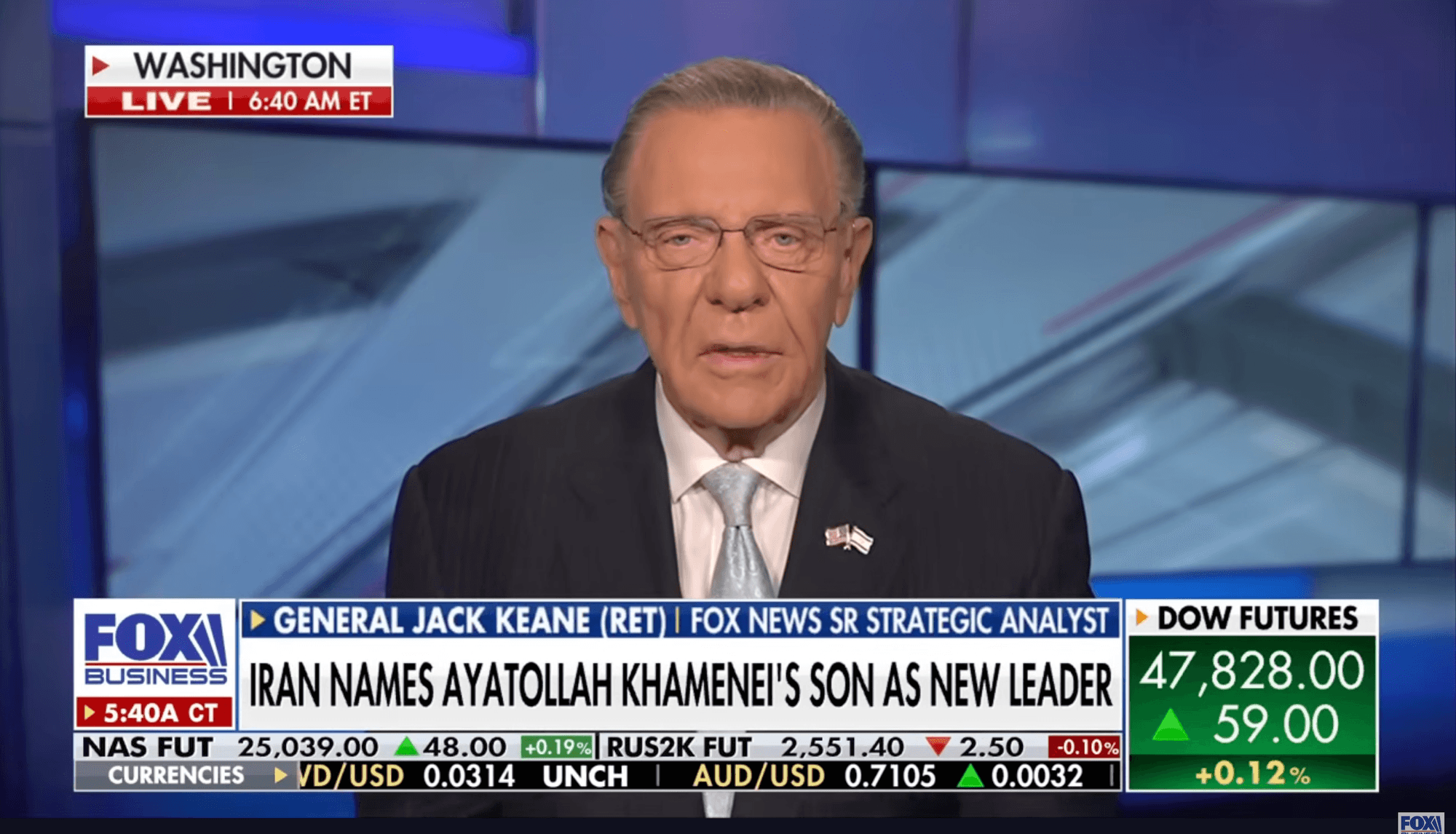
General (Ret.) Jack Keane, Chairman of the Institute for the Study of War, took to the airwaves to claim the U.S. should "take Iran off the map." In a segment on Fox, Keane made the case against exiting the conflict prematurely over rising oil prices; "Are we saying we can't accept several weeks of oil prices being higher than what they should be to take Iran off the map as a predator in the Middle East for decades to come?" asked Keane. "I think we're much tougher than that frankly."
ISW, Keane’s think tank, has received funding from major Pentagon contractors General Dynamics and CACI, but recently delisted the names of both donors from the website. In response to a request for comment, Alexander Mitchell, Director of External Relations at ISW, said, “ISW does not share information about our supporters or their giving histories outside standard 990 reporting.” ISW does list several other corporate sponsors on its website.
The Atlantic Council, which accepts more funding from the defense industry than any other think tank, hired an Israeli national security insider in the lead-up to the war, who used his new perch to make the case for U.S. attacks. Michael Rozenblat, who the Atlantic Council describes as a “visiting research fellow from the Israeli security establishment,” published an article titled “Six reasons why Trump should choose the military option in Iran” less than two weeks before the strikes, framing an attack as a “moral imperative.” Rozenblat concluded that “a decisive US-led coalition effort aimed at regime change may offer a more sustainable strategic outcome” in Iran.
Last year, the Atlantic Council published a report recommending that the U.S. procure more THAAD and SM-3 missiles to deal with threats abroad, including Iran. The manufacturers of those missiles, RTX and Lockheed Martin, have given the Atlantic Council $850,000 and $700,000 respectively since 2019. Both systems have been used extensively for missile defense against Iran.
War has been good for those donors’ pocketbooks. As stock exchanges opened the week after the U.S.-Israeli attack on Iran, the share price of weapons manufacturers RTX, Northrop Grumman, and Lockheed Martin soared.
On March 12, the senior director of the Atlantic Council Scowcroft Center Matthew Kroenig defended the military campaign on Iran during a debate with Trita Parsi of the Quincy Institute, which publishes RS. “Removing the Islamic republic from the chessboard, or significantly weakening it for years or a decade I think stands to greatly improve regional and global security, and the lives of ordinary Iranians,” said Kroenig.
Many of the most outspoken voices pushing for regime change in Iran come from dark money think tanks, which reveal nothing at all about their donors. Around 40% of the U.S. top think tanks fall into this category, according to the Quincy Institute’s newly updated Think Tank Funding Tracker.
The Foundation for Defense of Democracies (FDD), a prominent dark money think tank, has been advising the U.S. to topple the Iranian regime for years. Founded with a goal to “enhance Israel’s image in North America,” FDD played a critical role in pushing Trump to withdraw from the Iran nuclear deal.
On the day of the U.S.-Israeli strikes, FDD CEO Mark Dubowitz and senior analyst Ben Cohen wrote in an op-ed that “the survival of this regime – a nuclear-seeking, terror-sponsoring, protest–crushing dictatorship – is far more dangerous than the risks that come with its collapse.” Dubowitz has been cheering on the regime change effort since, recently retweeting an AI-generated video from Mossad encouraging Iranians to work with Israeli intelligence in overthrowing the Islamic Republic. FDD’s experts are invited to testify to the House Foreign Affairs Committee more than almost any other think tank, second only to the Center for Strategic and International Studies.
The Jewish Institute for National Security of America (JINSA) is another dark money think tank pushing for the military campaign on Iran. JINSA’s fellows include Benjamin Netanyahu’s former National Security Advisor, the former Commander of the Israeli Air Force, and Trump’s former Iran adviser, Elliott Abrams, as well as over a dozen retired U.S. generals and admirals. In 2020, after the U.S. assassinated Iranian military officer Qasem Soleimani, two JINSA scholars argued in the Washington Post that the United States “must keep up the attacks against Iranian assets in the region and join Israel in rolling back Iranian aggression,” with the goal of provoking a regime collapse.
When the military operation on Iran began, JINSA published an open letter signed by 75 retired generals and admirals in support of the war. Blaise Misztal, Vice President for Policy at JINSA, argued in an article titled “Iran is not Iraq” that fears of repeating the failures of Iraq are overblown.
In a recent appearance on Fox Business, JINSA strategic advisor Vice Admiral Robert Harward described the closure of the Strait of Hormuz as a “short-term problem” and argued that ending the war on Iran now would “only exacerbate” problems in the region.
Many other think tank experts have expressed support for the U.S. pursuing a military campaign against Iran. Analysts from the Washington Institute, which was founded as a spin-off of the American Israel Public Affairs Committee, have long pushed for Congress to pre-emptively authorize the use of military force against Iran.
The Middle East Forum, meanwhile, recently published an article pushing Congress to appropriate funds not just for missile stockpiles but also nation-building efforts in Iran. Gregg Roman, the Executive Director of the Middle East Forum, suggested the U.S. should fund “transitional governance planning” including “constitution-drafting support, judicial reform expertise,” and “lustration frameworks that remove regime loyalists” in Iran.
The Atlantic Council, the Hudson Institute, FDD, JINSA, the Washington Institute, and the Middle East Forum did not respond to a request for comment.
After the American public soured on the Iraq War, many groups that pushed for the invasion, including FDD, tried to downplay their role in the debacle.If the U.S.-Israel bombing campaign on Iran continues on its perilous trajectory, one can’t help but wonder whether these pro-war organizations will once again attempt to memoryhole their supporting role in America’s latest military misadventure.
- Witnesses backed by military, foreign $$ hype war with Iran ›
- First it was regime change, now they want to break Iran apart ›