

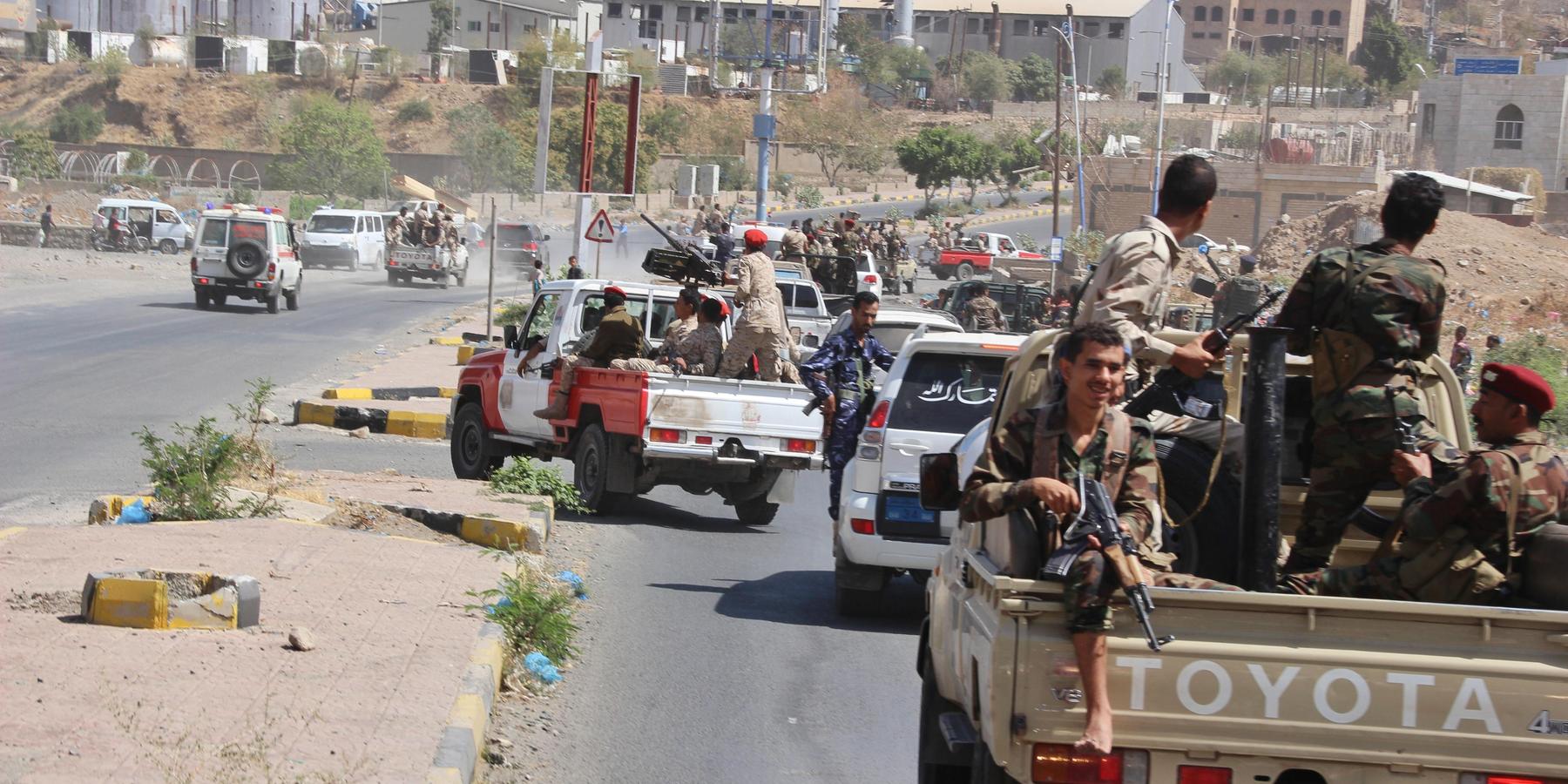
Taiz, Yemen’s third-largest city, endured a siege from 2015 to 2017. Today, it is encircled again.
The World Food Program says it cannot reach more than 600,000 people in and around the city. The International Organization for Migration counts over 200,000 people displaced since the Houthi offensive on Yemen’s Red Sea coast launched in September.
Why this city, and why now? The Houthis, formally known as the Ansar Allah movement, draw their strength from the Zaydi Shia highlands of the north. Critics say their governing ideology rests on the belief that the right to rule belongs to sayyids, descendants of the Prophet Mohammad, a lineage to which the Houthi family itself belongs. The Houthis have long denied seeking to restore the Imamate, but in Taiz, which has for a decade resisted Houthi encroachment, that denial finds few believers.
Taiz has a long history of political activism and hostility to the idea of religious hereditary rule. Its poets and journalists supplied much of the dissident energy that toppled the Imamate in 1962, and its streets were one of the centers of the 2011 uprising against then-President Ali Abdallah Saleh. This gives the governorate symbolic weight disproportionate to its size.
Moreover, Taiz is significant for its geography. It sits at the hinge between the Red Sea coast and the southern highlands that shelter the city of Aden, currently the administrative capital of Yemen’s internationally-recognized government, which the Houthis struck last week with missiles. Houthi control of the surrounding mountains would make the government’s counteroffensive around the Bab al-Mandab strait far harder to sustain.
That counteroffensive, known as Operation “Dawn of Yemen,” was announced on October 5 by President Rashad al-Alimi, a native of the Taiz governorate who chairs the Saudi-backed Presidential Leadership Council, the body that leads Yemen’s internationally-recognized government.
The stated aim of the counteroffensive is to recover the whole country from the Houthis, the capital Sana’a included. So far, it seems to have stalled in its second week.
Government forces, under heavy Saudi air cover, have retaken ground around Bab al-Mandab and Dhubab. But Mokha, the coastal prize the Houthis seized in September, remains in Houthi hands.
The Houthis hold a contiguous area and can shift forces and materiel between fronts with relative ease. Their opponents consist of numerous factions fighting under the government umbrella, each of which answers to different commanders with different political projects. When the west coast collapsed in September, Tareq Saleh, who heads the National Resistance Forces that held the coast, withdrew to Aden, where southern units initially refused his men entry. The southerners' wariness stems from the role Saleh's uncle, then president, played in the 1994 civil war, when northern forces overran the south and crushed their bid for independence.
Indeed, Yemen’s civil war was already heavily shaped by external forces. Today, it has grown even more tightly bound to the wider U.S.- Iran war.
Since July, the Houthis have declared a blockade on Saudi shipping and turned their arsenal on the kingdom itself. King Khalid International Airport in Riyadh has been attacked multiple times this month, with 13 killed and over 300 wounded.
The Houthis also hit Aramco’s headquarters in Dhahran last week, with fire spreading across several floors. Reuters estimates Saudi crude output ran below 7 million barrels a day for most of the first six months of the U.S.-Iran war, leading to $50 billion in lost revenue at current prices. The International Monetary Fund expects the Saudi economy to shrink by 3.3% this year.
Riyadh’s response has been aggressive in substance toward the Houthis but restrained in tone toward Iran, the movement's primary patron. Saudi Arabia says it has carried out waves of air and missile strikes on Houthi territory, yet Saudi officials largely stop short of naming Tehran.
The reticence is probably deliberate. Riyadh has every reason to preserve room for a deal between Washington and Tehran that could reopen the Strait of Hormuz and hopefully end attacks from Iran and Iran-aligned groups on Saudi soil. Iran is also the outside power with the most influence over the Houthis. If Tehran chose to press them to de-escalate, that could create space for a Saudi-Houthi ceasefire and talks.
In the meantime, the kingdom has few viable options to escalate pressure on the Houthis, who set the tempo of escalation.
Turkey and Pakistan have activated the Mecca Joint Defence Agreement, but both describe their roles as defensive. Egypt’s President Abdel Fatah al-Sisi on Saturday asked parliament for authority to militarily support the kingdom, but stressed that “we are speaking only about defense.”
President Donald Trump recently noted that the Houthis were “behaving very badly” and suggested he may ask Turkey to get more involved. Yet, with midterm elections looming on November 3, a war on Iran that has dragged on for eight months without settlement, and oil prices climbing, another American campaign in Yemen is the last thing the White House wants.
Riyadh, short of options, has yet to offer a comprehensive strategy beyond punitive airstrikes on the Houthis and support for its Yemeni partners’ counteroffensive, which is faring poorly, as the siege of Taiz makes clear.
The best clue to official thinking is a recent column by Abdulrahman al-Rashed, a former editor of Asharq al-Awsat and a well-connected Saudi commentator. He answers those who argue that the world should simply negotiate with the Houthis, as it has with other rulers of Sana’a.
The Houthi project, he argues, “is fundamentally at odds with the very idea of the state.” He describes how the Houthis have used all concessions and pauses to re-arm and wage war, calling the group “yet another Iranian proxy in the region, not the nucleus of an ordinary Yemeni system of government.”
Saudi Crown Prince Mohammed bin Salman appears to share this view that the Houthis are not a group to be accommodated. Chairing the cabinet on October 13, he declared that the “terrorist Houthi militia will face the consequences of its heinous crimes and attacks.”
Tehran’s position, meanwhile, has been contradictory. Foreign Ministry spokesman Esmail Baghaei says Iran will help mediate if both sides ask and denies any role in Yemeni operations. Yet numerous investigative reports demonstrate that Iranian advisers and intelligence actively enabled the Houthi capture of Yemen’s Red Sea coast.
Though Saudi Arabia has not responded to the mediation offer, the foreign minister of Yemen’s internationally-recognized government, Afrah al-Zouba, rejected it, calling Iran a “party to the war against the Yemeni people.”
This is not a surprising response. Iran’s own hardline press betrays official neutrality, running headlines that celebrate Houthi strikes on Saudi airports and Aramco facilities.
One report in Kayhan, whose editor-in-chief is selected by Iran's supreme leader, refers to the Houthis as the “Yemeni resistance” and frames war in Yemen as a “twelve-year aggression of the Saudi-American coalition.” Moreover, an adviser to the parliamentary speaker, one of the key negotiators with the U.S., wrote that Iran would use “tools in the Strait of Hormuz, Bab al-Mandeb and beyond” to keep oil prices elevated.
More telling is the extent to which Tehran has adopted the Houthi vocabulary. Iranian officials describe the Houthis as “Yemen’s armed forces,” overlooking the Saudi-backed government that holds Yemen’s U.N. seat, and call Saudi restrictions on flights and ports in Houthi-held territory a “blockade.” Riyadh sees those measures as the enforcement of a U.N.-backed arms embargo and as support for Yemen’s recognized government, whose current executive council took shape under Saudi sponsorship in 2022, after Riyadh pressed the previous president to step aside and transfer his powers to the newly created governing council.
Iran thus arrives with its position on the central questions already fixed, rendering its mediation offers largely hollow. Any Saudi move to the table would look like a concession to the Houthis’ and Tehran’s framing. That makes talks harder for Riyadh, even if it wanted them.
- Will Houthis' rapid advance drag US, Saudi Arabia back into Yemen? ›
- Why Saudi Arabia has returned to war in Yemen ›
- How Saudi Arabia's anti-Houthi strategy crashed and burned ›