

The Solomon Islands in the southwest Pacific recently emerged from weeks of parliamentary turmoil and a leadership shake-up resulting in a new government.
The new prime minister, Matthew Wale, who had led the opposition since 2019, is delivering a foreign relations reset with Australia and New Zealand, both long-term regional partners and U.S. allies. He has less than two years to make a mark with his foreign policy and development vision before the next national election in 2028.
“Fellow Solomon Islanders, change is coming,” Wale declared May 15 after assuming leadership of the island chain of more than 800,000 people. “The government that I lead will do its utmost to serve. Please help keep us accountable and responsible,” he told fellow citizens.
Wale gained the premiership following a no confidence vote in parliament prompted by the defection of ministers from the previous coalition government, led by Jeremiah Manele and the Ownership, Unity and Responsibility (OUR) Party since 2024.
Wale’s ascent marks a major shift from the state being a geopolitical flashpoint between the U.S. and China just four years ago. Manele continued much of the “look north” agenda of his predecessor, Manasseh Sogavare, who oversaw the country’s decision in 2019 to normalize relations with China at Taiwan’s expense and who in 2022 signed an extensive security pact with Beijing that aroused major concerns in Canberra, Wellington, and as far away as Washington.
For his part, Wale, who became opposition leader in 2019, has been a consistent critic of the country’s growing ties with Beijing.
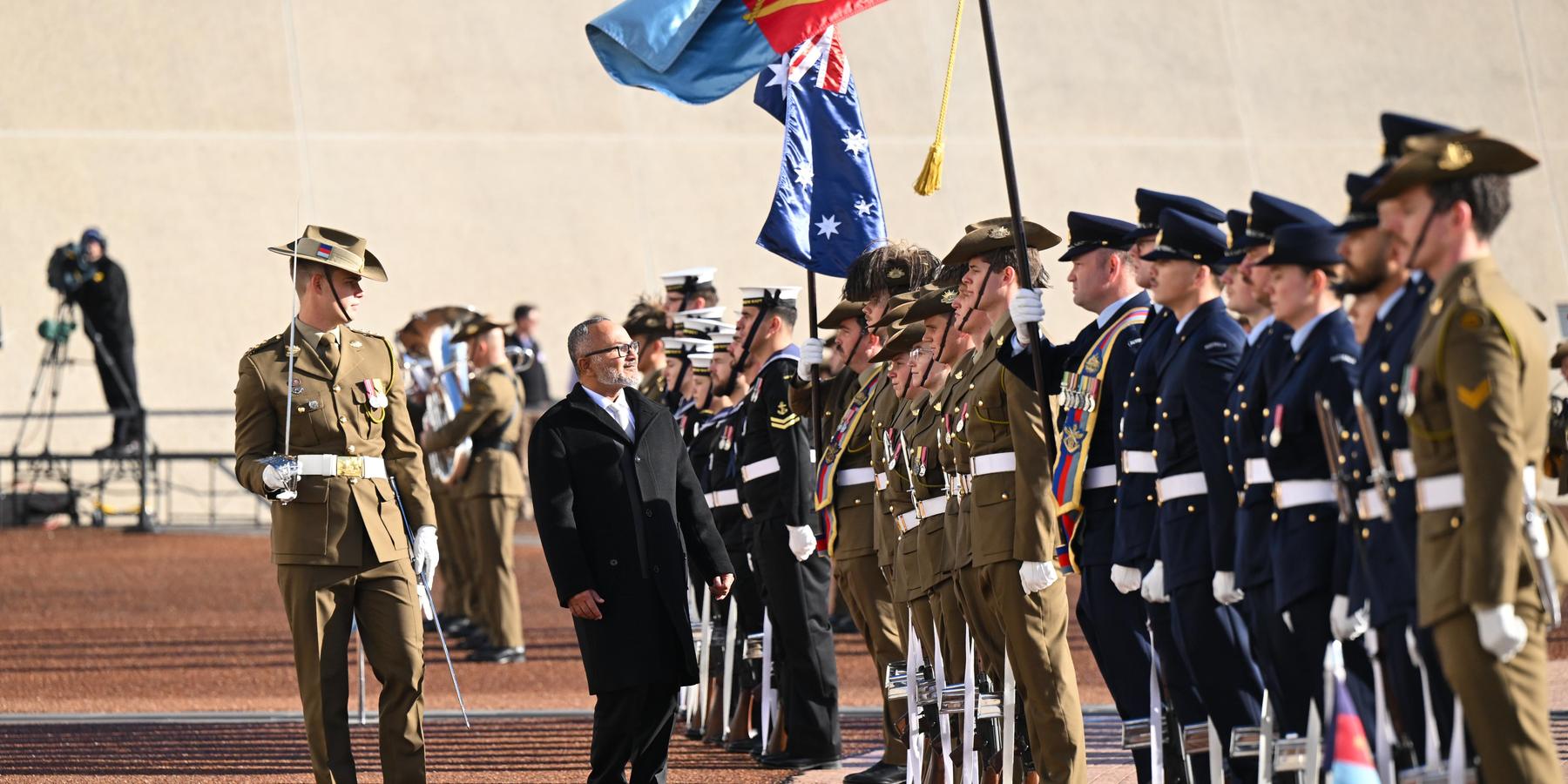
Wale sent a clear signal when he made his first official overseas visit as prime minister to Australia, where he initiated talks aimed at achieving a new strategic treaty less than three weeks after taking office. “Today we’ve committed to elevate our bilateral relationship at the request of the Solomon Islands,” Australian Prime Minister Anthony Albanese told a joint Canberra press conference June 3. “This will be agreed in a new comprehensive treaty underpinned by mutual trust, respect and open dialogue.” The agreement will include enhanced security and law enforcement cooperation, as well as economic, humanitarian and development assistance.
In response, Wale told the Australian media that “the resilience of our relationship, I think, is self-evident. It lies in our people to people contacts and, of course, in our institutional relations over so many years, perhaps even more than a century. And it is not easy to break that kind of depth and the strength of such a relationship.”
The solidarity follows Wale’s pledge last month to review the controversial security agreement with China, which provided the possibility for Chinese security forces to be used against internal social disorder.
The Pacific Islands, which consist of 22 countries and territories with a total population of 14.3 million people and which stretch from Papua New Guinea in the west to French Polynesia to the east, have been regarded by Beijing as strategically important for expanding its economic and political influence under the banner of South-South cooperation, extending its maritime and security presence in the region, and reducing Taiwan’s diplomatic presence and influence there.
The prospect of China’s security penetration so far south galvanized a rapid response from Australia and the U.S. The Biden administration sought to rectify decades of neglect in the South Pacific by reopening shuttered embassies, providing more economic and development assistance to the islands, and engaging in greater dialogue with the region. Summits in 2022 and 2023 with Pacific leaders were hosted in Washington, where major new economic and aid programs were announced. Washington’s renewed attention also carried an ideological dimension by stressing, rhetorically at least, a mutual commitment to democratic principles and to “a free and open region where individuals live in open societies [and] rules are reached transparently and applied fairly.”
Yet U.S. momentum in the region faltered last year as President Donald Trump, in his second term, abruptly slashed USAID programs and withdrew from multilateral organizations and the Paris climate agreement. The imposition of steep trade tariffs on Pacific Island developing countries, described as “disconnected with both reality and common sense” by the Center for Strategic and International Studies (CSIS), delivered a shock to the region, which already faces major national human and economic development challenges that are further jeopardized by the impacts of climate change, such as sea level rise, and natural disasters, such as typhoons.
Wale’s domestic objectives also include reducing corruption. He has voiced criticism for years about the connivance between political elites and foreign extractive investors in the logging industry, which has resulted in hundreds of millions of dollars in lost revenue every year. It is an issue that has also triggered long-term grievances among ordinary Solomon Islanders, of whom 31% live in poverty. And vociferous civil society opposition to perceptions of undue foreign influence on political leaders was a factor in violent protests in the Chinatown area of the capital, Honiara, in November 2021. The unrest was a catalyst for the security agreement the following year.
At the same time, established economic and trade ties with China, estimated to be worth US$3.5 billion since 2019, are unlikely to weaken. But the new prime minister, who also visited New Zealand in June, has framed his strengthening of bilateral ties with Australia as motivated in part by shared values and aspirations as representative democracies.
Australia also provides 34% of all overseas development finance (ODF) to the Solomon Islands, followed by China at 19%, according to the Sydney-based Lowy Institute for International Policy. And across the entire region, Australia contributed the largest portion, about 43%, of all ODF in 2023, with 10% contributed by New Zealand and 1% by the United States.
Last year, China tried to capitalize on perceptions of U.S. withdrawal from the region, hosting a summit with Pacific Island foreign ministers in May to showcase enhanced regional cooperation and climate assistance projects. Yet the magnitude of ODF it provides to the Pacific has diminished over the past two decades, from an average of $440 million in 2008-2019 to about $250 million in 2024, according to the Lowy Institute. The trend parallels China’s continuing decline in its rate of GDP growth from 14.1%percent in 2007 to 5% in 2024, with forecasts of a possible contraction to 3-4% in coming years.
This year, however, has seen the U.S. move to re-engage in the region. Deputy Secretary of State Christopher Landau hosted an investment summit with Pacific Island leaders in Hawaii in February and visited Samoa, Tonga and Fiji to promote private-sector-led economic and development partnerships. And in May, the U.S. and Solomon Islands signed a new joint investment incentive agreement. However, “even factoring in ramped up U.S. engagement in recent years, the U.S. remains far behind other countries in terms of what it contributes to the region, according to CSIS.
On the security front, Pacific leaders remain focused on their own identified security agenda and threats that range from climate change to transnational crime. Nevertheless, Wale reportedly proposed developing a Pacific-led regional security treaty during his visit to Canberra. The suggestion comes at a time when China’s expenditure on defense is on the rise, reaching an estimated $275 billion this year, with an increased tempo of naval operations in the region.
Wale’s proposal demonstrates that future strategic initiatives in the region may be driven as much by the Pacific Island states as larger powers. In so doing, Pacific leaders will prioritize international partners that walk the talk of consistent, long-term, trust-based and mutually beneficial relations.
- Not wanted: US, China barred from major Pacific Island summit ›
- US working to expand control over Compact states in the Pacific ›
- Goodbye Indo-Pacific, hello first island chain! | Responsible Statecraft ›