

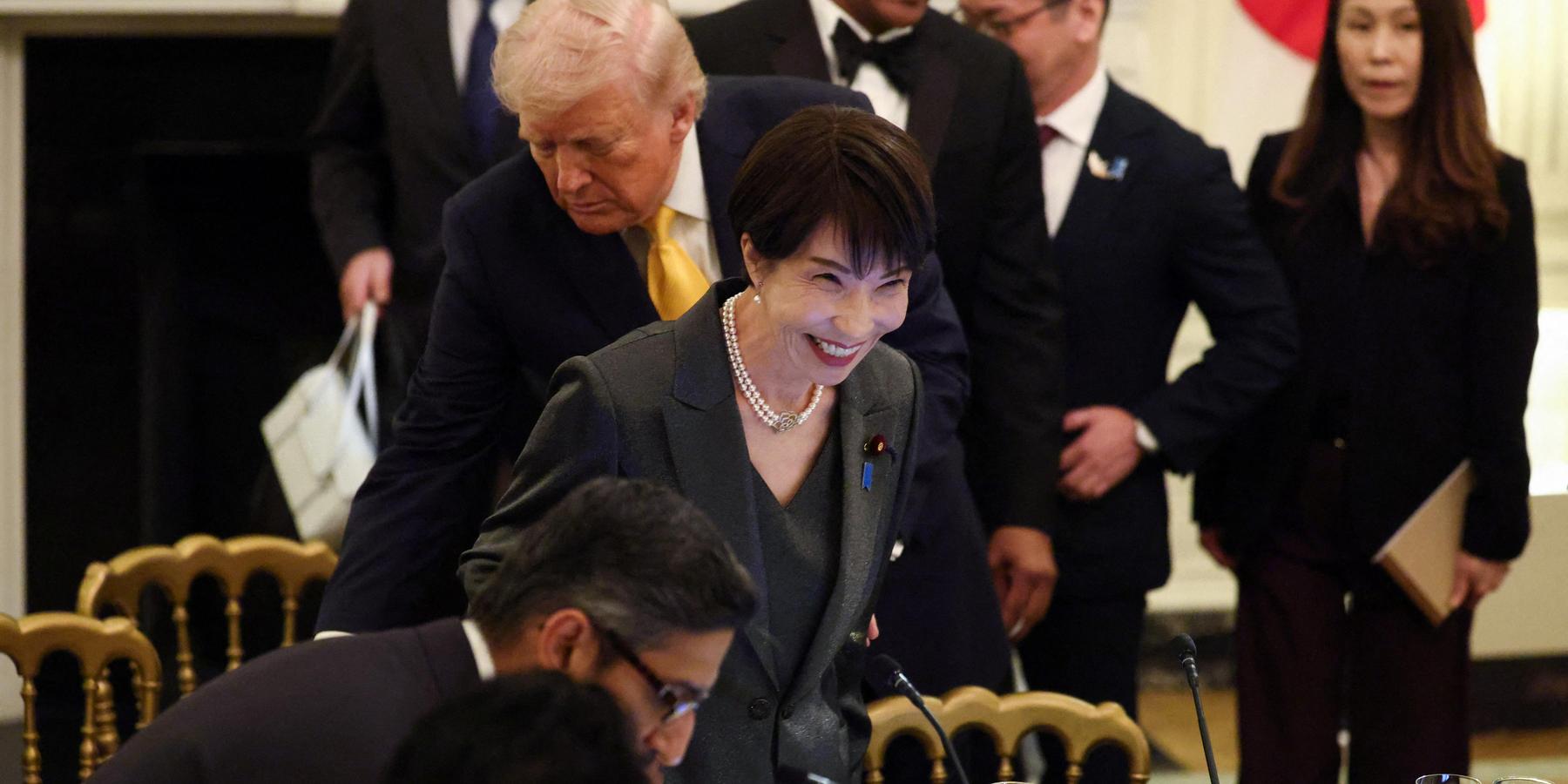
Prime Minister Sanae Takaichi’s high-stakes meeting with President Donald Trump began with a warm embrace and opening remarks that established a favorable mood.
Takaichi declared that “Donald” is the only person who can achieve peace and prosperity throughout the world, and that she intends to reach out to other countries to support his efforts. Trump congratulated Takaichi for her historic electoral victory, called her a “powerful woman,” and thanked her for all she has done.
But despite the positive atmosphere, this summit revealed the risks of Japan’s policy of clinging to the United States while allowing its relations with China to deteriorate.
Because of Japan’s assessment of the Chinese security threat, Takaichi seeks to lock-in Japan’s alliance with the United States by flattering Trump and appeasing as much as possible his demands on defense and economic issues.
When Takaichi originally requested a summit with Trump, her aim was to get reassurance from Trump before his scheduled trip to China (which has now been postponed). Last November, Takaichi’s imprudent remarks about how a Taiwan crisis could constitute a “survival-threatening situation” that might warrant a Japanese military response, triggered a sharp downturn in Sino-Japanese relations. Her statements wiped away the improvement in ties with China that had been achieved under Prime Minister Shigeru Ishiba, Takaichi’s immediate predecessor.
Rather than defending Takaichi as Japan-China tensions escalated, Trump reportedly told her in a phone call that she should tone things down because he wanted to avoid a conflict with China over the Taiwan issue. Trump’s cool response prompted Takaichi to seek assurances from Trump that he would not make deals with Xi Jinping that might undermine Japan’s interests. She also wanted to deepen bilateral cooperation to strengthen economic resilience in response to Chinese coercion.
The U.S. and Israeli war against Iran, however, complicated Takaichi’s original game plan and entrapped Japan in a severe dilemma.
On the one hand, Trump wants Japan “to step up” to help reopen the Strait of Hormuz by deploying naval vessels. From Trump’s perspective, Japan should take on this mission because Japan is more dependent on energy supplies passing through the strait than any other country. Given her landslide electoral victory in February, Takaichi ironically does not have the excuse of domestic political constraints to deny Trump’s request. Furthermore, Japan’s acute fear of China makes it hard for Takaichi to say “no” to Trump.
On the other hand, Takaichi faces strong domestic pressures not to comply with Trump. 82 percent of the Japanese public oppose the U.S. attack against Iran, and most Japanese strategic experts — including those who have stressed the importance of the U.S.-Japan alliance — believe that Trump’s war against Iran is an illegal and illegitimate strategic blunder. Japan’s legal and constitutional obstacles for deploying naval ships to a war zone are extremely high.
Furthermore, Iran has indicated that states that send naval ships to the area would be considered to have joined the American and Israeli side in this war and would be seen as hostile. Iran has, however, shown a willingness to allow oil tankers headed for countries that are not involved in the conflict and friendly toward Iran to pass through the strait. It is therefore in Japan’s energy security interests not to deploy naval ships into the area.
Although a joint press conference is usually held after U.S.-Japan summits, for some reason no Takaichi-Trump press briefing took place after their meeting. Instead, Takaichi held a solo press conference with the Japanese media on Thursday. She revealed that there was a discussion of the importance of ensuring the safety of the Strait of Hormuz and that she explained in detail what Japan can and cannot do within its legal constraints.
By refraining from mentioning at all any bilateral differences, she seemed to want to avoid giving the impression that there was any friction between her and Trump. And by not holding a joint press conference, both leaders perhaps sought to prevent the media from probing any discord between the U.S. and Japan.
So what should Takaichi do after this U.S.-Japan summit?
First, she should work energetically with other countries to facilitate an early termination of the Iran war. With the negative impact on gas prices and the strong American public opposition to the war, Trump should welcome such an effort because he wants a good off-ramp well before the November mid-term elections so that he can proclaim victory and mission accomplished.
More challenging will be convincing Iran to end the conflict. Not only does Iran want to avenge the killing of its top leaders and the death and destruction caused by Israel and the United States, it also wants solid international guarantees that it will not be attacked again and that its sovereignty will be protected. Among the G-7 countries, Japan maintains the best relations with Iran. Therefore, Takaichi should use this asset to promote serious diplomacy to explore viable ways to end this war.
Second, Takaichi should engage in proactive diplomacy to stabilize and improve relations with China. Although improving Japan’s own defense capabilities and deepening its ties with like-minded countries in Europe and the Indo-Pacific are important to counter China and to hedge against the uncertainty of the U.S. security commitment, they are no substitute for direct diplomacy with China to stabilize the regional security environment. An emphasis on military deterrence to the neglect of diplomacy will only fuel an arms race that will favor China given the asymmetry in material capabilities and China’s geographic advantages.
As a first step, the Japanese government should publicly clarify its basic stance regarding the Taiwan issue rather than simply repeating that there has been no change in policy. In addition to reaffirming the points about Taiwan made in the 1972 Japan-China normalization communique, Japan should state that it does not support the independence of Taiwan and that it supports any resolution of the Taiwan issue that is peaceful and achieved without coercion and accepted by both sides of the Taiwan Strait.
This is necessary to reassure Beijing that Tokyo is not surreptitiously seeking the independence of Taiwan or the permanent separation of Taiwan from China.
In addition, with an eye on the next Asia Pacific Economic Cooperation (APEC) summit scheduled in China in November 2026, Tokyo should expeditiously initiate discussions with Beijing on a broad range of issues. Rather than sticking to its current passive approach of simply leaving the door open for dialogue, Takaichi should dispatch to Beijing an influential political leader who is trusted by China to restart bilateral discussions. The agenda could include maintaining and strengthening a “rules-based” order, restraining the weaponization of economic interdependence, promoting stability and security of critical supply chains, cooperating more to address climate change, and enhancing confidence-building and crisis prevention measures.
Takaichi has touted that “Japan is back.” By engaging the above two diplomatic challenges, she can establish herself as one of the world’s most important leaders and upgrade Japan’s international status and influence.
- Takaichi 101: How to torpedo relations with China in a month ›
- First female Japan PM takes hawkish position on China, Taiwan ›