

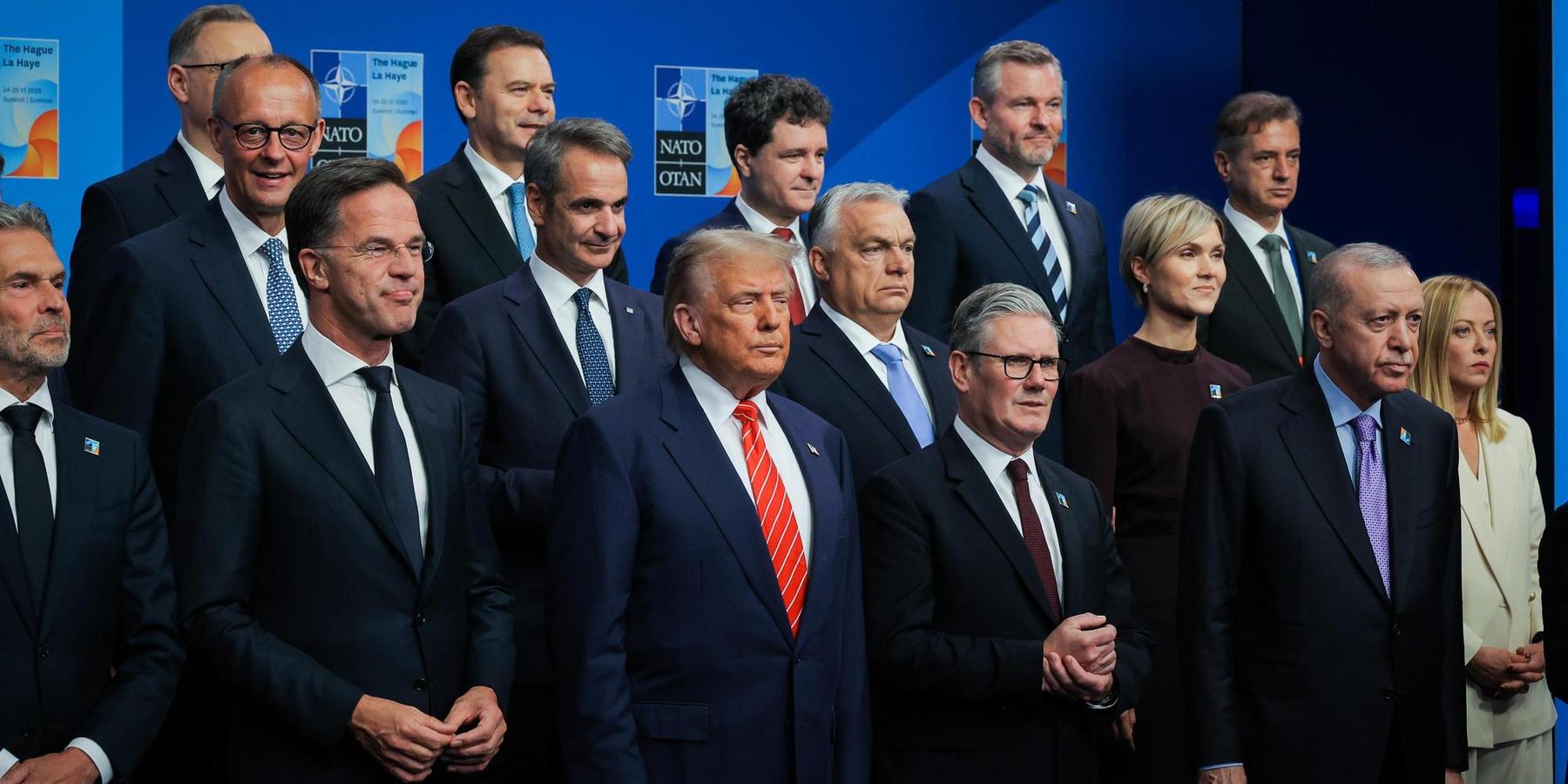
The mood ahead of NATO’s 34th summit in Ankara beginning on Tuesday can hardly be described as jubilant, and for good reason: the alliance and the transatlantic relationship underpinning it faces a crisis of purpose unlike anything in its history.
Contrary to the recriminations of European and American Atlanticists, NATO’s problems did not begin with President Donald Trump’s political ascendancy in 2016. The challenge is a structural one: namely, U.S. and European interests and priorities have increasingly diverged since the end of the Cold War.
NATO was conceived for the singular purpose of deterring a powerful Soviet rival from rolling into Western Europe. It was not built for a post-1991 world in which Europe is more than capable of managing its relationship with Russia through a prudent mix of deterrence and engagement. There is no longer any compelling reason for the U.S. to continue acting as the region’s primary security provider, especially at a time when America’s priorities are shifting to the Indo-Pacific, Western Hemisphere, and revitalization at home.
Attempts by previous Presidents to rebalance the transatlantic relationship were ill-fated because they did not fully conceptualize the problem. The nub of the issue is not that European states should spend more on defense, but that they need to take over specific functions and capabilities integral to European security.
The administration’s NATO 3.0 initiative, spearheaded by Under Secretary of War for Policy Elbridge Colby, is the first real U.S. attempt to institutionalize a framework not merely for burden sharing but burden shifting. As I explain in my new brief for the Quincy Institute, the Pentagon’s ongoing force posture reductions are an important step toward the Europeanization of European defense and should be followed by steeper cuts over the coming years, with the goal of scaling back the U.S. force presence to about 20,000 troops mainly responsible for logistics, maintenance, and other support roles.
The administration understands that retrenchment must be presented to our European partners as a fait accompli if it is to progress, as any attempt to carve out a force posture consensus within NATO will come under relentless bureaucratic and political obstruction from European leaders whose goal is to keep the U.S. in as the region’s security guarantor.
Retrenchment must be accompanied by a strict division of labor within the alliance. NATO is the North Atlantic Treaty Organization, not a North Pacific one. Any efforts to arrive at a common NATO posture on China are dead on arrival given that the U.S. and Europe are driven by entirely different sets of interests toward Beijing, and would distract NATO’s European arm from what should be its laser focus on assuming the primary responsibility for its defense.
Yet the right-sizing of U.S. commitments, though vital and long-overdue, is only one component of what it takes to revitalize the transatlantic relationship. The experience of the Ukraine war has demonstrated that the U.S. cannot sustainably retrench away from Europe while its NATO partners remain locked in an escalatory spiral with Russia. The U.S. will always be one regional conflagration away from being sucked back into European security matters unless and until it plants the seeds of long-term East-West stability.
The U.S, in keeping with the NATO 3.0 vision, should take steps to recommit the alliance to its original mandate of territorial defense within permanently drawn borders. It should be reflected in the alliance’s staffing, public messaging, intellectual output, and overall organizational ethos that NATO exists to meet the hard security requirements of its members, not to be a conduit for democracy promotion.
It is in U.S. interests to emphasize that European deterrence, in order to be effective, must be balanced with formats for pragmatic East-West engagement. If the White House is intent, as it should be, on right-sizing the U.S. military footprint in Europe, it would be a lost opportunity not to tie ongoing reductions to a larger security dialogue with Moscow aimed at extracting Russian concessions, which can include limitations to force deployments on NATO’s eastern flank, a legally binding commitment by Russia not engage in acts of aggression against NATO countries, and a dialogue on arms control.
This is both smart politics and sound policy. It is every bit in European interests to support diplomatic and deconfliction guardrails that would reduce Europe’s overall deterrence burden. By the same token, it would be easier to sell retrenchment to skeptics on Capitol Hill and institutionalize it as a mainstay of U.S. policy over the coming years if it’s part of a package for a more stable European order that involves concrete compromises by Russia.
Alliances are always a means to an end, never an end in themselves. While the U.S. derives certain geostrategic benefits from NATO, the organization has drifted from its core mission in ways that are increasingly at odds with core American interests. For the first time since 1991, there is a window for a managed recalibration of NATO that won’t just make for a more balanced transatlantic relationship but would set the conditions for peace and stability on NATO’s eastern flank.
Revitalizing the alliance will require a firm sense of strategic direction and no shortage of political will. The White House, by taking the first step, has established a foundation that should be unambiguously reaffirmed in next week’s Ankara summit and solidified over the coming years.
- Zelensky threatens Belarus as NATO hovers at edges of war ›
- Will NATO survive Trump? ›
- Trouble in Paris? There's a Gaullist cure for that American hubris | Responsible Statecraft ›
- How about a 'NATO of nations' rather than treaty of consensus | Responsible Statecraft ›