

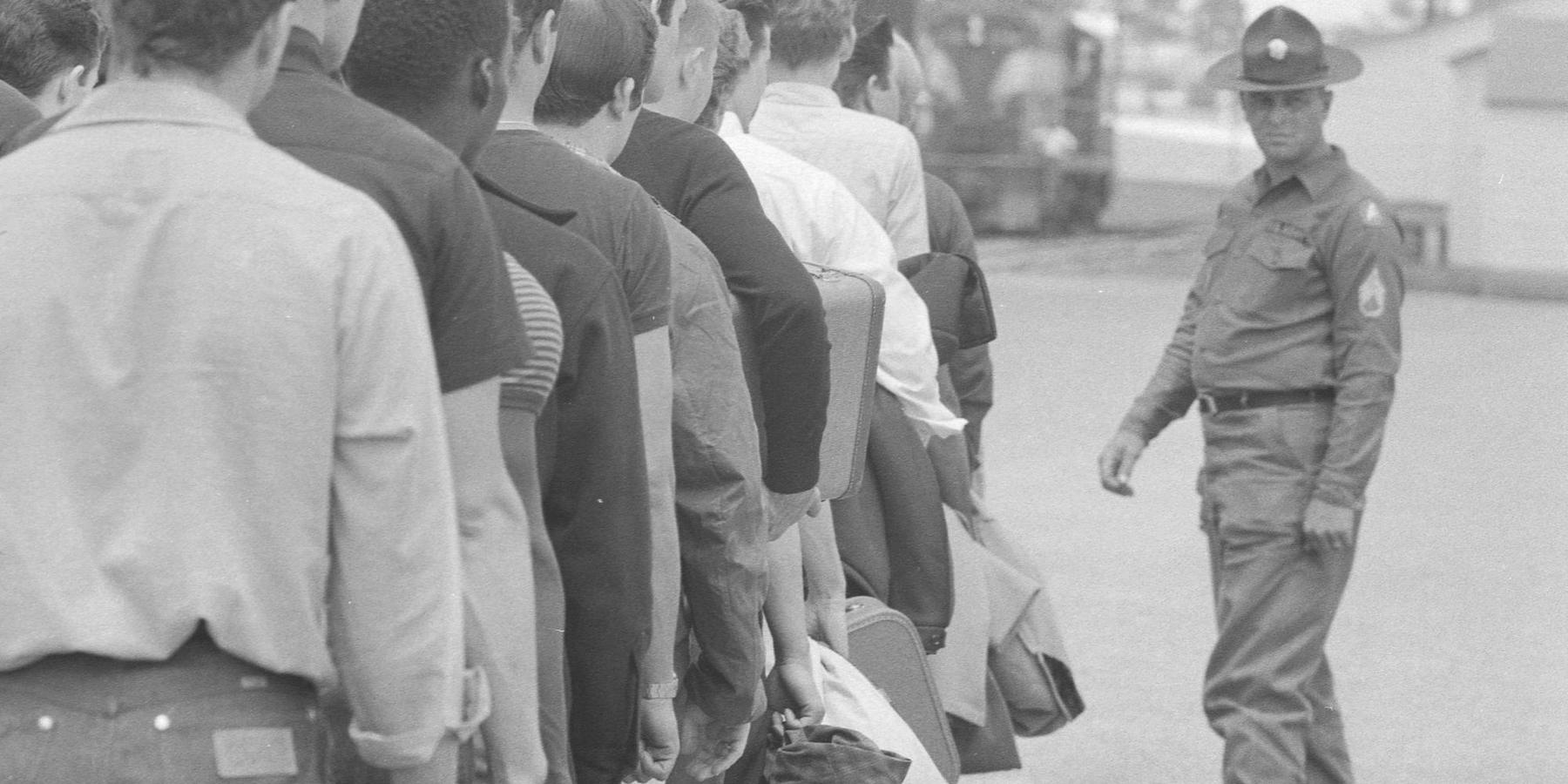
On Sunday, Fox News anchor Maria Bartiromo asked White House press secretary Karoline Leavitt about the possibility that a ground war in Iran might lead to activation of a U.S. military draft.
“Mothers out there are worried that we’re going to have a draft, that they’re going to see their sons and daughters get involved in this,” Bartiromo asked. “What do you want to say about the President’s plans for troops on the ground?”
Leavitt didn’t mention the draft specifically in her response, but said repeatedly that no option had been ruled out. Presumably those “options” included the draft, which was the focus of the question.
“President Trump wisely does not remove options off of the table,” Leavitt said. “It’s not part of the current plan right now, but the president, again, wisely keeps his options on the table.”
Leavitt’s comments highlight the ways that, even when a draft is neither likely nor feasible, military planners and politicians insist on keeping it in their playbook of “options” for military escalation and threats.
The Selective Service System (SSS) is mandated by Federal law to maintain readiness to activate either of two types of draft whenever ordered to do so by Congress and the President. In theory, the SSS has plans for either a general “cannon fodder” draft of young men, or a Health Care Personnel Delivery System (HCPDS) for men and women up to age 44 in certain medical professions.
In reality, attempting to activate either type of draft would be a fiasco. The list of registrants for a general draft is grossly incomplete and inaccurate. Draft boards that would have to make life-and-death decisions about who to send to war have received only cursory training. Many draft boards lack a quorum and would be unable to function, letting anyone who applied for a deferment or exemption off the hook if no draft board was available to adjudicate their claim.
Meanwhile, proposed regulations for the HCPDS were published in 1989 and revised in 2009 but never finalized.
To prosecute a draft resister, the government must prove to a jury, beyond a reasonable doubt, that any violation of the Military Selective Service Act is “knowing and willful.” If a draftee knows not to sign for any certified letters or make incriminating public statements, they can ignore induction orders with impunity unless and until they are individually served by a U.S. Marshal or FBI agent.
This year the SSS is preparing for the largest change in its operation since 1980. In response to plunging compliance with the requirement for men ages 18-25 to register and report all changes of address to the SSS, Congress has directed the SSS to try to register potential draftees “automatically” by using data obtained from other Federal agencies.
This change in the law was enacted without hearing, debate, or any budget review, and takes effect in December 2026. It will require new regulations and notices and one of the largest and most complex data aggregation and matching programs in Federal history. SSS data sharing is drawing criticism even before the launch of “automatic” draft registration.
But none of the necessary rules or notices for “automatic” draft registration have been published yet, and no money for this project is included in this year’s SSS budget. Much of the information that would be needed to identify and locate all potential draftees isn’t in any current Federal database.
Therefore, “automatic” registration will produce a list that’s just as inaccurate and incomplete as the current “self-registration” system. The list it does produce will be vulnerable to weaponization and misuse. Enforcing a draft will prove just as impractical as enforcing registration has been.
The lengths to which Congress is willing to go to try to salvage a failed Selective Service System are indicative of the importance war planners place on claiming to be “ready” for a draft – even if an actual draft is and will remain a political and practical non-starter.
Under both Democratic and Republican administrations, military planners from the Pentagon, the SSS, and hawkish think tanks have argued that ongoing preparation for a draft is needed as a “fallback” for scenarios such as an invasion of the mainland U.S. by China or a land war in Central Asia that would immediately require an additional 100,000 “bodies” to bolster U.S. active-duty forces.
What’s really at stake in this debate over the “need” to be prepared for a draft is whether it should be possible — and whether it’s desirable — for war planners to contemplate wars like these without having to think about whether enough Americans will volunteer to fight them.
Perceived or pretended availability of a draft as a “fallback” enhances the ability of U.S. war planners and policy makers to threaten or commit the country to larger, longer, less popular wars and more rapid military escalation. Having a draft available also encourages the president and commander-in-chief to be quicker and less thoughtful in resorting to military means to resolve diplomatic disputes.
In situations like these, a fallback draft serves as part of the arsenal of military escalation and threats.
President Trump’s insistence on keeping a draft “on the table” as an option is dangerous but, sadly, nothing new. Its dangerousness is indicative of why it’s so important to do precisely what he doesn’t want: take the draft off the table as an option by abolishing the Selective Service System.- Summer of the draft: What govt and think tanks are planning and why ›
- Congress quietly moves US closer to military draft ›
- Did Caine just announce the Morgenthau option for Iran? ›
- Vast number of Trump voters want him to declare victory and get out | Responsible Statecraft ›