

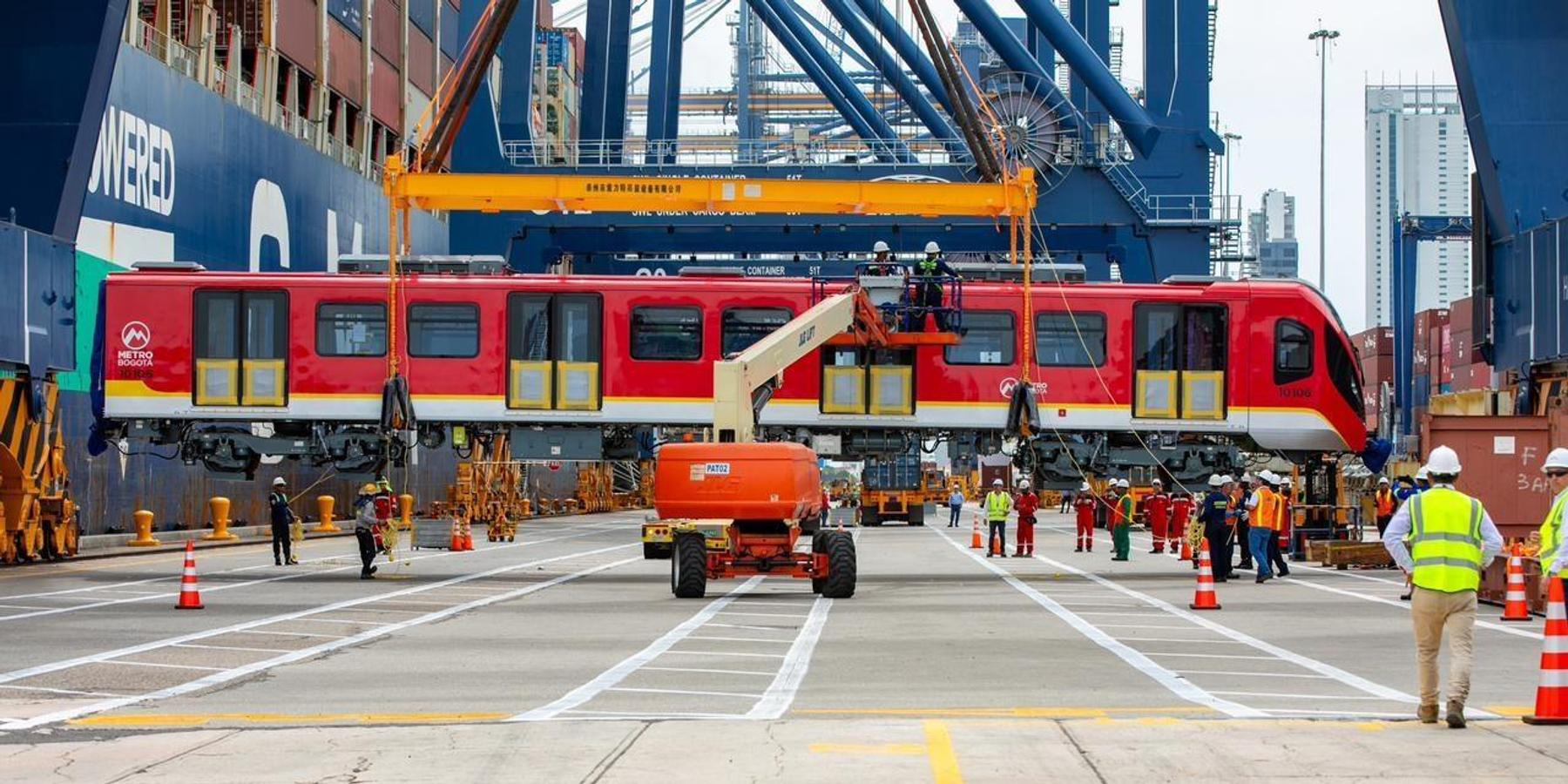
On May 22, the first train of Bogota’s new metro system made its initial trial run on the 15-mile elevated viaduct for Line 1. The line runs all the way from the southwestern part of the Colombian capital to Avenida Caracas, with a total of 16 stations.
This marks a milestone in a project set to revolutionize the city’s public transport. Long accustomed to some of the worst traffic jams in Latin America, bogotanos can now look forward to shorter and more comfortable commuting times, on thirty electric trains with capacity for 1800 passengers each that will run in a line that is set to be inaugurated in 2028.
But Bogota’s new subway also marks another first: this is the first such system in Latin America to be entirely designed, built and operated by a consortium of Chinese companies. Led by China Harbor Engineering Company (CHEC), the group won the bid for the project with an initial cost of $4 billion, expected to rise to $5.8 billion with various additions, in an open tender in October 2019. This is the biggest infrastructure project in Colombia in a long time and presently employs 15,000 workers.
Chinese companies have won bids to provide train cars for the Mexico City, Sao Paulo and Buenos Aires metro systems, and are involved in the building of a new line in Santiago. With over 4000 electric buses of Chinese manufacture (mostly from Shenzhen-based BYD), Santiago prides itself as being the city outside China with the largest number of e-buses. These buses can also be found in Bogota, Mexico City, Sao Paulo, Quito, Montevideo and elsewhere. In short, Chinese companies and transport technology are revolutionizing mobility in Latin American cities, traditionally known for long commutes, heavy pollution from smoke-belching diesel buses, and deafening noise.
In the 2000s, it was the rapid rise of trade between China and Latin America that mainly drove links between the region and Beijing. In the following decades, trade has been joined by investment and various infrastructure and energy projects, as well as power-generating and distribution initiatives and e-vehicle factories. These are making a significant impact on the quality of life of Latin Americans. In Santiago, the fact that 68% of the bus fleet is now electric has led to an 80% reduction in the emissions of Fine Particulate Matter, a two-thirds noise reduction in the city’s main thoroughfare, and the saving of 60 million liters of diesel fuel.
Not surprisingly, in a 2026 AMLAT poll conducted in ten Latin American countries on the perceptions of the role of various foreign powers in the region, China is the only country that has improved its image since 2021-2022. In fact, China has displaced the United States as the region’s preferred development model and is also seen as the preferred partner in areas like education, science and technology.
A total of 36.1% of those polled now consider China as their preferred development model, while 31.5% prefer the U.S. In turn, the United States is considered the most significant military and economic power, but its standing has considerably deteriorated under the Trump administration, with a 28 point drop in the approval rating of U.S. policies since 2021-2022. This drop reaches as much as 65 points in the case of Mexico, and 34 points in the case of Colombia. In the battle for the hearts and minds of Latin Americans, the United States is clearly losing ground.
Revealingly, a vast majority of those polled reject the notion of a new Cold War between the United States and China and do not want their countries to take sides in this great power competition. They are keen for their nations to diversify their foreign links and to collaborate with all great powers and with the Global South.
In the wake of the recent summit between President Donald Trump and Chinese leader Xi Jinping in Beijing, U.S. policymakers should rethink a key aspect of their approach to Latin America under Trump, namely, the effort to exclude China as much as possible from the region. This is a self-defeating strategy that is eliciting much pushback. Moreover, it stands in stark contrast to the message conveyed by Trump in Beijing, which was all about the many business opportunities offered by improved bilateral relations and how Washington and Beijing should make the most of them. This conciliatory tone is very different from Washington’s hostility toward Latin America’s dealings with China.
One can understand U.S. reservations about, and opposition to, the military presence of extra-hemispheric powers in the Americas, a reasonable concern with a long history. What is untenable, however, is for Washington to rail against China’s highly effective investments in Latin America while professing its own keenness to do business with China, secure more access to the Chinese market for U.S. companies, and attract more Chinese investment in the United States.
This is not a proposition based on any kind of legitimate U.S. security interest, or even national interest. It is simply an effort to impose U.S. commercial interests on the region. There is no reason Latin American countries should take it at face value. In order to access the continent’s many valuable natural resources and commodities, gain access to its markets, and contribute to its industrialization, great powers must embrace competition, not exclusion. What the U.S. has been doing until now is not only failing but is in fact backfiring.
A U.S.-China détente of sorts, if it comes to pass, should be welcomed by all. What should not be in the cards, though, is for the United States to play footsie with China while attempting to block Latin America from doing business with the Asian giant.
- Why Ecuador went straight to China for relief ›
- How US incompetence empowers China in Latin America ›