

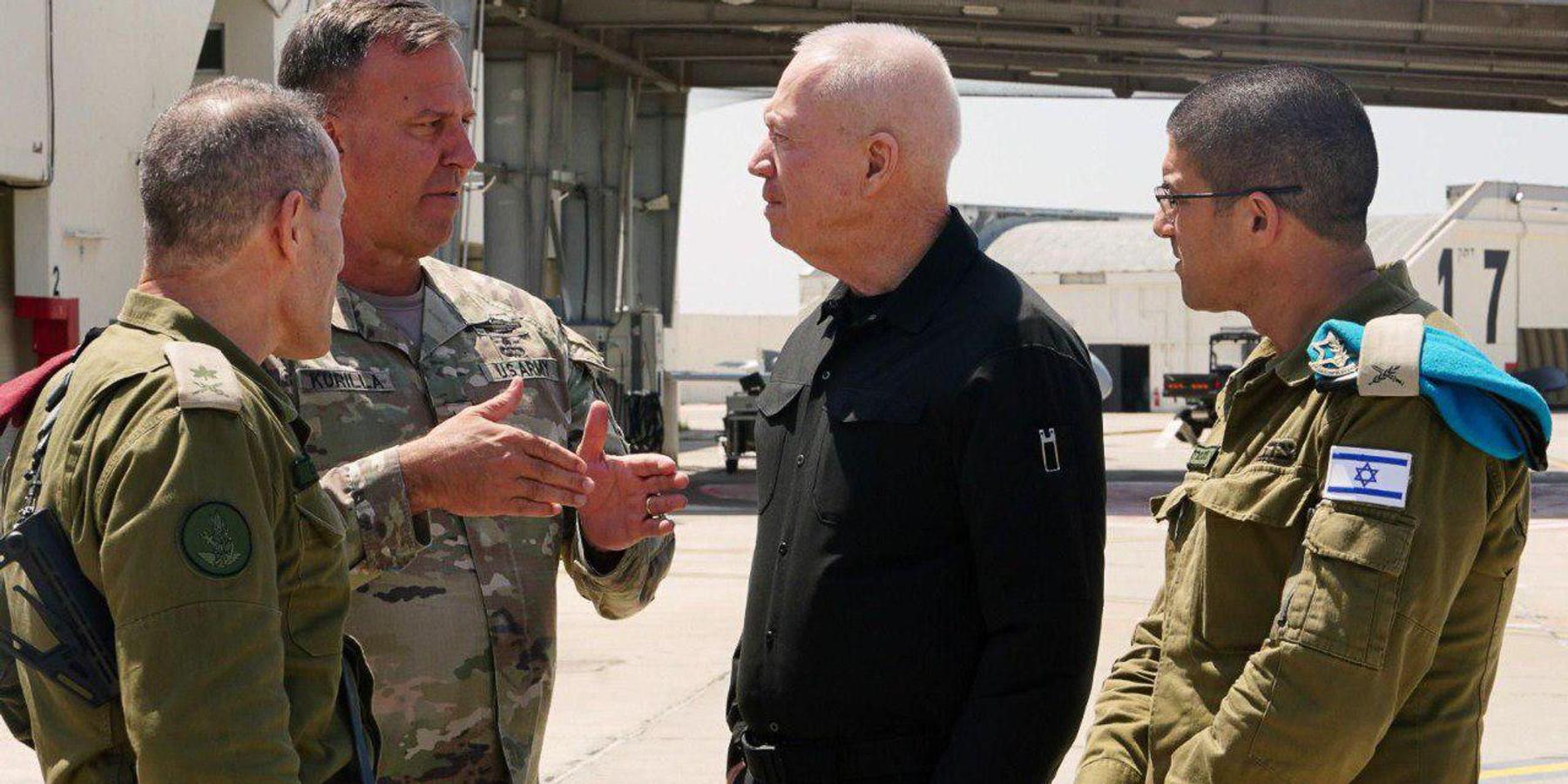
Known as “one of Israel’s staunchest allies in the American defense establishment,” Ret. Gen. Michael Erik Kurilla, who just retired from his post as head of U.S. Central Command last summer, will feel right at home presenting the keynote at the Israeli-American Council's "Strength in Unity" gala tonight.
According to Jewish Insider's morning newsletter, others speaking at the event will include pro-Israel megadonor Miriam Adelson and former Mossad Deputy Director Henrike Weissberg. The gala is part of the Israeli-American Council's national conference, which also features speeches from Senate Minority Leader Chuck Schumer (D-N.Y.), House Minority Leader Hakeem Jeffries (D-Del.), and Rep. Nancy Pelosi (D-Calif.).
Pentagon insiders largely credited Kurilla with promoting what would become "Operation Midnight Hammer" — a surprise attack on Iran during nuclear negotiations — in June 2025.
Earlier that spring, Israel news outlet Ynet coined him as “The U.S. general Israel doesn’t want to strike Iran without.” As I wrote for Responsible Statecraft at the time, Kurilla's relationship with Israel “runs deep,” dating back to his time as a young officer in his 20s.
“He’s a hawk of hawks,” noted Curt Mills, executive director of the American Conservative, at the time. “(The Israelis) knew they were losing an ally soon. They knew the negotiations (with Iran) were ongoing. The Iranians had signaled that they were close to accepting a deal days before the strike. So all of these things were a factor."
"And then meanwhile, I think there's every piece of evidence that Kurilla would at least start the conflict and pop his cork on it before he leaves.”
His commitment on this score did not go unnoticed. When Israeli Prime Minister Benjamin Netanyahu came to Washington in July 2025 after the bombings, he feted Kurilla in a dinner at Blair House, the storied guest residences of the White House.
Netanyahu, according to Jewish Insider reporting on the event, said Kurilla is a “commander without peer” whose successor would have “gigantic shoes” to fill, adding that Kurilla’s support has been “truly remarkable.”
Netanyahu then presented Kurilla with a sculpture made from a piece of an intercepted Iranian missile, featuring a map of Israel, a tree and a dove of peace, which Netanyahu said symbolized “peace through strength," according to Jewish Insider.
His successor, Adm. Bradley Cooper, may not fill the same space in Israeli hearts as Kurilla, but he oversaw the second Feb. 28 attack, Operation Epic Fury, which Trump Administration officials said was initiated in part because the Israelis were threatening to do it themselves, first.
The Israel-American Council, meanwhile, is heavily funded by Adelson, and it has a political lobbying arm that works to oppose anti-Israel boycotts (BDS) and has promoted war with Iran. It has been called a rival of AIPAC for influence on Capitol Hill and in the two major parties. They have had major Democrats and Republican figures speak at their national conferences, including Pelosi, Schumer, President Donald Trump, and former Vice President Mike Pence.
Kurilla is not the first CENTCOM commander to be associated with a hawkish pro-Israel organization. His predecessor, Gen. Frank McKenzie, Jr., who led CENTCOM from 2019 to 2022, accepted an endowed fellowship at the Jewish Institute for National Security of America (JINSA) in 2024. When it announced McKenzie's fellowship, JINSA, which has long promoted an aggressive military posture toward Iran, highlighted the general's role in the "killing of Iran's Quds Force commander General Qassem Soleimani" in January 2020.
It is not clear what Kurilla will talk about at the glittering ceremonies in New York tonight. Aside from standing shoulder to shoulder with Israel in shared Middle East military policy, Kurilla was integral to the integration of Israel into CENTCOM, which began in 2021. Israel used to be in European Command (EUCOM). But, as one Israeli military analyst put it, "profound changes in the Middle East — chief among them the expansion of the Iranian threat and progress in normalization processes with Israel toward the end of the second decade of the millennium — undermined this organizing logic and led to a fundamental change in the Unified Command Plan."
In other words, the U.S. could work more closely in the efforts to advance "their" interests in isolating Iran. Former U.S. envoy and longstanding neoconservative Elliott Abrams put a finer point on it:
We’re used to saying that the sort of key organizing event in the region in the last few years — say, ten years — may be the Abraham Accords, but I would argue — I can make a good case for, no, it’s the inclusion of Israel in CENTCOM, because that has led to a kind of reorganization of the relations — and not only military, but intelligence and to some degree political — that includes countries that are not involved in the Abraham Accords. It includes just about everybody except Iran.
Kurilla was the perfect man for the job, and there is a reason why he is considered Israel's favorite commander and is feted by Netanyahu and Adelson, both of whom had aggressively pushed for the war we are in today.
Post retirement, Kurilla has got it pretty good by all accounts. Today he works as a senior adviser at Lazard, which provides geopolitical risk counsel to corporate executives and company directors.
- Did the US only attack Iran because of Israel? ›
- Is Israel's favorite US general helping to push us into war? ›
- Meet the US generals and admirals advancing Israeli policy | Responsible Statecraft ›