

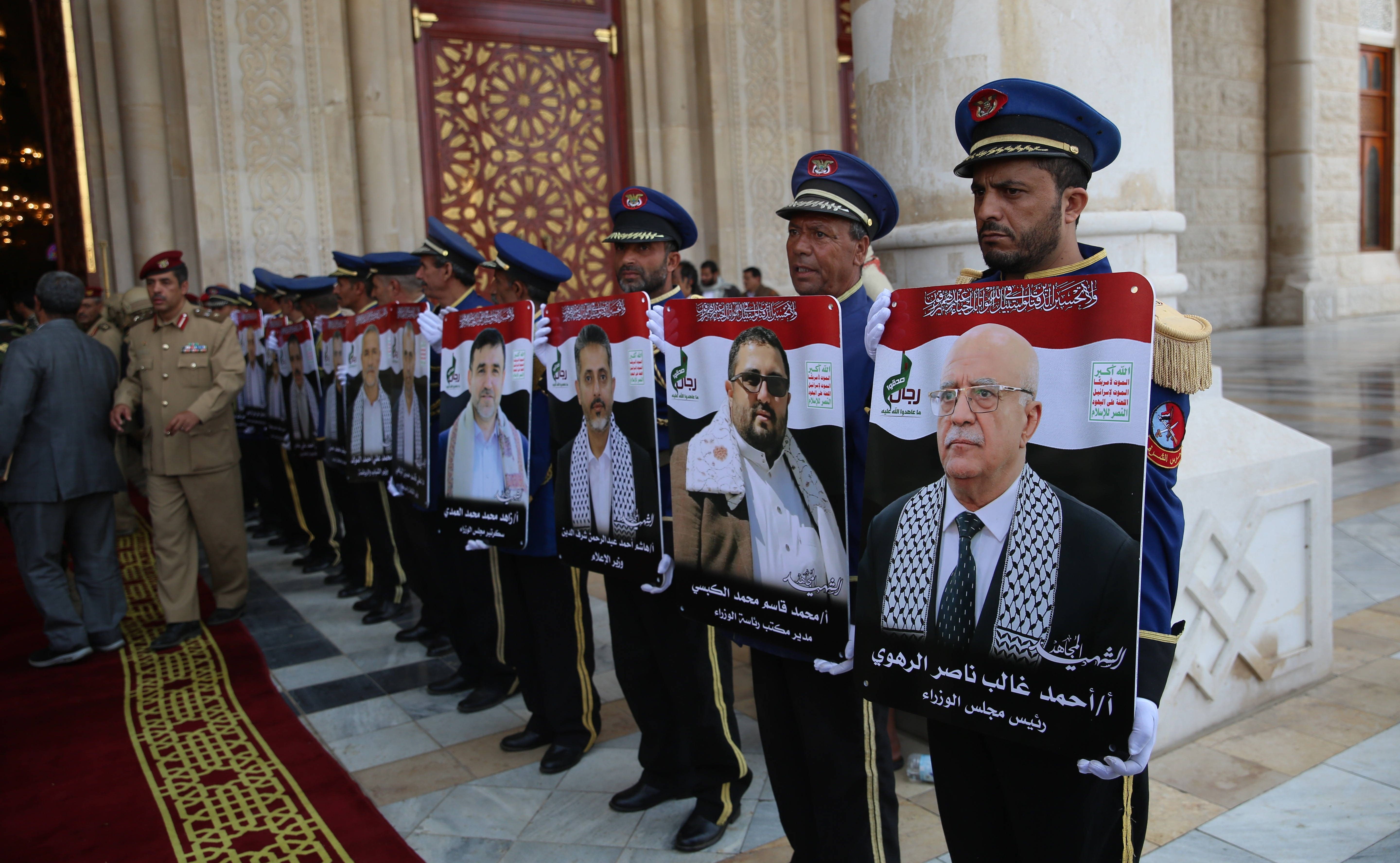
“The war has entered a new phase,” declared Mohammed al-Bukhaiti, a senior official in Yemen’s Ansar Allah movement, after Israeli jets streaked across the Arabian Peninsula to kill the group’s prime minister and a swathe of his cabinet in Yemen’s capital, Sana’a.
The senior official from Ansar Allah, the movement commonly known as the Houthis, was not wrong. The strike, which Israel’s Defense Minister Israel Katz promised was “just the beginning,” signaled a fundamental shift in the cartography of a two-year war of attrition between the region’s most technologically advanced military and its most resilient guerrilla force.
The retaliation was swift, if militarily ineffective: missiles launched towards Israel disintegrated over Saudi Arabia. Internally, a paranoid crackdown ensued on perceived spies. Houthi security forces stormed the offices of the World Food Programme and UNICEF, detaining at least 11 U.N. personnel in a sweep immediately condemned by the U.N. Secretary General.
The catalyst for this confrontation was the war in Gaza, unleashed by Hamas’s October 7 attacks on Israel, which provided the Houthis with the ideological fuel and political opportunity to transform themselves. Seizing the mantle of Palestinian solidarity — a cause their leader, Abdul-Malik al-Houthi, frames as a “sacrifice in the cause of God Almighty ” — they graduated from a menacing regional actor into a global disruptor, launching missiles toward Israel just weeks after Hamas’s attacks and holding one of the world’s most vital shipping lanes hostage.
The chessboard was dangerously rearranged in May, when the Trump administration, eager for an off-ramp from a costly and ineffective air campaign, brokered a surprise truce with the Houthis. Mediated by Oman, the deal was simple: the U.S. would stop bombing Houthi targets, and the Houthis would stop attacking American ships. President Trump, in his characteristic style, claimed the Houthis had “capitulated” while also praising their “bravery.”
The deal was, in reality, a propaganda victory for the Houthis, allowing them to claim they had faced down a superpower and emerged unshaken. For the U.S., it was a transactional exit that prioritized halting expenditure over achieving the previously stated goal of “annihilating” the group. Crucially, the deal was cut without consulting Israel or the internationally recognized Yemeni government, leaving both parties exposed.
For Israel, the unilateral American move meant that it was left to face the Houthi threat alone. For Yemen’s Presidential Leadership Council (PLC), the fractured entity that constitutes the internationally recognized government, it was a devastating blow. Yemeni Vice Foreign Minister Mustapha Noman captured the government's surprise and despair, telling PBS he came to Washington in May with questions and was "leaving with more of them.”
The American withdrawal from direct conflict did not bring peace by any measure. Instead, it created a permissive environment for escalation between the Houthis and Israel, transforming a distant problem for Washington into an open-ended strategic challenge for its closest regional ally.
The strike on the Houthi cabinet meeting in late August was a demonstration of Israel’s formidable intelligence reach, but the significance of the targets is a matter of debate. The slain prime minister, Ahmed al-Rahawi, was largely a political figurehead — the Houthi government’s civilian "décor," as one analyst termed it — and not a member of the secretive ideological and military command that constitutes the movement's true center of gravity.
Nonetheless, the assassinations represent a serious escalation, one that not only sees Israeli strikes systematically target the country’s already crippled infrastructure — from ports to power stations, deepening the humanitarian crisis with every salvo — but also one that forces Israel to contend with a distant, resilient foe that has a high tolerance for casualties and a proven ability to adapt. Unlike the contained battlefields of Gaza or southern Lebanon, Yemen is a vast, mountainous country where the Houthis have perfected the art of concealment and asymmetric warfare.
An air campaign alone is unlikely to defeat them, a lesson etched in the wreckage of a seven-year Saudi-led intervention. Launched in 2015 to reverse the Houthi takeover of Sana’a, the capital, and restore Yemen's internationally recognized government, the coalition's campaign devolved into a brutal war of attrition. It failed to achieve its strategic objectives and ended with a Saudi-led and UAE-supported truce with the Houthis in 2022.
Washington was merely the latest to relearn this lesson during its own brief and ultimately futile aerial war. With air power proven futile and a ground invasion logistically and politically unthinkable, Israel is left with no viable military path to victory.
Furthermore, engaging the Houthis directly drains resources and focus from Israel’s primary obsessions: Hamas in Gaza as well as Iran and its nuclear program. The Houthis understand this; they are waging a war of economic and psychological attrition, knowing that even symbolic strikes, like the missile that reached the outskirts of Ben Gurion Airport close to Tel Aviv, have negligible military effects but deliver immense political dividends. It allows them to unite Yemenis under a popular cause, project an image of heroic resistance to the wider Arab audience, and crucially, distract from their own governance failures.
For Israel's current leadership, this is no longer a war of containment but a grander crusade, a mission to dismantle “the axis [of resistance] brick by brick” as Prime Minister Benjamin Netanyahu put it. The strategy behind Israel's intensification of its war with the Houthis was made explicit when, just a day after killing the Houthi prime minister in Sana’a, an Israeli airstrike in Gaza City killed Abu Obeida, the masked spokesman for Hamas.
For Israeli policymakers, the back-to-back assassinations were a demonstration of a long-held strategic conviction that they are fighting on multiple fronts, but the same enemy. This view was articulated by Netanyahu as far back as 2014, when he warned of "militant Islamists" driven by a "master faith" vying for regional supremacy. After two years of war in Gaza and a direct 12-day clash with Tehran, the Houthi front is becoming an increasingly integral part of this existential, multi-front campaign.
But the consequences of this strategy are profound and are already shattering Yemen's fragile political landscape. The direct entry of Israel into the conflict has rendered the official Yemeni peace process effectively obsolete. The U.N.-backed roadmap, a framework designed to coax Ansar Allah into a nationwide ceasefire and an “inclusive political process” with other Yemeni factions was already on life support. It is now a historical document, its terms irrelevant to the post-October 7 reality of a fully regionalized war.
The Yemeni civil war’s center of gravity is no longer the internal power struggle but the growing showdown between the Houthis and Israel. This shift has been catastrophic for the anti-Houthi coalition. Indeed, the PLC, established in Riyadh in 2022 to unify disparate factions and serve as the executive leadership of the internationally recognized government, is collapsing under the weight of its own contradictions.
Recent months have seen public spats and demands for a rotating presidency, reflecting a deep power struggle between its Saudi-backed chairman, Rashad al-Alimi, and a UAE-backed bloc that includes the secessionist Southern Transitional Council leader Aidarous al-Zubaidi and military commander Tareq Saleh. This paralysis prevents any coherent political or military strategy against the Houthis, leaving them unchallenged as the de facto authority in northern Yemen.
The result is a strategic dead end from which there is no clear exit. With the political path rendered irrelevant and the military path foreclosed by the anti-Houthi coalition’s own fractures, the internal logic of the Yemeni conflict has become fully subsumed by regional animosities.
In this vacuum, Israel finds itself tied to a conflict it cannot win, the U.S. has carved for itself a narrow peace at the cost of broader instability, and the factions of Yemen’s shattered state are left to fight over the scraps. The escalating confrontation with Israel has only served to entrench the dominance of Ansar Allah, the sole beneficiary of this new, chaotic order.