

Israeli Prime Minister Benjamin Netanyahu announced late last month that he had ordered the Israeli military to seize 70% of the Gaza Strip.
Under President Donald Trump’s 20-point ceasefire plan, Israeli forces were required to withdraw to a zone encompassing roughly 50% of Gaza’s territory, demarcated by the so-called Yellow Line, ahead of further withdrawals in the future. Instead of retreating, however, the Israeli army has steadily expanded its area of control, which now stands at roughly 60% of Gaza, while leveling the areas under its occupation to the ground.
Indeed, despite a so-called ceasefire, Israel continues to carry out near daily attacks on Gaza — at least 932 people have been called since the ceasefire was announced — while heavily restricting the entry of aid.
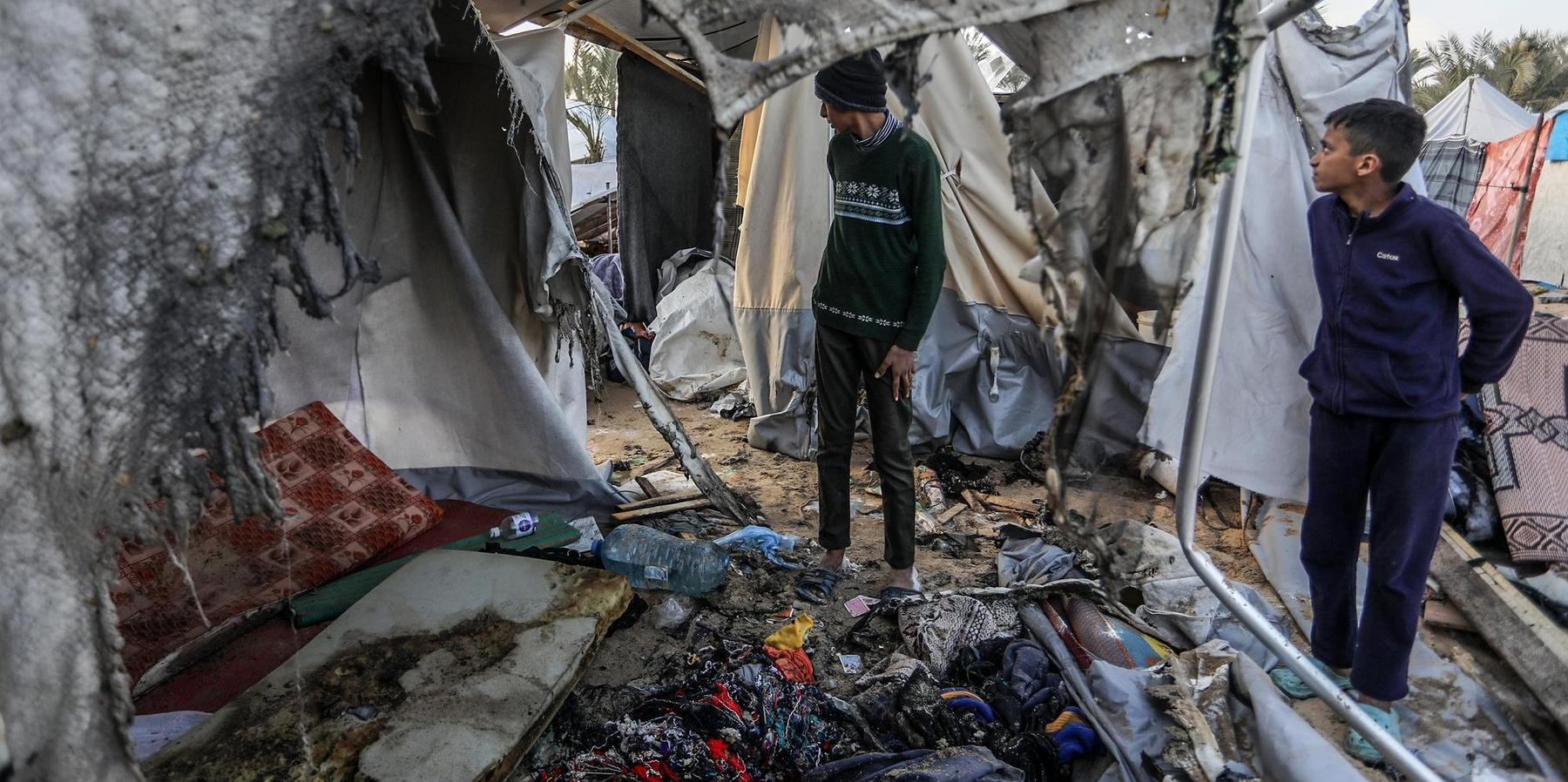
So what does it mean to squeeze more than two million people into 30% of the already tiny Gaza Strip? It is a direct and deliberate policy of slow death, one that forces the population into an overcrowded and ever-shrinking open-air prison that lacks even the most basic conditions to sustain life. The plan Israel is implementing in Gaza is not the Trump Plan but a plan to make Gaza permanently uninhabitable.
Prior to the war, the Gaza Strip had an area of about 140 square miles and a population of roughly 2.2 million people, making it one of the most densely populated territories in the world. If around 2 million people are squeezed into only 30% of the territory, density rises to more than 46,000 people per square mile; if the full pre-war population is counted, it approaches 52,000. These basic figures are consistent with the World Bank's latest rapid damage and needs assessment (RDNA) and with the wider demographic reality of Gaza before the war.
For comparison, population density per square mile is about 230 people in Morocco, 320 in Egypt, 100 in the United States, 390 in China, 750 in the United Kingdom, around 1300 in India, and about 1000 in Belgium. Even before the war, Gaza’s population density already exceeded any of these at 16,000 people per square mile. What is being imposed now is the compression of an entire society into a space that can no longer support life, services, dignity, or social order. This is nothing short of demographic suffocation.
The Israeli plan for controlling 70% of the territory — up from 50% in October 2025 — will turn the remaining 30% into a pressure cooker. The occupied and inaccessible areas include much of Gaza’s agricultural land, especially around Beit Hanoun, Beit Lahia, Deir al-Balah, Khan Younis and Rafah. These lands are Gaza’s food basket. They also include water wells, desalination projects, wastewater facilities, roads, warehouses and open public land needed for future expansion.
The U.N. summary of the RDNA estimates recovery and reconstruction needs at $71.4 billion, including major needs in agriculture, health, education and sanitation. But without land, even the best-funded reconstruction plan becomes a spreadsheet without geography.
The humanitarian reality is already catastrophic. According to the RDNA, more than 1.9 million Palestinians have been internally displaced, many several times, and more than 1.2 million people have lost their homes. Fewer than half of hospitals and less than 38% of primary healthcare centers are even partially functional. Around 728,000 school-aged children and youth have been out of formal education for more than two years. At least 41,844 people are estimated to be living with life-changing injuries requiring long-term rehabilitation, and over 68 million metric tonnes of debris must be removed.
Under these conditions, the absence of cemeteries is one of the cruelest indicators of social collapse. Families in Gaza have already been forced to bury their dead in informal graveyards, empty lots and makeshift spaces because major cemeteries were damaged, inaccessible or full. A society that cannot find space to bury its dead cannot be expected to build schools, clinics, playgrounds, water tanks, greenhouses, factories or homes. Even death becomes displaced.
This is why the question of land cannot be separated from health, education and social behavior. Gaza’s population grows by roughly 60,000 people each year. Under normal circumstances, the territory would need dozens of new schools annually, additional hospitals and clinics, more cemeteries, more sports facilities, more wastewater treatment capacity, and more public space. Today, Gaza must do all of that while rebuilding hundreds of destroyed or damaged schools and hospitals, tens of thousands of homes, and the economic base that once allowed families to survive without total dependence on aid.
The loss of schools is not only an educational problem. Schools regulate time, protect children, transmit civic norms, and give adolescents a reason to imagine a future. When schools disappear, the street, the shelter, the armed group, the black market and the phone screen become alternative institutions.
This environment is fertile ground for violence, hatred and extremism — not because Gazans are naturally violent, but because engineered deprivation produces social pathologies. Overcrowded shelters and informal camps concentrate exhausted families in spaces where privacy is absent and resources are scarce. PalThink’s research on displacement and survival in Gaza describes how mass displacement has torn family and neighborhood bonds and replaced many patterns of solidarity. When this condition continues for months and years, it becomes very difficult to contain.
The most dangerous outcome is not only humanitarian collapse, but the formation of a generation raised without school, reliable health care, employment, public space, justice institutions, or a credible political horizon. Such a generation will not simply wait patiently for reconstruction conferences. Some will withdraw into despair. Some will search for revenge. Some will be recruited by radical actors. Some will turn against their own society. Others will try to leave. These are the predictable outcomes of compressing life until it becomes unlivable.
It is in this light that one should read Israeli Defense Minister Israel Katz’s recent calls for “voluntary migration” from Gaza, to be implemented “at the proper time and in the proper manner.” Indeed, Israeli authorities have created an official government agency to advance such departures. The sequencing of Israeli actions suggests clear intent: first make return impossible, then make life unbearable, then present departure as voluntary.
If two million people are denied land, water, schools, hospitals, jobs, safe homes and even cemeteries, the final destination will be a mass exodus.
The policy conclusion is straightforward. Preventing mass displacement begins with ending the policy of territorial compression inside Gaza. Palestinians must regain access to their land, including agricultural areas, public land and infrastructure sites. Reconstruction must be allowed where people actually lived, not only in overcrowded containment zones. Schools, hospitals, cemeteries, water systems and municipal services must be treated as security infrastructure, because without them no society can remain governable.
In 2012, the United Nations warned that Gaza could become unlivable by 2020. That warning now reads like an understatement. Amid the destruction of war, the loss of homes, the collapse of services and the shrinking of available land and resources, Gaza is not merely facing a humanitarian catastrophe but an imposed and politically engineered geography of non-life.
The occupation of 70% of the already tiny Gaza Strip is not merely the occupation of land. It is a policy aimed at the destruction of all means of life within a confined enclave. If this continues, the question will not be whether people leave but how many will be forced to choose the sea.
- Israel’s foreign influence is the most unrelenting in US history ›
- Why the plan to disarm Hamas is destined to fail ›