

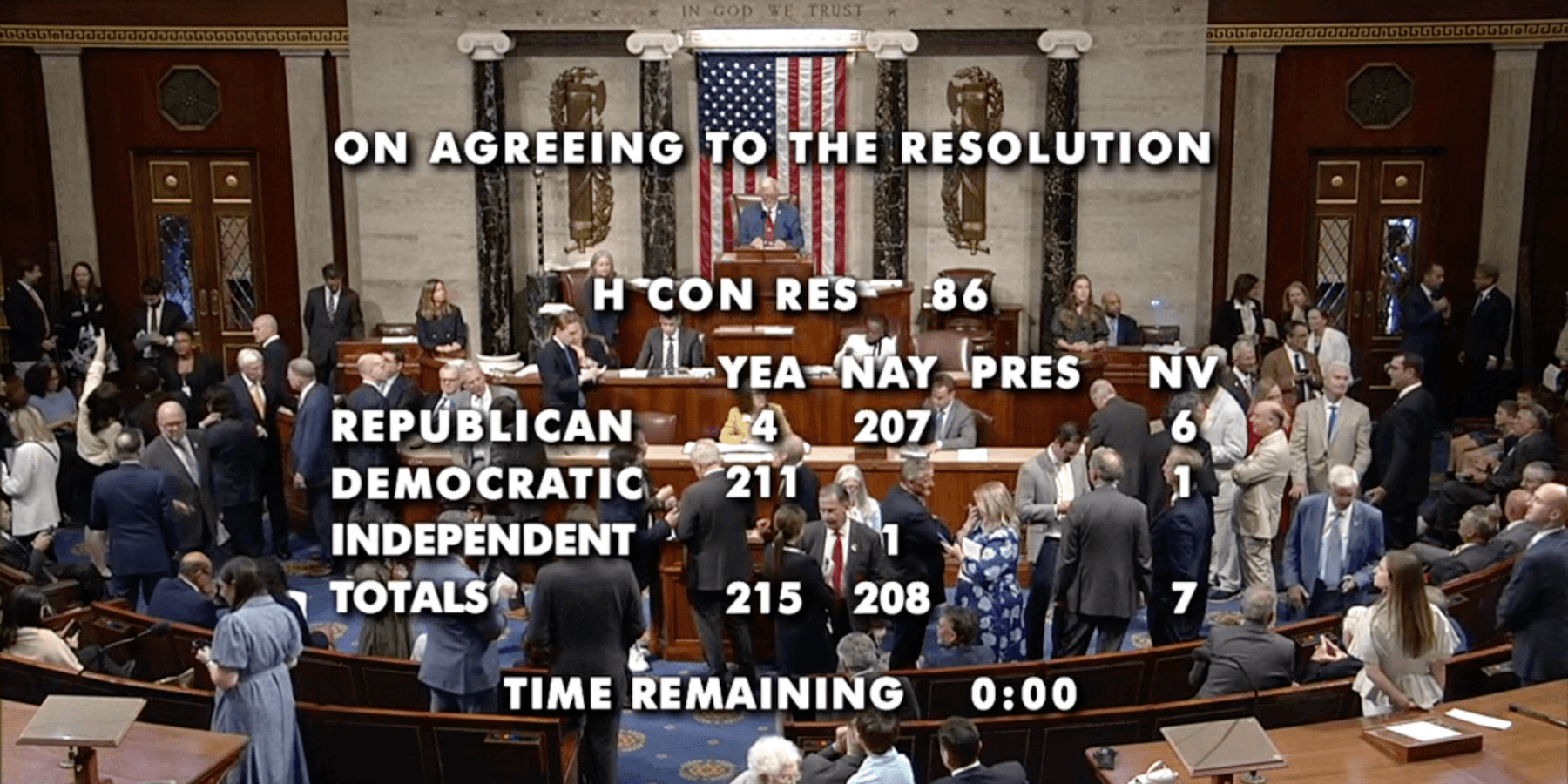
The House of Representatives successfully passed a resolution Wednesday that would direct President Donald Trump to remove U.S. armed forces from hostilities with Iran absent congressional approval.
The legislation passed by a vote of 215-208, with all Democrats voting in favor. They were joined by four Republicans. Seven members, including six Republicans, missed the vote.
“A War Powers Resolution to end the war in Iran just passed the House! The American people are tired of presidents abusing their power by spending billions of our taxpayer dollars on unnecessary wars.,” Rep. Mark Pocan (D-Wis.) wrote on X following the vote. “I urge the Senate to quickly pass this bill to end Trump’s illegal war in Iran.”
Reps. Thomas Massie (R-Ky.), Tom Barrett (R-Mich.), Warren Davidson (R-Ohio), and Brian Fitzpatrick (R-Pa.) broke with the rest of their party to support the resolution, which was introduced by the ranking member of the Foreign Affairs Committee, Rep. Gregory Meeks (D-N.Y.). Davidson was the only one of the four defectors who had not voted in favor of a previous WPA resolution, which ended in a tie.
This attempt had been expected to pass after the House GOP leadership abruptly canceled a vote on it in May, when it seemingly was on track to garner enough votes.
The Senate passed a similar procedural vote on Iran war powers last month.
The votes in both chambers mark a meaningful symbolic rebuke of the Trump administration's increasingly unpopular war. Some Republican members had said that they hoped the administration would come to Congress for authorization after the 60-day limit imposed by the 1973 War Powers Act. Instead, the war has blown past not only that deadline, but also the additional 30 days that the WPA allows for the orderly withdrawal of forces.
“It should have passed after 60 days,” Fitzpatrick said after the vote.
It is unclear if or when the Senate will next vote on its own version of the bill (S.J. Res. 185) or take up this House version, which is a concurrent resolution and therefore does not necessarily have the force of law and does not go to the president to sign. Like other administrations since the WPA became law, the Trump administration has said it considers the War Powers Act unconstitutional.
Proponents of diplomacy with Iran said the outcome showed that the war was becoming increasingly politically untenable.
“President Trump has now received two clear and unmistakable signals from a majority of the Republican-controlled House and Republican-controlled Senate: end this war before more harm is done to American security and the American economy,” the president of the National Iranian American Council, Jamal Abdi, said in a statement. “President Trump needs to stop dithering and bring this disastrous war to a close before more harm is done. Otherwise, more harm to the nation and more political blowback will follow."
For its part, the Trump administration has argued that “the war is over,” – and therefore not subject to congressional approval – because, as Secretary of State Marco Rubio testified on Wednesday, the U.S. military is no longer “conducting sustained strikes” against Iran, even as the region experienced some of the heaviest attacks over the past five days since the U.S. and Iran entered a ceasefire in April, and the Strait of Hormuz remains closed.
Trump, speaking from the Oval Office on Wednesday, said that “in that part of the world, a ceasefire is when you're shooting in a more moderate manner.”
- Dems: We will not approve one more cent for this war ›
- GOP senators want to give Trump official blessing for Iran war ›
- On 10th attempt, Senate votes to stop Iran war | Responsible Statecraft ›