

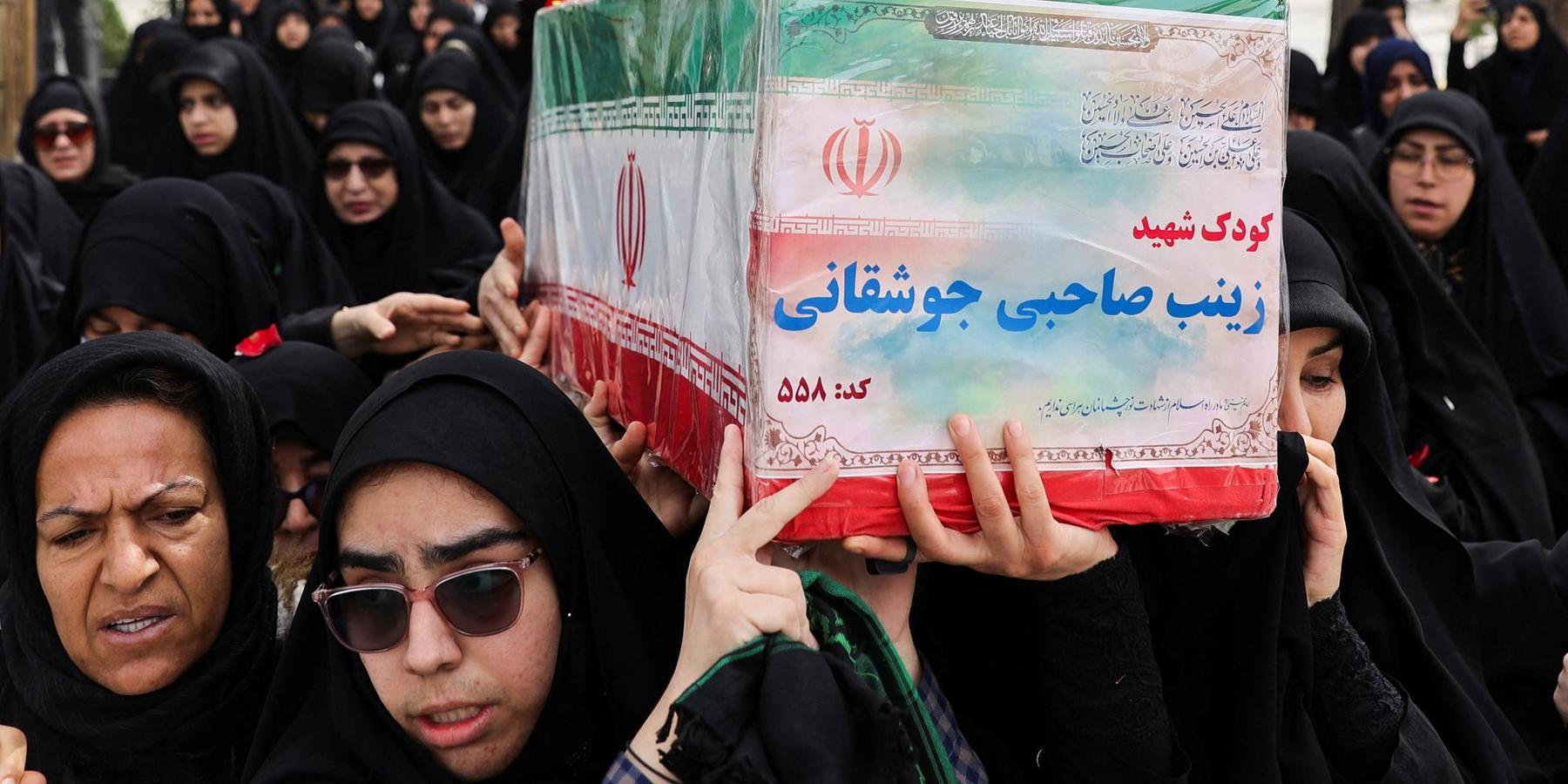
When it comes to the U.S.-Israel war on Iran, there is no more misleading term than “decapitation.” I am not making the obvious point that killing Iranian leaders will not topple the regime. The more crucial point is that by design or default, decapitation could lead to the dismembering of the Iranian state.
The reason for this is simple: over the last few decades, the Iranian state was tied to the security sector, political institutions, the state-financed clerical establishment, state-owned industries (including gas and oil), universities, religious institutions, courts, and the ruling regime in all its many dimensions, including the “Abode (House) of the Supreme Leader.”
The intertwining of these institutions into a single ruling pillar gave the regime tremendous power, but it also left it vulnerable: if one of its strands was pulled away, the rest could quickly unwind and the pillar would collapse. The most important strand, of course, was the security sector. Its weakening of elimination made the state's collapse very likely.
As the U.S.-Israel war accelerates and the prospects of state implosion grow, the only option for the Islamic Republic’s leaders is to retaliate in ways that exact a similar cost for the Gulf Arab states. Faced by a do-or-die scenario, Tehran will try to choke off the life reservoir of both Israel and its Gulf neighbors, i.e., oil, gas, and water. It is already closing the Strait of Hormuz, has hit oil facilities in the U.A.E., and has damaged and possibly crippled Qatar’s LNG production.
The U.S. and Israel are racing to destroy Iran’s ballistic missiles, but it is very likely that it has many in reserve to deliver the final blow, which is the destruction of desalination plants, without which the Gulf states cannot survive. No water, no state, it is as simple as that. State implosion is a very real possibility in the U.A.E, Qatar, and other Gulf states.
Knowing this, it is very likely that Gulf Arab leaders will sooner rather than later press Donald Trump to declare victory and end the U.S. assault. As their supplies of anti-ballistic “interceptor” missiles dwindle, they will have to choose between their own survival and tolerating the near existential costs of a prolonged conflict. Not surprisingly, U.S. military officials insist that the Arab states are not running out of interceptors, but the supply is finite. A catastrophe of epic proportions is a real possibility.
This is a scenario that Trump created by refusing to accept any diplomatic solution other than zero uranium enrichment, an outcome that Iran has rejected outright for well over two decades. Given the substantial concessions that Iran put on the table during indirect talks that were clearly an American cover for war, it is clear that White House decided from the outset that decapitation was preferable to a real compromise, one that would have allowed the regime to survive. After all, Trump assumed that with Iran’s top political and security leaders killed and its security apparatus severely damaged, Iran’s people would somehow be liberated and thankful. Why choose diplomacy with a hated regime when a quick and decisive war, perhaps no more than a month, might bring democracy to Iran?
It would be lovely if the Iranian people would rise up, and in the dust and rubble of a seemingly collapsing regime, seize power. But there is no democracy without a state, and without the security it can provide in one form or another. If and when Iran’s security institutions collapse, the most likely outcome is that different groups will seize the weaponry without which they will have zero power. We will soon see this logic play out if and when the U.S. and Israeli-backed Kurdish militias take control of police stations and outposts of the military and Islamic Revolutionary Guard Corps (IRGC).
Other groups — such as the Baluchis in the eastern part of the country — will try to follow suit. The mostly Sunni Baluchis have long hated the Islamic Republic of Iran and what they saw as their “occupation” of Sistan and Baluchistan provinces by foreign Persian Shi’a forces. As the prospects for other rebellions in the border provinces grow, Iran’s leaders will have every reason to push the proverbial button. What they are saving for a later date, they might use this week or next.
It appears that no one in Trump’s inner circle either recognized or dared try to explain to him the dire dangers unleashed by a war of “decapitation.” Instead, they still cling to the idea that killing Iran’s leaders will produce one of two very different and fantastical solutions: Either it will open the door for groups such as Kurds to seize power, a prospect that Trump has applauded, or it will produce a compliant regime that Trump will somehow control.
Indeed, Trump now insists that the U.S. has the right and the means to choose, or help choose, Iran’s next Supreme Leader. And why not? As he correctly noted, this is what the U.S. did in Venezuela.
Such a scenario might have been possible when Ali Khamenei was the Supreme Leader. But now that his son Mojtaba has apparently emerged as his successor, vengeance will be the order of the day. Of course, Trump insists that Mojtaba is a “lightweight,” and I imagine many Iranian leaders would agree. But Mojtaba, who must be smarting from press reports that he visited London four times seeking treatment for impotence, will not cut a deal with the American president who celebrated the murder of his father and who is now taunting Mojtaba from the safety of the Oval Office.
In short, the chances of pulling off a “Venezuela” deal in Iran, which were always very small, have probably been completely shut down. This is fine with Trump. As he stated today, “there will be no deal with Iran except for UNCONDITIONAL SURRENDER…Make Iran Great Again.”
Prime Minister Benjamin Netanyahu will welcome this statement. For him and his hardline allies in and outside the Israeli government, state collapse (or civil war) in Iran is the ultimate goal. But an imploding Iran will pose a dire threat to U.S. interests, as the chaos in Iran bleeds into the wider region. Living in a bubble of magical thinking, instinct, and unrelenting narcissism, Trump will not and perhaps cannot see the dark clouds gathering as the calamity of state collapse becomes real for Iran and its Gulf neighbors.- Are Kurds really joining US-Israel fight to take down Iran regime? ›
- Did the US only attack Iran because of Israel? ›
- First it was regime change, now they want to break Iran apart ›