

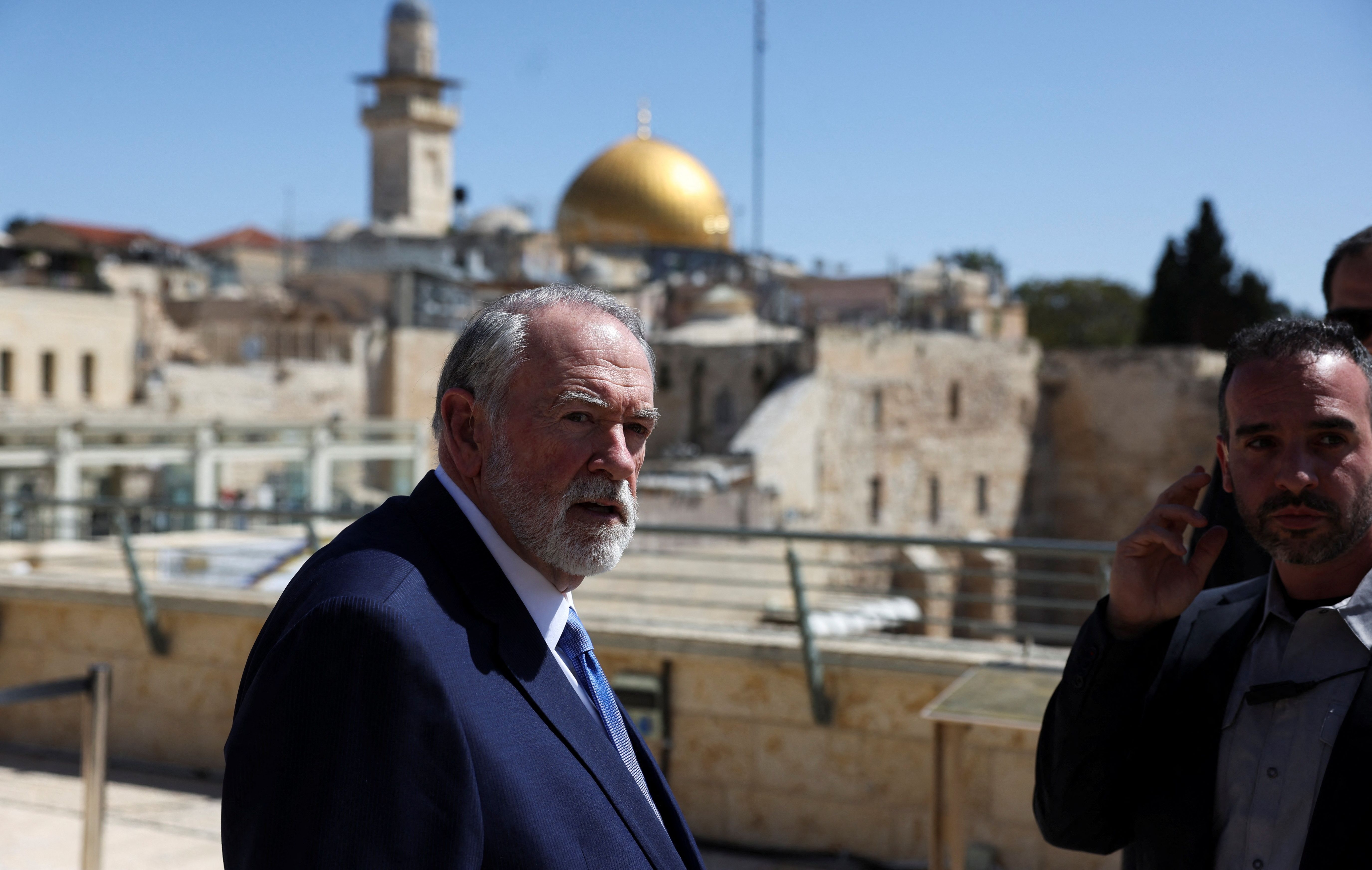
Mike Huckabee is many things. A former Republican presidential candidate. The former governor of Arkansas. Father of the current governor of Arkansas. A Baptist minister.
He is also the current U.S. Ambassador to Israel. President Donald Trump said he chose Huckabee because, “He loves Israel and the people of Israel, and likewise, the people of Israel love him.”
Huckabee’s not loving Israel quite as much at the moment, as American evangelical Christians seeking to visit the country are having quite the time trying to get their tourist visas approved.
This has never been a problem. Huckabee’s first trip to the country, what he calls a “holy ground to Jews, Christians and Muslims” was in 1973 and he claims to have visited about a hundred times. American Christian groups have been traveling to Israel with relative legal ease for decades.
But, in a recent letter to Israel’s Interior Minister Moshe Arbel, obtained by The Times of Israel, Huckabee expressed his frustration with Israel’s, apparently new, policy of keeping American Christians out of the country and even threatened to do the same to Israelis wanting to visit the U.S. if something doesn’t change.
“It is with great distress that I write to you my profound disappointment that the meeting held in your office has not resulted in what I hoped to be a simple resolution of the issue of routine granting of visas for Christian organizations and workers, as has been practiced for decades,” Huckabee wrote.
Copies of the letter were sent by Huckabee to Prime Minister Benjamin Netanyahu, President Isaac Herzog, Foreign Minister Gideon Sa’ar, Strategic Affairs Minister Ron Dermer and Knesset Speaker Amir Ohana.
Huckabee continued, “It would be very unfortunate that our embassy would have to publicly announce throughout the United States that the State of Israel is no longer welcoming Christian organizations and their representatives and is instead engaging in harassment and negative treatment toward organizations with long-standing relationships and positive involvement toward Zionism and friendship to the Jewish people and the State of Israel.”
Huckabee clearly sees the treatment of these Christian groups as harassment.
According to the Times, “Huckabee wrote to Arbel that at the start of 2025, the Interior Ministry launched investigations into several evangelical Christian organizations with long ties to Israel, including the Baptist Conference in Israel and the Christian Missionary Alliance.”
“Huckabee informed Arbel that these organizations were required to complete lengthy questionnaires and that they had still not received new visas for religious leaders to travel to Israel, despite submitting their applications at the beginning of the year,” the report noted.
These are harsh words from Huckabee, who as a Zionist believes that God made a covenant with the Jews of the Old Testament, which gives Israel claim to the land.
This tension also comes on the heels of Israel launching a strike on Gaza’s only Catholic church, in which three were killed and its priest, injured. Pope Leo XIV renewed his call for a ceasefire in Gaza after the incident, and has been outspokenly opposed to the killing in that region throughout his papacy. While Israel apologized for the strike, some within the Church, like Cardinal Pierrebattista Pizzaballa, have expressed doubts, hinting that it may have been intentional after Catholic leaders recently condemned Israeli settler attacks on a West Bank Christian town.
It’s unclear why Israel is singling out all Christians in these cases or whether it has to do with criticisms of its wars from the Catholic Church.
Indeed, while the Vatican has condemned the war in Gaza, Zionist Christians of Huckabee’s stripe rarely, if ever, question or criticize Israel’s government, most particularly that of Prime Minister Benjamin Netanyahu. American evangelicals even regularly fly Israeli flags along with American ones, even in Congress.
Yet here we are. One of America’s most high profile evangelical political figures is really ticked off at the Israeli government for denying American Christians the opportunity to see the country.
Huckabee wrote in the letter, “If the government of Israel continues to cause the expense and bureaucratic harassment for the granting of routine visas that for decades have been routine, I will have no other choice than to instruct our consular section to review options for reciprocal treatment of Israeli citizens seeking visas to the United States.”
The ambassador also threatened to tell American Christians that their donations to Israel are not warmly received and that maybe they should change their travel plans if they include Israel.
This is new, tense ground when it comes to the relationship between Israel and American Christians, historically some of the most avid supporters of Israel.
How big or bad or could this rift get? Who knows. But when Israel has lost Mike Huckabee …