

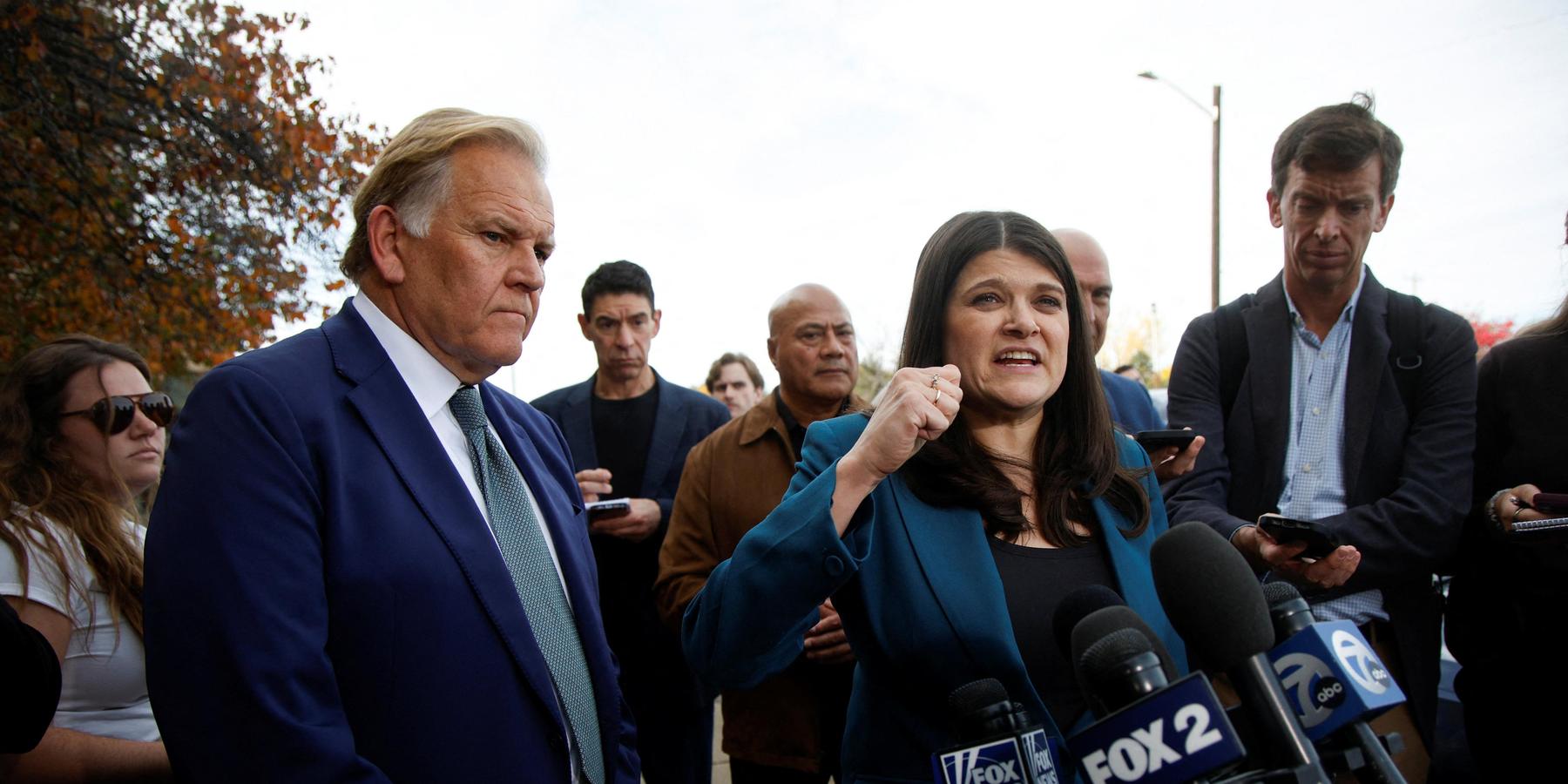
Rep. Haley Stevens’s surprising decision to abandon the Democratic Party and endorse Mike Rogers, the Republican candidate running for Senate in Michigan, was widely interpreted as a slap across the face to Michigan Democrats, who chose Abdul El-Sayed over Stevens to run as their party’s candidate in the general election.
Speculation about Stevens’s erratic behavior — endorsing El-Sayed and then shifting her endorsement to Rogers less than 48 hours before Election Day— has centered on the role played by her new, and allegedly controlling, fiance, Jason Turkish. But if political journalism has one rule, it’s “follow the money.” And in this case, there’s a lot of money, and it points to the role of a lobby for a foreign country.
Stevens may have gone a step too far for Democrats by endorsing a Republican, but her actions were entirely in line with the pro-Israel donors who had supported her candidacy.
The Michigan Democratic Senate primary race was exceedingly expensive, even by the standards of modern American elections, and most of that funding went to supporting Haley Stevens against Abdul El-Sayed. The money largely came from out of state, and much of it came from outside the Democratic Party. The unifying factor was that pro-Israel megadonors wanted to boost her campaign against El-Sayed, a candidate who openly criticized Israel and the ways in which U.S. aid to the country was instrumental in Israel’s war on Palestinians in Gaza, which numerous leading human rights groups have deemed a genocide.
Pro-Israel super PACs spent more than $30 million for TV and social media ads supporting Stevens and attacking El-Sayed, and in most cases they avoided any mention of Israel. This approach was a tacit admission that their core issue was toxic with Democratic voters, nearly three-quarters of whom oppose providing additional economic and military support to Israel.
Stevens, who is not Jewish, once said “I see Israel in my dreams,” and emerged as the model staunchly pro-Israel candidate for Israel’s lobby but not for Michigan Democrats, where she lost to El-Sayed in August. That’s where the story could have ended, but Israel’s lobby wasn’t done just yet. The lobby, driving home the message that it isn’t wedded to either the Democratic or Republican Party, backed Rogers in the general election, doubling down on its efforts to defeat El-Sayed, having failed in its attempt to influence the Democratic primary.
If Stevens dreamed of Israel, Rogers was living the dream. Drop Site reported on Sunday that his campaign spokesperson Abby Ronson and communications staffer Jesse Stokes are both registered agents for the state of Israel. In short, his campaign isn’t just benefiting from pro-Israel political spending; it is staffed by individuals who are also doing contract work to spread pro-Israel messaging.
Stevens’ Sunday decision to rescind her endorsement of El-Sayed and back Rogers took the political world by storm. Effectively switching parties within 48 hours of a consequential election is not normal behavior, and Stevens’ supporters, as well as Stevens herself, had emphasized her commitment to a Democrat winning the Michigan Senate race in November, whether it was Stevens or El-Sayed. Stevens, who had previously attacked Rogers as a “rubber stamp for Donald Trump's dangerous agenda," is now publicly appearing with Rogers and offering her endorsement to the man she had warned Michigan voters about.
The Democratic establishment responded with surprise and anger. Senate Minority Leader Chuck Schumer of New York, himself a staunchly pro-Israel Democrat, called Stevens' move a "despicable betrayal.” The swift closing of ranks around El-Sayed — unprecedented public support for El-Sayed that many mainstream Democrats had avoided offering until last weekend — seemed to only be made possible by Stevens’ unseemly defection to the Republican Party.
Stevens’ behavior, meanwhile, is entirely consistent with what the party’s leadership had already signaled. Speaking to The New York Times last year, Schumer explained that “My job is to keep the left pro-Israel.” Schumer and other senior Democrats were silent as millions of dollars poured into the Michigan Democratic primary from out-of-state and out-of-party sources to attack El-Sayed on behalf of Israel’s lobby.
Stevens’s decision to explicitly switch sides cost her the public support of her party, but it was also a logical decision to follow the special interest money that had backed her in her failed race in August, as those same donors shifted their focus to backing Rogers in the general election. It’s also the message sent by Schumer and former House speaker Nancy Pelosi (D-Calif.), who attacked El-Sayed and New York City Mayor Zohran Mamdani’s criticisms of Israel as “wrong” and not “a reflection of the Democrats in the Congress.”
For those who find all this distasteful, consider that Israel’s lobby has spent nearly a quarter-of-a-billion-dollars on this election alone. Stevens’, Schumer’s, and Pelosi’s behavior comes along with unprecedented special interest spending on behalf of a foreign country that is deeply unpopular with Democratic voters.
Preventing the transmission of public opinion into public policy is the lobby’s core mission in this election, and the cost of building that obstruction is reaching unprecedented heights. Stevens’ behavior over the past day offers insights into what is expected of pro-Israel candidates: turning their backs on their party and their voters in favor of prioritizing the narrow interests of a country 6,000 miles away.
The first step to combatting the corrupting influence of pro-Israel political spending is to talk openly about the role of Israel in our elections. To not do so is to invite pro-Israel money to continue shaping the actions of candidates in both parties at the expense of their parties and constituents.
- Unhinged attacks against El-Sayed reach a fever pitch ›
- Is Darline Graham the canary in coal mine for midterm war backlash? ›