

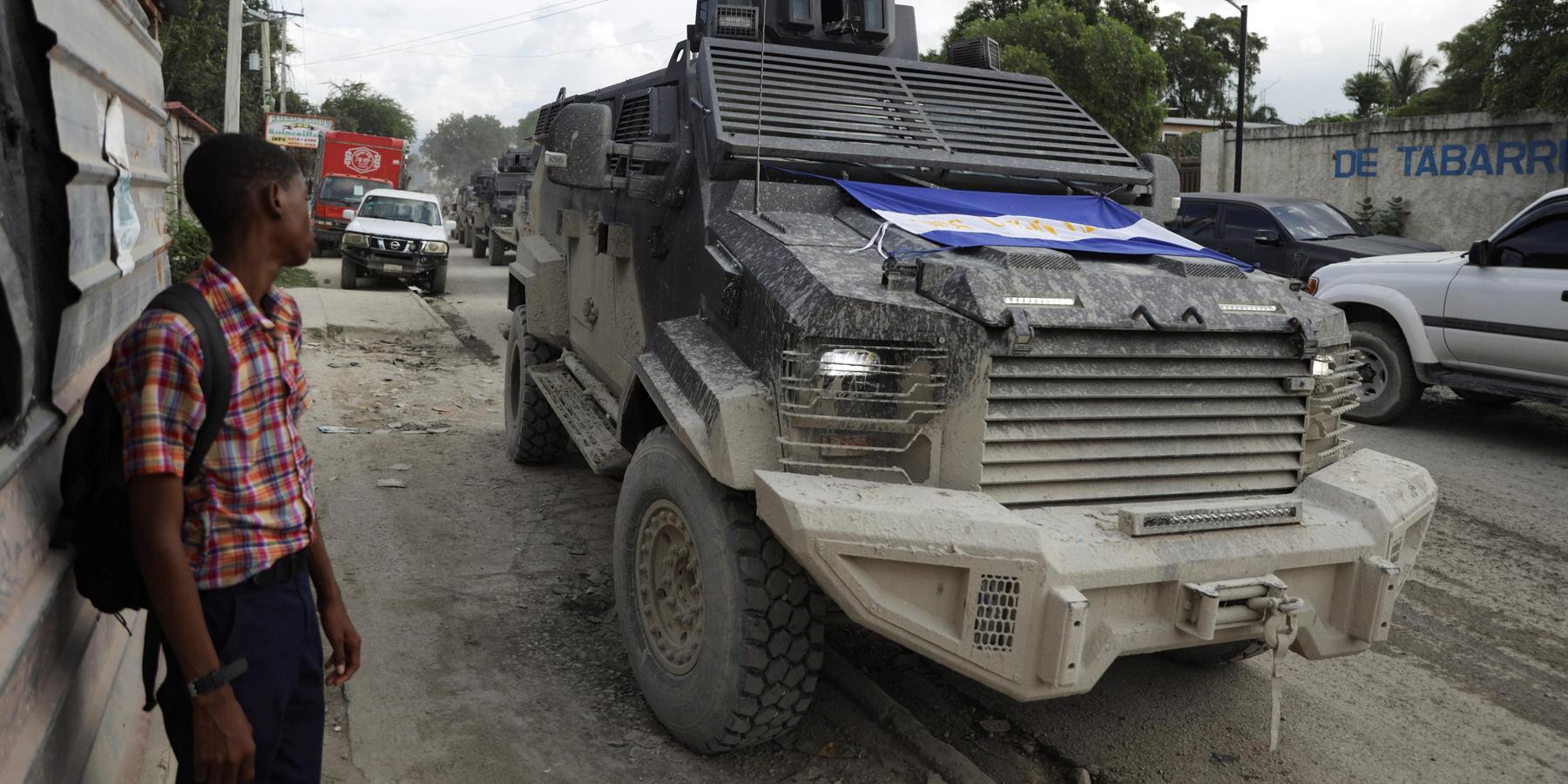
On October 18, four Salvadoran airmen vanished after gunmen ambushed their armored vehicle in Croix-des-Bouquets, a gang-held suburb about seven kilometers outside Port-au-Prince, Haiti’s capital. They were in Haiti as part of a UN-authorized multinational force sent to retake territory from the armed gangs that now dominate large swathes of the Caribbean nation.
El Salvador’s hardline president, Nayib Bukele, famous for jailing tens of thousands of suspected gang members at home without due process under a state of exception, insists his contingent was there for medical evacuations, “not to wage war.” Within days he rushed hundreds more troops to the island, reportedly now 2,500, with U.S. C-130s helping fly them in.
At the U.N. Security Council, U.S. Ambassador Mike Waltz, calling Haiti a failed state, promised the missing men: “we will bring you home.”
How did Salvadoran airmen end up in a gang ambush outside Port-au-Prince?
Stepping back, Haiti has been in free fall since President Jovenel Moïse was assassinated in July 2021. It has not held a national election in nearly a decade, and the political, economic, humanitarian, and security crisis has really spiraled since the 2010 earthquake that killed at least 100,000 people. Into that vacuum stepped armed groups, many of them backed by politicians and business elites, who have since merged into coalitions, such as Viv Ansanm. Extortion is the gangs’ main revenue source, and U.N. investigators have documented politicians bankrolling gang members.
By last year, the U.N. estimated gangs controlled roughly 90% of the capital. More than 1.5 million Haitians have been displaced, and the U.N. documented 1,408 killings between April and June of this year alone.
There has been a multilateral response. In 2023, the U.N. Security Council authorized a Kenyan-led police mission to support Haiti’s outgunned national police. Underfunded and understaffed, it failed and wound down this spring, trailed by a U.N. report citing several cases of sexual exploitation and abuse by members of the mission.
Its replacement, the Gang Suppression Force (GSF), approved by the Security Council in September 2025 and steered by a group of partners led by the United States, carries a far more aggressive mandate. It can launch offensive operations independently of the Haitian police force. It aims to field 5,500 personnel, about 2,000 of whom are ground forces. In a U.S.-sponsored resolution approved last month, the Security Council extended its mandate through March 2027. Bukele’s forces now outnumber the GSF.
El Salvador’s legislature first approved its contribution to handle medical evacuations in late 2024 and extended its participation for another year in early October this year.
Outside the U.N., Haiti’s transitional government hired Vectus Global, a firm run by Trump ally Erik Prince, founder of the notorious mercenary company Blackwater, to back a government drone task force that began operations in March 2025. Prince says he holds a 10-year contract whose value he won’t disclose, and the State Department licensed his company to work in Haiti.
In 2025, Washington designated Viv Ansanm and Gran Grif as foreign terrorist organizations, recasting a criminal and political crisis as a counterterrorism mission. The U.S. military has previously said it is prepared to deploy if called upon.
Together, these measures risk producing more bloodshed than they prevent.
Prince’s forces, closely linked to the Trump administration and associated as a proxy of the U.S. government, also risk dragging the U.S. further in. Prince’s drone task force operates outside any judicial process, and Human Rights Watch found its strikes killed at least 1,243 people by January 2026, including 17 children and 43 adults with no gang ties. Prince promised to reopen key roads within a year, a benchmark that he has almost completely failed to meet.
He told CNN that for gang members, “the best place for them is in the ground.” The comment reflects his view that this is purely a military problem requiring a military solution, despite the failures of military-centered approaches in Haiti in recent decades.
Bukele is caught in the same logic. His medevac mission crept into a frontline deployment, and Haiti is becoming a showcase for exporting his militaristic approach to law enforcement.
This approach has seen some success in El Salvador, but not necessarily for the reasons Bukele wants you to believe; as U.S. Treasury sanctions and investigative reporting have revealed, Bukele has cut secret deals with gangs to reduce their activities. In practice, this is the most pragmatic part of what one might call the “Bukele model.” The problem is that he shows little interest in negotiations with gangs in Haiti, which may prove a grave mistake.
Amb. Waltz has fed the escalation. He has warned gang bosses that “your days of acting with impunity are numbered,” reminded the Council that “Haiti’s just a few hundred miles from Florida,” and claimed the gangs move guns as far as West Africa, Europe, and the United States, without offering evidence. In reality, the flow mostly runs the other way.
None of these actors grapples with where the gangs’ power comes from. A GAO review found 73% of traced firearms recovered in 25 Caribbean countries came from the United States, mostly sold in Florida, Texas, and Georgia. The U.N. estimates 270,000 to 500,000 illegal firearms circulate in Haiti. The UNODC’s chief has urged “the main source country” to tighten controls.
Force alone will only breed more force. The U.N.’s top official in Haiti warns that gangs adapt as operations intensify. Their leaders also feed on foreign intervention: Jimmy “Barbecue” Chérizier has rebranded himself as a proto-revolutionary, posting videos denouncing Haiti’s elites and foreign meddling to thousands of followers.
The gangs are not unshakeable terrorists. They are criminal enterprises feeding off political instability and economic despair, and every innocent killed by a drone makes recruitment easier. Local narratives of residents in gang-controlled areas as “human shields” also heightens casualty risks. The terrorist label, meanwhile, locks Washington into an aggressive posture that makes negotiation politically toxic.
Haiti’s despair has a long history. The United States refused to recognize the first republic born of a slave revolt until 1862, and sponsored an international boycott. France’s 1825 indemnity drained an estimated $560 million from Haitians, with more repaid over two centuries, according to a New York Times analysis.
Washington occupied Haiti from 1915 to 1934, backed the Duvalier dynasty, and tolerated the CIA-linked FRAPH paramilitary after the 1991 coup against Jean-Bertrand Aristide – though Washington reversed course in 1994 after significant reporting and public pressure related to FRAPH’s excesses.
France’s former ambassador told the Times that Paris and Washington effectively orchestrated “a coup” against Aristide in 2004. The U.N. mission that followed made minor progress in restoring security but created new problems, introducing cholera that killed some 10,000 Haitians. Some peacekeepers also ran a sex ring involving at least 134 soldiers. A U.N. panel later found that former president Michel Martelly, a longtime U.S. ally, used gangs to advance his political agenda.
Security-first missions without political legitimacy or negotiation keep backfiring. Washington’s most useful role now is to stop supplying the guns, the cash, and the misery.
That means enforcing the arms embargo at American ports and sanctioning the financiers. Viv Ansanm has signaled willingness to negotiate in exchange for amnesty, an opening worth testing.
Children, driven by aid cuts and poverty, make up roughly half of gang members, which argues for a reintegration program; there are lessons to draw from Colombia, Mexico, and even El Salvador’s own short-lived truces.
Any security effort should be Haitian-led and accountable, vetted under mechanisms like the Leahy laws. Haitians keep hoping for these missions to work, but they have not addressed core problems. Above all, Haiti needs a legitimate government to hand territory back to, and an end to the plague of socio-economic misery.
Elections, delayed again and again, must actually happen. Prince’s contract should end, and foreign troops should be drawn down rather than surged. Emergency food and medical aid should flow without breeding dependency.
For centuries, Western powers and opportunistic elites have blocked peace and democracy in Haiti, then blamed Haitians for the fallout. It is time to end that cycle. Haiti should be for and by Haitians.
- Further US intervention in Haiti would be worst Trump move of all ›
- Throwing thousands more soldiers at Haiti will not solve this crisis ›