

On one side of Guantánamo Bay, U.S. soldiers face a temporary disruption in the availability of lattes. On the other side, Cubans sit in darkness, waiting for the power to come back on.
Amid the Trump administration’s fuel blockade on Cuba, conditions in the country are deteriorating rapidly, raising the very real possibility of mass emigration. In February, the United Nations warned that a humanitarian collapse could be possible and reported that people are experiencing rolling blackouts, lack of access to medical care, and food shortages.
In response to the crisis, Russia provided a shipment of oil this week and has announced plans for a second shipment. However, these only provide short-term relief. The Trump administration continues to enforce the blockade and grant exceptions on a case-by-case basis. The situation is compounded by the impact of Hurricane Melissa in October and decades-long economic strain affecting basic social services across the country.
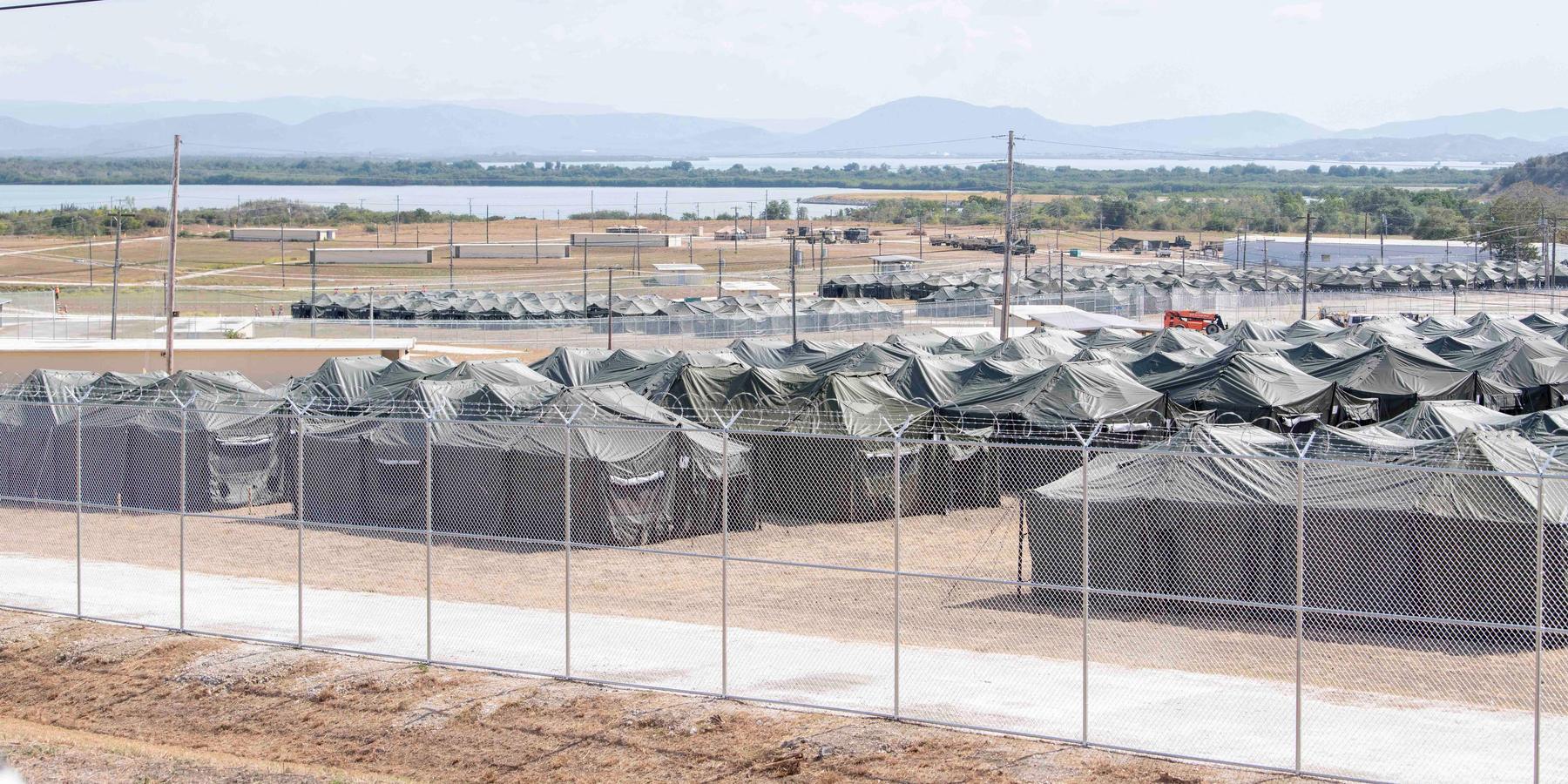
Against this backdrop, Gen. Francis L. Donovan, commander of U.S. Southern Command, said in a March 19 Senate hearing that, in the event of mass migration from Cuba, “we would set up a camp to deal with those migrants or any overflow from any situation in Cuba itself” at Guantánamo Bay. This proposal is as familiar as it is alarming. It reflects a long-standing pattern: when faced with a migration or security challenge, the United States pulls Guantánamo, a legal gray zone, out of its back pocket.
Donovan’s words are chilling as it is well known that the administration’s fuel blockade is exacerbating an ongoing economic crisis — causing businesses, public transportation, schools, and hospitals to shut down, all while food and water are becoming increasingly scarce.
Cuba’s problems are not solely the product of external pressure. Years of economic mismanagement, declining productivity, and a decline in tourism have weakened its economy. Aging and poorly maintained infrastructure such as a crumbling power grid and deteriorating water system had already created everyday hardships, leaving basic services unreliable even before the blockade intensified the crisis. The statement remains chilling, however, because individuals would flee to find refuge, and Guantánamo is a place where rights are curtailed, oversight minimized, and accountability deferred.
Guantánamo’s horrors did not begin with the so-called “Global War on Terror.” Long before the military detention center was established by the Bush administration in 2002, the base was already being used to detain migrants. On the Leeward side of the base sits the Migrant Operations Center (GMOC), which, for decades, has been used to hold individuals interdicted at sea. On the Windward side is the infamous military detention center created under the 2001 Authorization for Use of Military Force, colloquially known as GTMO.
To better understand how these came to be, it’s important to trace the history of the base. Since the 1900s, the U.S. has used the land as a naval station, forcing Cuba to lease it out under the Platt Amendment and subsequent 1903 Cuban American Treaty of Relations. Over time, it has been used as a space to manage migrants from the Caribbean. In the 1970s and 80s, Haitian asylum seekers fleeing violence and instability were brought there, screened offshore, and often returned. By the 1990s, tens of thousands of Haitians and Cuban migrants were held in overcrowded tents at the GMOC in inhumane conditions, without access to counsel.
Less than a decade after the horror of the 90s, Guantánamo took on an even darker role. It became a CIA black site and for the past two decades has been known for hosting the most notorious and expensive detention site in the world. Guantánamo was chosen because administration officials believed it existed beyond the reach of U.S. courts. One Bush official called it “the legal equivalent of outer space.” The military detention facility has since held 780 detainees, most without charge or trial, at a historical cost of $500 million annually.
Currently, 15 men remain detained under the 2001 AUMF in conditions described by a former United Nations special rapporteur in 2023 as “ongoing cruel, inhuman, and degrading treatment…and may also meet the legal threshold for torture.” Three of the detainees have been cleared for release by U.S. national security agencies but remain indefinitely detained. Three others have not been charged nor cleared and remain in limbo, and seven are in the broken military commission system.
For the three cleared detainees, their fate rests in the hands of the U.S. government and its decision to prioritize their lives. Two of the three also cannot be repatriated due to congressional restrictions, and it’s up to the government to resettle them in a third country.
And on the other side of the base , the GMOC also remains in use. Interdicted migrants are brought there for screening. If they are found to have a credible fear of persecution in their home country, the U.S. works to find a third country where they can be resettled. Otherwise, they are sent back. In recent years, the U.S. government has continued to invest in it. Towards the end of its tenure, the Biden administration gave a private prison company a $163.4 million contract to manage the GMOC.
The problems at Guantánamo are not only legal or moral — Guantánamo is structurally incapable of holding any number of people humanely. Rights groups, U.N. experts and, in a rare public statement, the International Committee of the Red Cross have raised concerns that Guantánamo does not provide adequate medical care.
The Department of Defense also admitted to gaps in the ability to address serious medical needs. Often, surgeons have had to be flown to the base to perform procedures. Infrastructure across the base is aging. There is an unstable supply of clean water, disruptions to the electricity and communication systems, and damages from hurricanes. While the military has conducted exercises in anticipation of a mass migrant surge, Guantánamo clearly cannot adequately house a wave of people seeking safety. Rather, the U.S. would be deliberately holding them in the worst place we can think of.
This is not accidental. Guantánamo is not just a base; it is a symbol meant to deter and instill fear. In the past year, the Trump administration has relished using the grim legacy of Guantánamo in its immigration policies, proposing to expand the detention capacity at the base, and, for the first time ever, transferring individuals from the U.S. to be held there. So far, close to 800 people have been held there at a cost of $60 million. They were kept in solitary confinement and inhumane conditions, and were denied or restricted access to counsel.
What we see now is the result of a systematic, bipartisan erosion of the rule of law in the name of national security — whether by choosing to open Guantánamo or by failing to close it. Guantánamo’s persistence, and the Trump administration’s fixation on the weaponization of national security against immigrants, such as invoking the Alien Enemies Act of 1798 — a wartime authority — deploying the National Guard to aid in mass deportations, using Fort Bliss for immigration detention, or even sending migrants from the U.S. to Guantánamo as mentioned above, reveals something deeper – the lines between domestic and foreign policy, between wartime authorities and immigration enforcement, are increasingly blurring. And in that fog, human rights are the first casualty.
Hundreds of thousands of Cubans may have to flee their homes due to a humanitarian crisis created by the U.S. More than one million left Cuba due to worsening conditions during the first Trump administration and a government crackdown. And rather than providing relief — which it easily can — the United States, in true American hubris, is considering detaining them at Guantánamo.
Until Guantánamo is closed, it will continue to rear its ugly head. Its very existence offers a ready-made loophole — a place designed to sit outside the law and public scrutiny. But breaking this cycle and ultimately securing the responsible closure of detention facilities at Guantánamo will require a reckoning.
Closure is not just about closing the facilities but rejecting a way of thinking: Guantánamo is not a hammer to hold over the heads of Cubans or migrants. The United States must step back from creating a humanitarian crisis in Cuba and cease its threats against those who are being harmed by its actions.
- The US is building, rather than tearing down GTMO prison facilities ›
- Why won’t Biden close Gitmo? ›