

President Trump and members of his administration have repeatedly claimed that the United States’ prodigious oil production insulates the country from price shocks stemming from Iran’s closure of the Strait of Hormuz.
It’s not clear whether they’re acting as fools or knaves – but either way, they’re wrong.
U.S. oil production does not render American consumers immune to fluctuations in oil prices, which are determined by the interplay of supply and demand in a global market. To the contrary, because the U.S. economy burns more oil to produce each unit of economic output than peer countries do, the United States will suffer more from the Iran War price shock than will China, Russia, or the European Union.
Those facts will surprise many Americans because myths and misconceptions about oil have long clouded U.S. political debates and the reasons behind U.S. vulnerability are genuinely counterintuitive.
Oil price shocks affect all countries, regardless of how much petroleum they produce, because of the deeply globalized nature of oil markets. Economists often compare the global oil market to a giant bathtub with many spigots and drains. The spigots represent all the countries producing commercial quantities of oil, and the drains represent states consuming oil, which is every country in the world.
It generally doesn’t matter which molecules from which spigots go into which drains. What determines prices is the overall level of oil in the bathtub, which represents the global oil supply, and market speculation, or predictions about future oil prices that can influence actual prices through self-fulfilling prophecies.
Normally, the global market supplies roughly 100 million barrels per day, but the Hormuz closure provoked by President Trump’s disastrous war against Iran has abruptly removed about 10 million barrels a day. That has reduced the bathtub level of oil and raised prices for every country attached to the global oil market – including the U.S. – regardless of whether or not they directly consume Persian Gulf oil.
The crisis is unfolding on a time delay, with Asia hit first — but not worst — due to its proximity to the Persian Gulf, the site of the physical disruption. The worst effects have yet to ripple across the full length of the bathtub, but their arrival is imminent in the Western Hemisphere.
Ironically, the stream of empty oil tankers crossing the Atlantic to load up on U.S. oil, which President Trump bragged about on Truth Social on April 11, is the exact transmission mechanism through which the shock spreads.
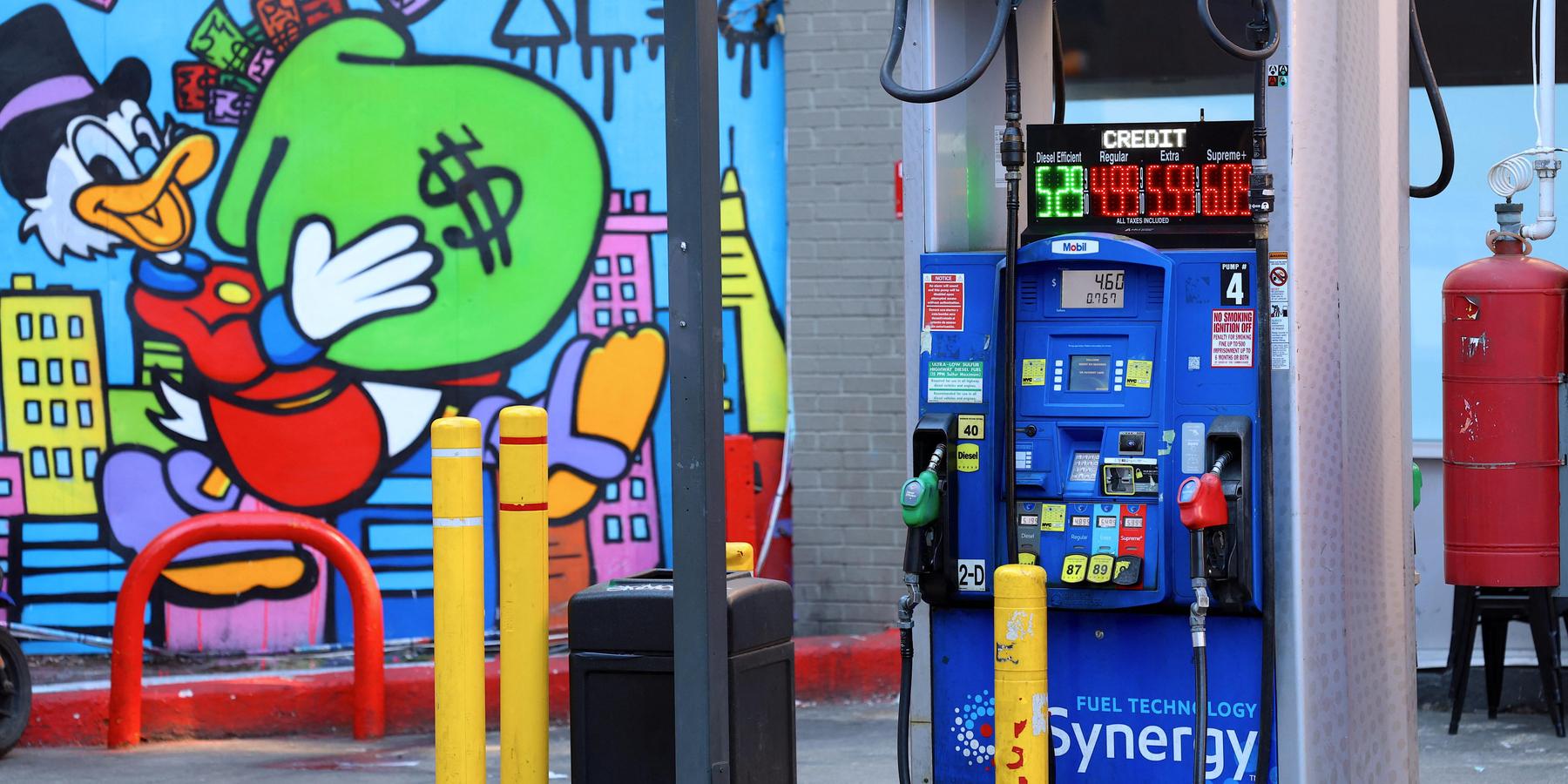
Those tankers are now diverting U.S. supply to Asia, where prices are higher, which in turn drives up oil prices here. Energy Information Administration (EIA) data for the week ending April 24 shows a massive drawdown of 6.2 million barrels from U.S. oil inventories, confirming that diversion is already underway. EIA now estimates that average U.S. gasoline prices jumped to $4.24 per gallon in April, up from $3.77/gallon in March and $3.03/gallon in February, before the war began.
Even if the Strait of Hormuz reopened at full capacity tomorrow, U.S. gasoline prices in May will no doubt be even higher than April, due to the time-delayed effects of Persian Gulf oil already removed from the market.
It’s no exaggeration to say a global economic meltdown could be the result. Oil price shocks are linked to economic recessions, with 10 out of the 12 post-WWII U.S. recessions immediately preceded by a spike in oil prices. The only exceptions are the 1960-61 recession and the Covid pandemic.
Oil consumption is a necessity that can’t be quickly reduced. U.S. consumers live where they live, drive the car they drive, and must still commute to work. So high gasoline prices force U.S. households to reduce spending on everything else, leading to massive demand shock for all other goods. Increased transportation costs for items like food and clothing will also cause the prices of those necessities to spike, worsening U.S. inflation.
That’s the basic logic for how oil price shocks affect consumers, but the actual pain felt by Americans will be comparatively worse than the situation in China, Russia, and the EU. The U.S. economy is highly oil intensive, meaning that it burns more oil to produce each unit of GDP than all of these countries, by quite significant amounts. Per dollar of economic output, the U.S. economy consumes twice as much oil as the EU, 40% more oil than China, and 20% more oil than Russia — which is especially astounding because Russia is a petrostate.
Two underlying factors explain why U.S. output is so reliant on oil. First, the U.S. is a car-loving culture, and its transportation system has always relied more heavily on automobiles than other major powers. Second, the U.S. has lagged in transitioning to electric vehicles, which can be powered by electric grids that are almost entirely independent of oil. China, in particular, has long pushed EVs and electric rail for strategic reasons, understanding the security benefits of decoupling their transit system from a global oil market prone to price shocks.
In the long term, the U.S. should copy China’s strategy and de-risk from petroleum through government policies to encourage the U.S. transition away from oil-burning automobiles.
But in the short run, the only solution is to make a deal with Iran to reopen the Strait of Hormuz — and the sooner the better. As the disruption hits and U.S. prices skyrocket, Trump’s bargaining power vis-à-vis Iran will plummet. Whatever cost the U.S. must pay to Iran to reopen Hormuz will only compound as the oil crisis worsens. Time is not on Trump’s side.
- Lowballing? Critics balk at military's $25 billion cost estimate of war ›
- Do the math: How much Trump's Iran war will cost you at the pump ›
- Winning? Republicans support a war that's pummeling ‘Main Street’ | Responsible Statecraft ›
- Banning diesel exports won't fix spiking prices due to war ›