

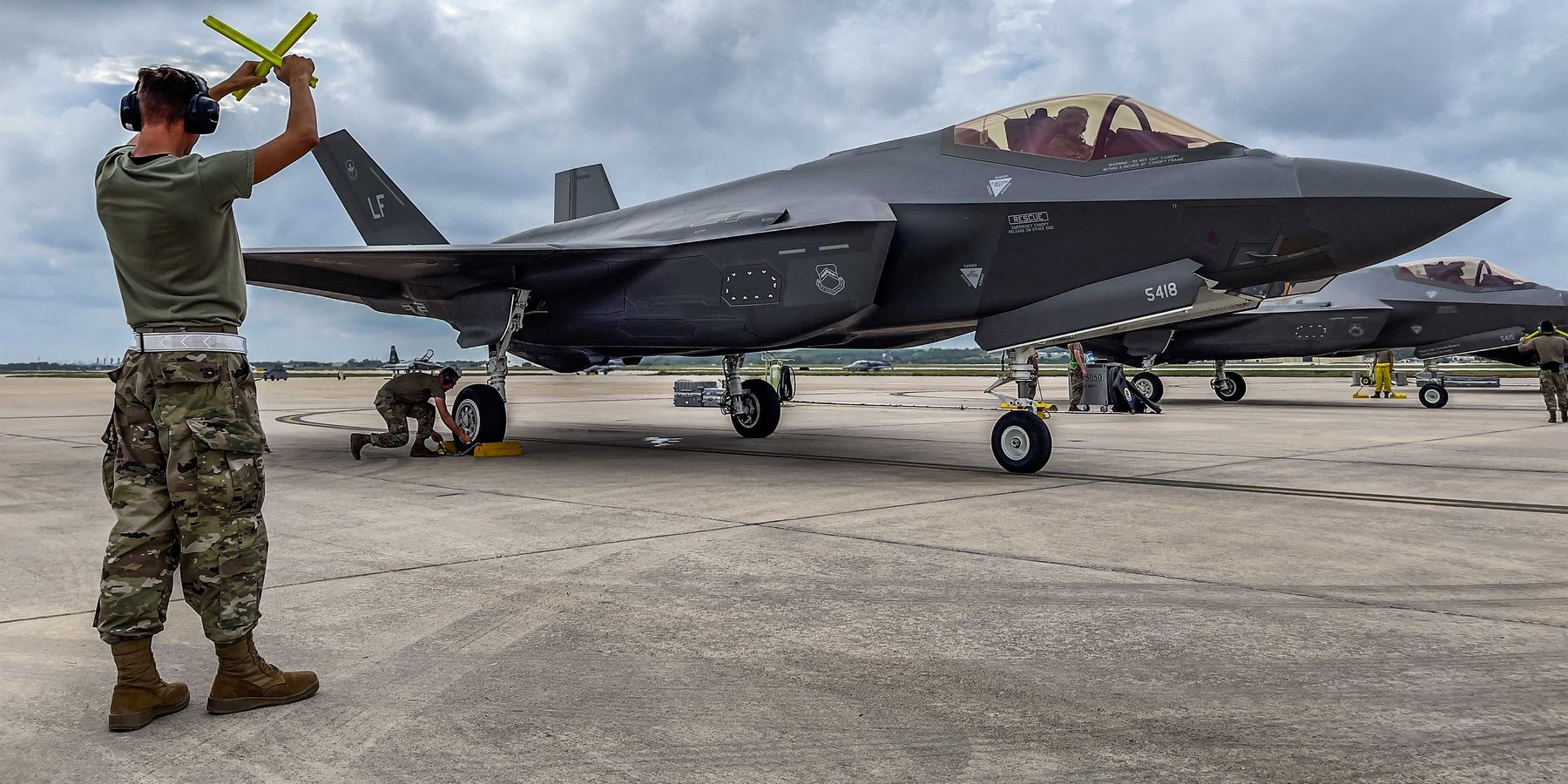
Nearly a quarter century after the Pentagon awarded Lockheed Martin the contract to develop the Joint Strike Fighter Program into the F-35, the government finally admitted the jet will never live up to Lockheed’s ambitious promises — used to sell the $2 trillion boondoggle to nearly 20 countries around the world.
The Government Accountability Office released a report last month detailing the ongoing challenges the program faces. The first paragraph of the highlights page includes this sentence:
“The program plans to reduce the scope of Block 4 to deliver capabilities to the warfighter at a more predictable pace than in the past.”
The casual reader will be forgiven for possibly glossing over the passage because of its anodyne wording. But the statement is a profound admission that the F-35 will never meet the capability goals set for the program. “Reduce the scope of Block 4” means that program officials are forgoing planned combat capabilities for the jets.
Block 4 is the term to describe ongoing design work for the program. It began in 2019 and was termed as the program’s “modernization” phase. In reality, Block 4 is just a continuation of the program’s initial development process. Officials were unable to complete the F-35’s basic design within the program’s initial budget and schedule. Rather than making that embarrassing admission and requesting more time and money from Congress, Pentagon officials claimed the initial development process was complete (it was not) and they were moving on to “modernization.” What they really did was simply reclassify initial development work with a fancy rebrand.
So, when program officials say they plan to “reduce the scope of Block 4,” they are saying the F-35 will not have all the combat capabilities that were supposed to be a part of the original design.
This is a remarkable development. The American people have been paying a premium for more than two decades to develop and build the most sophisticated strike fighter jet in history. Pentagon officials, politicians, and defense industry executives have been saying for years that the United States needed the F-35 and all its planned capabilities to maintain a qualitive technological advantage over potential rivals. The combat capabilities at the top of the “scope” of Block 4 included some related to electronic warfare, weapons, communication, and navigation according to the GAO. These top-level capabilities were the ones for which the American people supposedly needed to pay a premium.
By admitting that the program cannot deliver the jets that were promised is really an admission that the entire project is a failure. The implications of that could be profound beyond the money that has been wasted throughout the past quarter century. There are 19 countries that either already are, or will shortly, operate F-35s after buying them from the United States. Several countries like the United Kingdom, Norway, and Italy have been a part of the program well before Lockheed Martin won the contract to develop the F-35. These countries have invested heavily in the program with the expectation that they would receive the most combat capable aircraft in history. All have seen their costs rise throughout the years and now they find out that the jets will never live up to the hype.
So, in addition to being a military disaster, the F-35 many also prove to be a foreign relations disaster as well. F-35 boosters in the United States sold the jet to the leaders of these countries with elaborate pitches of the combat capabilities they planned to deliver. There were also promises made early in the process about the program’s affordability, which seem comical today. The next time an American attempts to sell a “transformative” weapon abroad, they shouldn’t be terribly surprised if a potential customer expresses skepticism. F-35 customers have paid a fortune above the quoted price, receiving only a fraction of what was promised. The United States may find a shrinking market for weapons exports in the years ahead.
This should be a moment of deep reflection for the entire national security establishment. The F-35 was never going to live up to expectations because its very concept was deeply flawed. Trying to build one jet that could serve as a multi-role aircraft to meet the needs of just a single military branch is a highly risky proposition. When you try to build a single jet to meet the multi-role needs of at least 15 separate militaries, while also being a global jobs program and political patronage scheme, you get a $2 trillion albatross.