

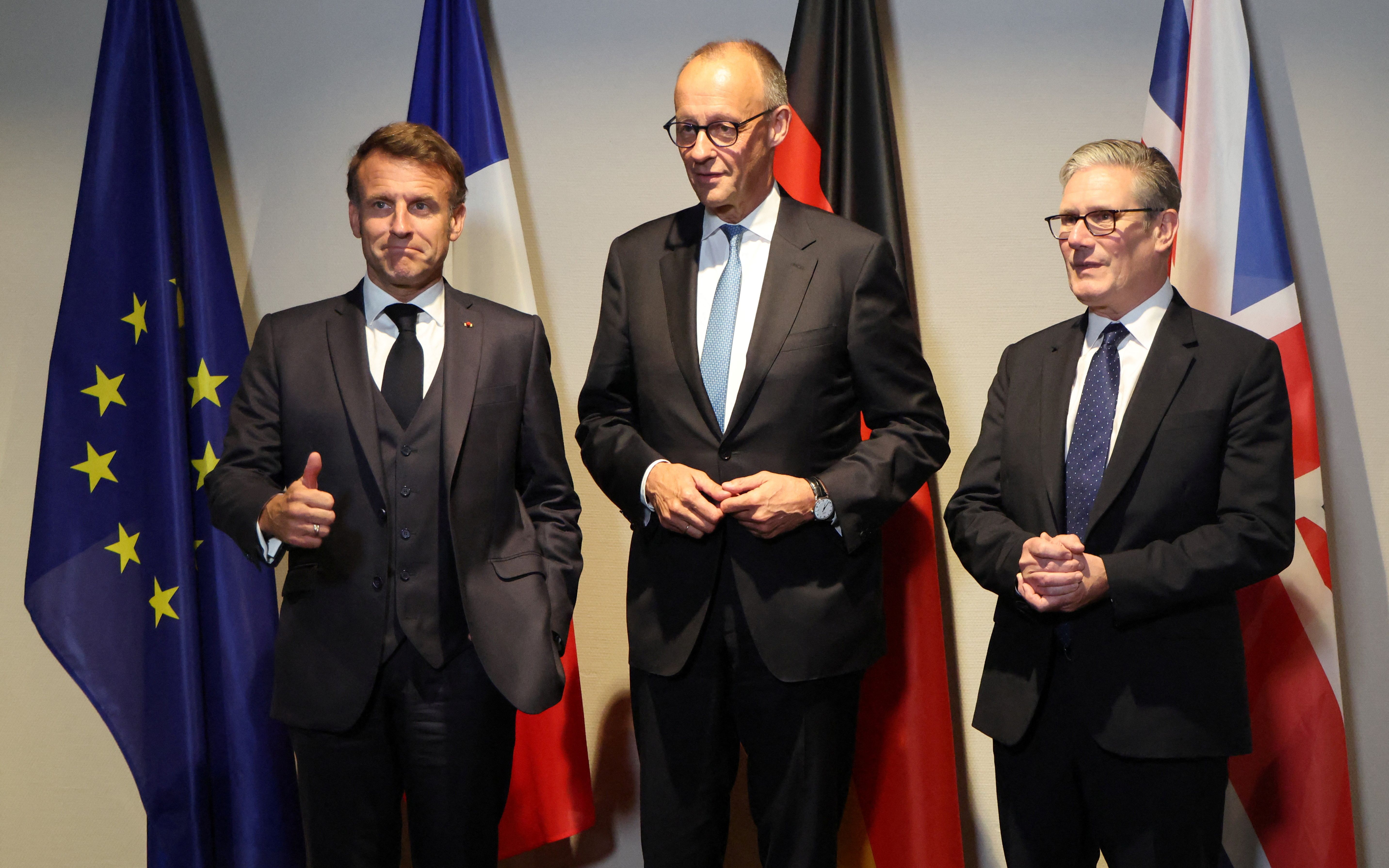
France, Germany, and the UK (E3) have announced they will trigger snapback sanctions on Iran at the United Nations. This will launch a 30-day process that will likely culminate in the full reinstatement of all U.N. sanctions lifted under the 2015 nuclear deal. The move will carry four major consequences.
First, the U.N. Security Council will formally adopt the demand — pushed by Israel — that Iran cease all uranium enrichment. Israel designed this demand to sabotage nuclear diplomacy and edge the conflict toward war.
Next, a U.N. arms embargo on Iran will return, potentially curbing Tehran’s ability to rebuild deterrence against future Israeli or American strikes, provided Russia and China treat the snapback as legitimate and enforce it.
Third, Iran’s already fragile economy will deteriorate further; its currency has already taken a hit.
And finally, far from advancing diplomacy, the measure risks accelerating escalation. While Israel hardly needs a pretext to launch another strike on Iran, as I have argued, snapback could provide useful political cover — a thin veneer of legitimacy — for renewed attacks.
The E3 argues that snapback is necessary to pressure Iran into resuming talks with the U.S. and granting the International Atomic Energy Agency (IAEA) access to its nuclear facilities, including disclosure of the stockpile of 60% enriched uranium.
On the surface, these demands may seem reasonable. But Tehran has legitimate reservations. Iranian officials suspect the IAEA of leaking sensitive information that enabled Mossad’s assassination campaign against their nuclear scientists, and they fear that revealing the stockpile’s location could simply invite another round of U.S. airstrikes.
Moreover, Iran was at the negotiating table when Israel and the U.S. began bombing it. The E3 now insists Tehran return to talks, yet they make no parallel demand that Washington refrain from bombing again.
Perhaps most importantly, given the unbridgeable gap over enrichment, Trump’s limited patience for diplomacy, and Israeli pressure to resume hostilities, restarting talks that are almost certain to collapse — unless both sides show greater flexibility on enrichment — only increases the likelihood that war will start sooner rather than later..
But that may well be the point. The E3 of today bears little resemblance to the one of two decades ago. When it was created in 2003, its purpose was to prevent the Bush administration — fresh off its disastrous and illegal invasion of Iraq — from launching another war, this time against Iran.
Today, the geopolitical context has shifted. Iran’s alignment with Russia in Ukraine has recast it as a direct threat in Europe’s eyes. The EU is also far more dependent on the transatlantic relationship than it was 20 years ago, while successive rounds of sanctions have rendered Iran a negligible economic partner for Europe.
Escalation with Iran through snapback now serves two EU objectives: punishing Tehran for supporting Russia in Ukraine, and aligning Europe with hawkish elements in the Trump administration — an alignment calculated to ease tensions in other areas of a transatlantic relationship under unprecedented duress.
In this sense, the E3 constellation that was designed in 2003 to prevent war may, in 2025, be pushing us closer to one.
But don’t take it from me. After all, Germany’s chancellor has openly admitted that Israel “did Europe’s dirty work for it” by bombing Iran in June.
- Pure Orwell: Europe condemns Iran for attacks on its own territory ›
- Europe's snapback gamble risks killing diplomacy with Iran ›
- In twist, Europe appears to be deliberately undermining Iran talks ›
- Iran's political factions divided over future of nuclear program | Responsible Statecraft ›
- 'Annulled'! Russia won't abide snapback sanctions on Iran | Responsible Statecraft ›