

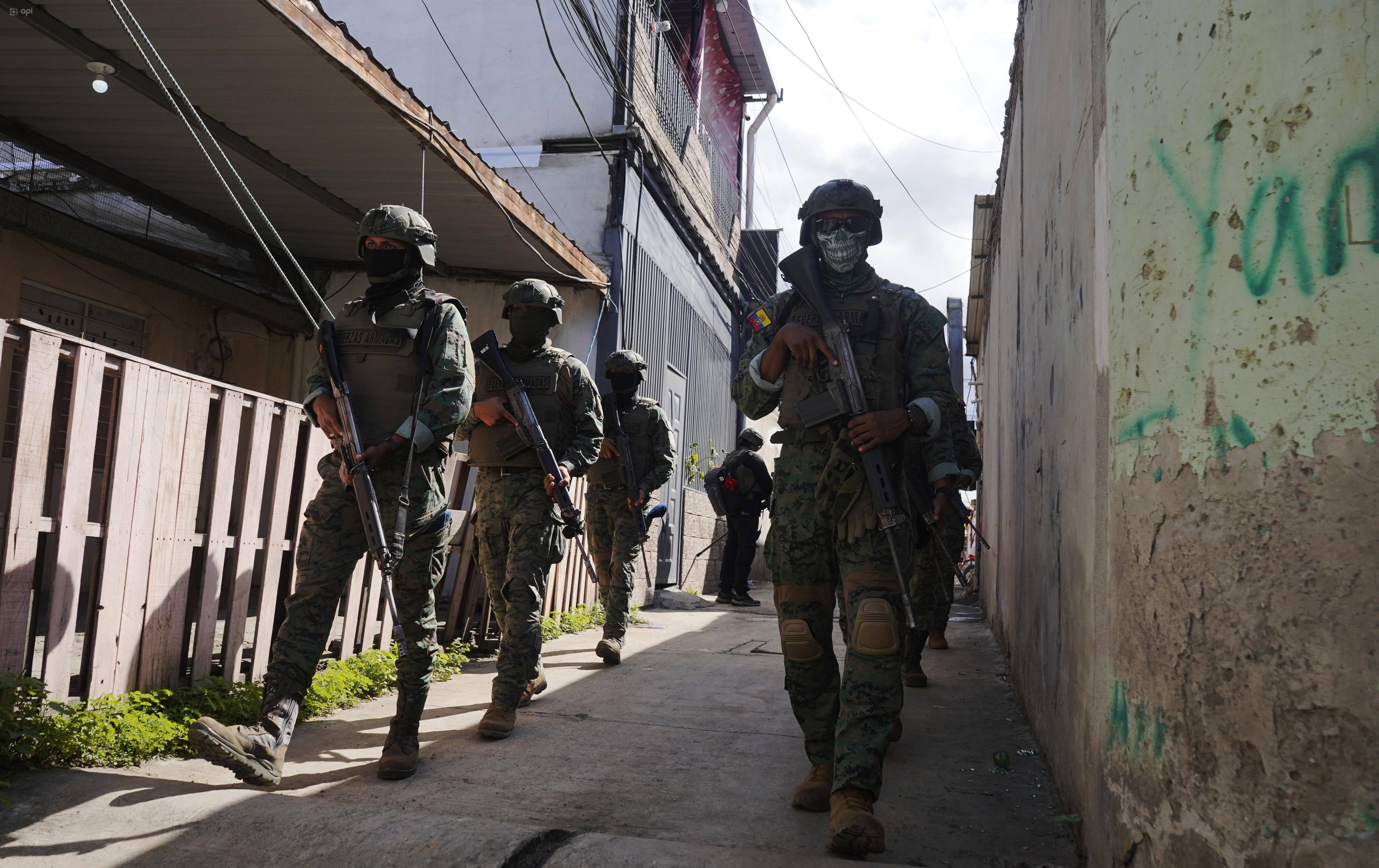
As the world’s attention is focused on the U.S. and Israeli war on Iran, the United States has, with little fanfare, opened another front in its expanding campaign against so-called “narco-terrorism” in the Western Hemisphere.
Since this new "war on drugs" began last year, U.S. military strikes on alleged drug-smuggling boats, as well as a direct military intervention in Venezuela, have claimed the lives of more than 250 people. Now, Ecuador, a country on the northwestern edge of South America, has become the latest site of Washington’s reinvigorated “war on drugs.” This escalation risks making the United States complicit in the human rights abuses of a government that is steadily dismantling its own country’s democracy, including by suspending the nation’s largest opposition party.
The new campaign began last week, when SOUTHCOM announced that “Ecuadorian and U.S. military forces launched operations against Designated Terrorist Organizations in Ecuador.” No further details were provided, leaving the public to guess at the scale, location, and target of this intervention. This move followed a meeting a day earlier between the head of SOUTHCOM and the Ecuadorian president, who subsequently announced a series of “joint operations with our allies in the region, including the United States.”
Trump stepped up the attacks on the eve of Washington’s Shield of the Americas summit on Saturday, which brought together regional leaders who have supported U.S. military operations in the hemisphere. Just before the conference, Ecuadorian and U.S. forces carried out joint strikes near the Colombian border against an encampment allegedly linked to a dissident rebel group that splintered from the now-dissolved Revolutionary Armed Forces of Colombia (or FARC).
SOUTHCOM described the action as a series of “lethal kinetic operations against Designated Terrorist Organizations,” even though the dissident group hasn’t been designated as such by the US. As yet, no deaths have been reported, and videos shared by a US official appeared to show the site was empty.
That these “lethal kinetic operations” took place in Ecuador is no coincidence. Since his election in 2023, President Daniel Noboa — whose militarized approach to law enforcement has failed to stem soaring rates of violent crime — has sought to strengthen bilateral security ties with the U.S. and ingratiate himself with the Trump administration at almost any cost, including his country’s sovereignty.
In February 2024, Noboa, an heir to Ecuador’s wealthiest family, ratified a Status of Forces Agreement that allows U.S. troops to operate in the country while shielded from local laws and prosecution. In December of that year, he issued an order permitting the U.S. military to station ships and personnel in the environmentally fragile Galápagos Islands. Noboa then went a step further: in November 2025, he invited Homeland Security Secretary Kristi Noem to tour the site of a former U.S. military base in the city of Manta. Ecuadorian authorities said they hoped to reopen the facility — which had served as a major hub for Washington’s war on drugs until its closure in 2009 — as a U.S. base.
This push came despite the Ecuadorian constitution’s prohibition of foreign military bases on Ecuadorian soil — a ban Noboa attempted to overturn through a national referendum that was decisively rejected by Ecuadorian voters late last year. Nevertheless, U.S. troops have been stationed at the same base Noem toured since December, though officially only on a “temporary” (yet indefinite) basis until the joint operations, of which the strikes are a part, conclude.
More recently, Noboa severed diplomatic ties with Cuba and abruptly expelled its diplomats, claiming without evidence that Havana was interfering in Ecuador’s domestic affairs. He also cheered on the U.S. military intervention in Venezuela, declaring that “all the criminal narco-Chavistas will have their moment.” Following the U.S. and Israeli attacks on Iran, Noboa even baselessly alleged that contingents of Iran’s Islamic Revolutionary Guard Corps, Hamas, and Hezbollah are operating out of Venezuela to train Ecuadorian criminal groups.
Noboa frames security cooperation with Washington as essential to his own war on criminal groups and “narco-terrorists”— a term he began using even before the election of Donald Trump. For more than two years, Noboa has governed through a permanent state of emergency, deploying the military to the streets and suspending certain rights. A combination of austerity measures and shifts in global drug trade dynamics has, since 2021, plunged Ecuador into a state of daily, deadly violence. Despite Noboa’s hardline efforts, which are inspired by those of Salvadoran President Nayib Bukele, the country’s homicide rate hit a record high last year, surpassing 50 per 100,000 people — up from 5.8 less than a decade earlier.
Today, the military faces accusations of widespread human rights abuses, including torture, extrajudicial killings, arbitrary arrests, and forced disappearances. Just this week, Ecuador’s Constitutional Court ruled that the military was responsible for the torture and forced disappearance of four children whose charred bodies were later found dumped on the side of a road and whose fate created a national uproar.
At the same time, Noboa has moved to close civic space, using a fast-tracked law to freeze the bank accounts of indigenous organizations, charging activists with terrorism, expelling foreign journalists, and violently repressing peaceful demonstrations.
Ecuador’s democratic institutions have not been spared. When the Constitutional Court struck down his moves to consolidate power, Noboa responded with public threats and pressure campaigns, calling the judges “enemies of the people.” He has also maneuvered to stack key independent oversight and electoral bodies with loyalists. And through the Noboa-aligned attorney general — whose appointment has been challenged as illegal — the president secured a judge's order banning the country's largest opposition party for nine months, effectively barring it from competing in upcoming local elections.
On these issues, the U.S. government has done more than look the other way; it has rewarded Noboa by honoring his request for Ecuadorian gangs to be designated as “Foreign Terrorist Organizations,” inviting him to the Shield of the Americas summit, opening an FBI office in Quito, and launching joint military operations and strikes.
Until now, Noboa had only sparingly utilized airstrikes. But recent signals from Washington suggest these joint strikes won’t be the last. In recent days, President Trump formally notified the Senate of the strikes, and Defense Secretary Pete Hegseth boasted that the U.S. is “bombing narco-terrorists on land as well” and promised that there would be “Much more to come.”
Further operations are expected this weekend, with Ecuador’s interior minister announcing a curfew in several eastern provinces and the launch of a “major offensive against criminal groups” with “significant support from U.S. forces.” It is thus clear that the “new phase against narcoterrorists” Noboa declared on the day of the strikes is only the beginning.
For Noboa, this escalation in U.S. support marks a major victory in his efforts, with joint operations serving as the next best thing to the permanent U.S. military base he could not secure through the ballot box. For the Trump administration, Noboa’s eagerness to host US troops and participate in its “war on narco-terror” allows it to expand the U.S. military’s operational scope within what Secretary Hegseth has referred to as “the immediate security perimeter" of a “Greater North America” stretching to the Equator.
In exchange for ceding Ecuadorian sovereignty, Noboa can expect Washington to be a willing partner in continued acts of state violence and to ignore, if not embolden, a further deterioration of human rights and democracy in Ecuador.