

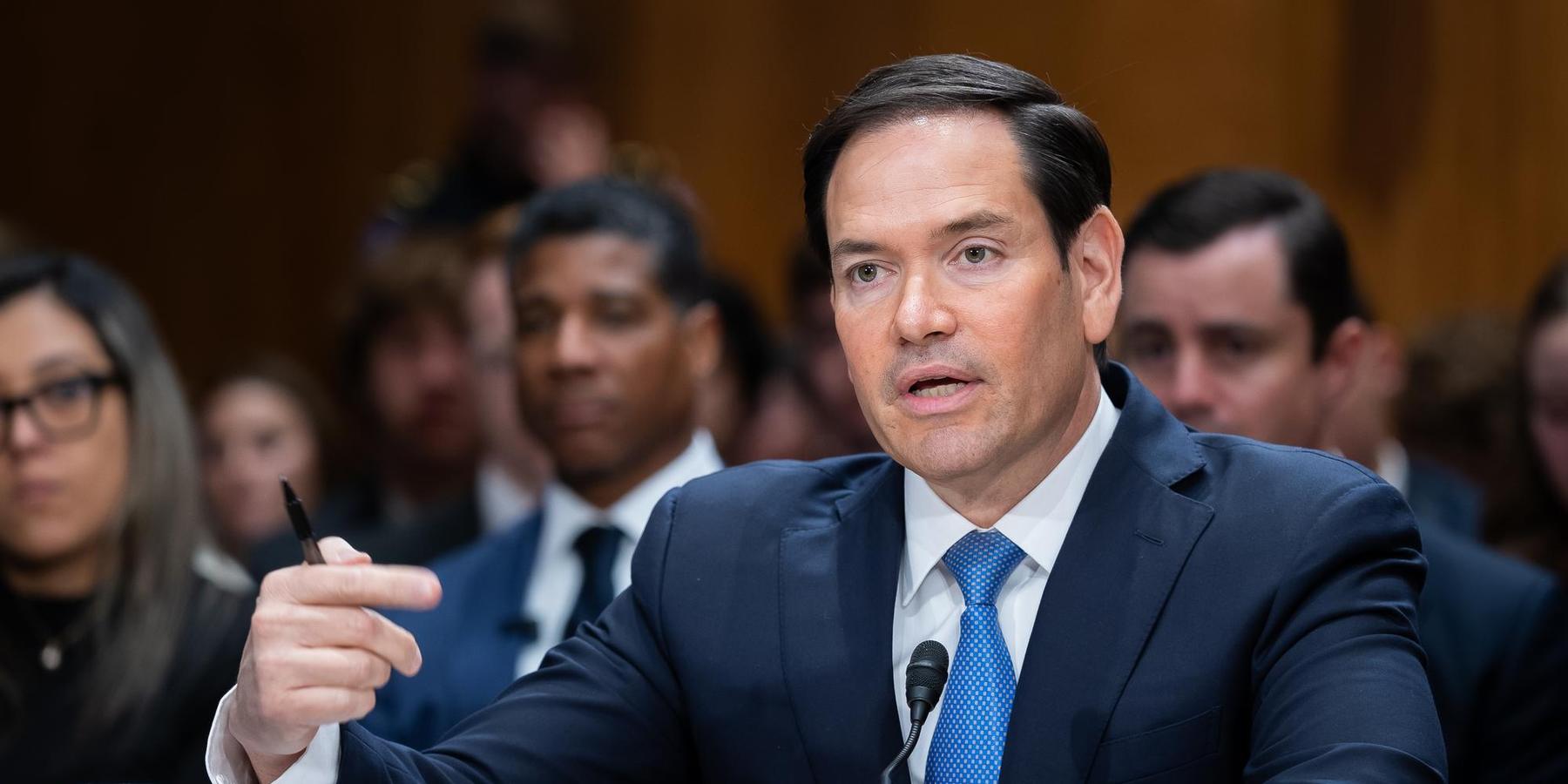
In recent remarks to Fox News, Secretary of State Marco Rubio outlined a plan to task the Lebanese army with disarming Hezbollah — an effort that could spark civil war in Lebanon.
“That’s what we’re working towards establishing, is a system that actually works where vetted units within the Lebanese Armed Forces have the training, the equipment, and the capability to go after elements of Hezbollah and dismantle them so Israel doesn’t have to do it,” he said, arguing that Hezbollah poses a threat to the Lebanese people as a whole.
Rubio’s remarks come after two rounds of direct talks between the Lebanese and Israeli ambassadors to Washington, mediated by Rubio himself. These meetings marked the first direct talks between Lebanese and Israeli representatives since 1993, and have been described as an effort to achieve a lasting peace on the Lebanese-Israeli front.
Notwithstanding Rubio’s remarks, it is unclear if the Lebanese state is on board with the supposed plan to have vetted Lebanese army units disarm Hezbollah; so far, no senior Lebanese official has confirmed the proposal Rubio laid out.
However, prior to Rubio’s statements, Lebanese Prime Minister Nawaf Salam said that enhancing the capabilities of the Lebanese army was the “only way” to disarm Hezbollah, albeit without explicitly advocating that the army use force to achieve this goal.
On the Israeli side there have been indications at least from some circles that the complete disarmament of Hezbollah can only happen from within. In recent weeks a senior Israeli military official said Israel would need to completely occupy Lebanon to disarm the group, and the only realistic option was therefore to pursue disarmament through the Lebanese state.
A new study by the Institute for National Security Studies, an Israeli think tank, included recommendations for disarming Hezbollah that are somewhat similar to what Rubio appeared to suggest. One suggestion was a training program for Lebanese army personnel similar to the ‘Dayton Plan’ implemented in the West Bank, under which security forces affiliated with the Palestinian Authority were tasked with hunting down and disarming members of Hamas.
Rubio’s statements appear to be geared mainly towards serving Israeli ends, according to Joshua Landis, a professor at the University of Oklahoma and a non-resident fellow at the Quincy Institute, which publishes RS. “Rubio is pushing forward with the Israeli agenda,” Landis explained. “The policy being pursued in Lebanon is being pursued purely for Israeli interests.”
At the same time, any effort to task army units with the disarmament of Hezbollah will face major structural hurdles, given the risks of causing unrest in the army or even across the country as a whole.
“The army is multi-confessional, mirroring Lebanese society,” retired Lebanese Army Gen. Ali Abi Raad told RS, in a veiled reference to the fact that the Lebanese military includes many Shiites in its ranks.
“If they want to establish a special force to hunt down and confront Hezbollah, this will drag the country into something worse than civil war,” warned Abi Raad. “It will lead to partition and the collapse of the Lebanese army.”
Such assessments appear consistent with a growing sense of Shiite victimhood among Shiites across the region and beyond, including in Lebanon. As Hamidreza Azizi has argued, the war on Iran and assassination of former Supreme Leader Ayatollah Ali Khamenei exacerbated already existing sentiments that the wider Shiite community is under attack.
In Lebanon’s case, Azizi argues that the heavy blows inflicted on Hezbollah in its 2024 war with Israel, as well as the latter’s more recent bombardment of predominantly Shiite areas in the south, have amplified this sense of victimhood.
Lebanese Shiite fears are likely more pronounced than those of their counterparts in other countries. Lebanese Shiites see themselves facing potentially existential cross-border threats from multiple directions, and not only from the southern front with Israel. In the eyes of a sizable segment of Lebanese Shiites, the rise to power of former Al-Qaeda commander Ahmad al-Sharaa in Syria now means having to contend with another mortal danger coming from across Lebanon’s Northern and Eastern fronts.
Further compounding Lebanese Shiite fears is a perception of a threat from within represented by the rising political influence of the Christian right-wing ‘Lebanese Forces’ party, led by former warlord Samir Geagea.
This party, known for its fierce opposition to Hezbollah, is the largest Christian parliamentary bloc, with strong representation in the Lebanese government that includes the foreign ministry and three other portfolios.
“For the overwhelming majority of Shia, as well as for a large number of Lebanese of other faiths, not only is it out of the question to disarm Hezbollah when the Lebanese army lacks the means to repel a new Israeli occupation of Lebanon, but it is better to have a parliamentary majority committed to Hezbollah’s cause than to that of the Lebanese Forces,” explained Aurelie Daher, a lecturer at Paris Dauphine University and an expert on Lebanon and Hezbollah.
These dynamics imply that Lebanon is likely to descend into chaos if army units are tasked with disarming Hezbollah. As some observers have noted, unrest may be an Israeli objective. If the situation in Lebanon spirals completely out of control, it would effectively render Lebanon a failed state, arguably making it that much easier to pursue the establishment of a ‘Greater Israel,’ as some Israeli politicians now advocate.
Post-Assad Syria serves as a good example. Israel occupied new swathes of Syrian territory in the midst of the chaos following the toppling of former President Bashar al-Assad. Israel also lobbied strongly — albeit unsuccessfully — for the partitioning of Syria along ethnic lines, which would have helped it expand its cooperation with minorities in the country.
For the United States, on the other hand, civil strife in Lebanon has little upside. Among other things, one of the likely casualties of such a scenario would be Syria, where the Trump administration has invested heavily in propping up al-Sharaa, while at the same time withdrawing American troops from that country.
“Instability in Lebanon is not good for the United States,” Landis warned. “Civil war in Lebanon will only destabilize Syria and the larger region.”
- US pressure risks plunging Lebanon into violence ›
- Why Hezbollah's 'irrational' gambit against Israel makes sense ›
- Israel's 'permanent security' quest is a policy with sinister implications | Responsible Statecraft ›
- If Trump wants out of war he needs to stand up to Israel on Lebanon | Responsible Statecraft ›
- Is Lebanon hurtling towards a Libya-style civil war? | Responsible Statecraft ›