

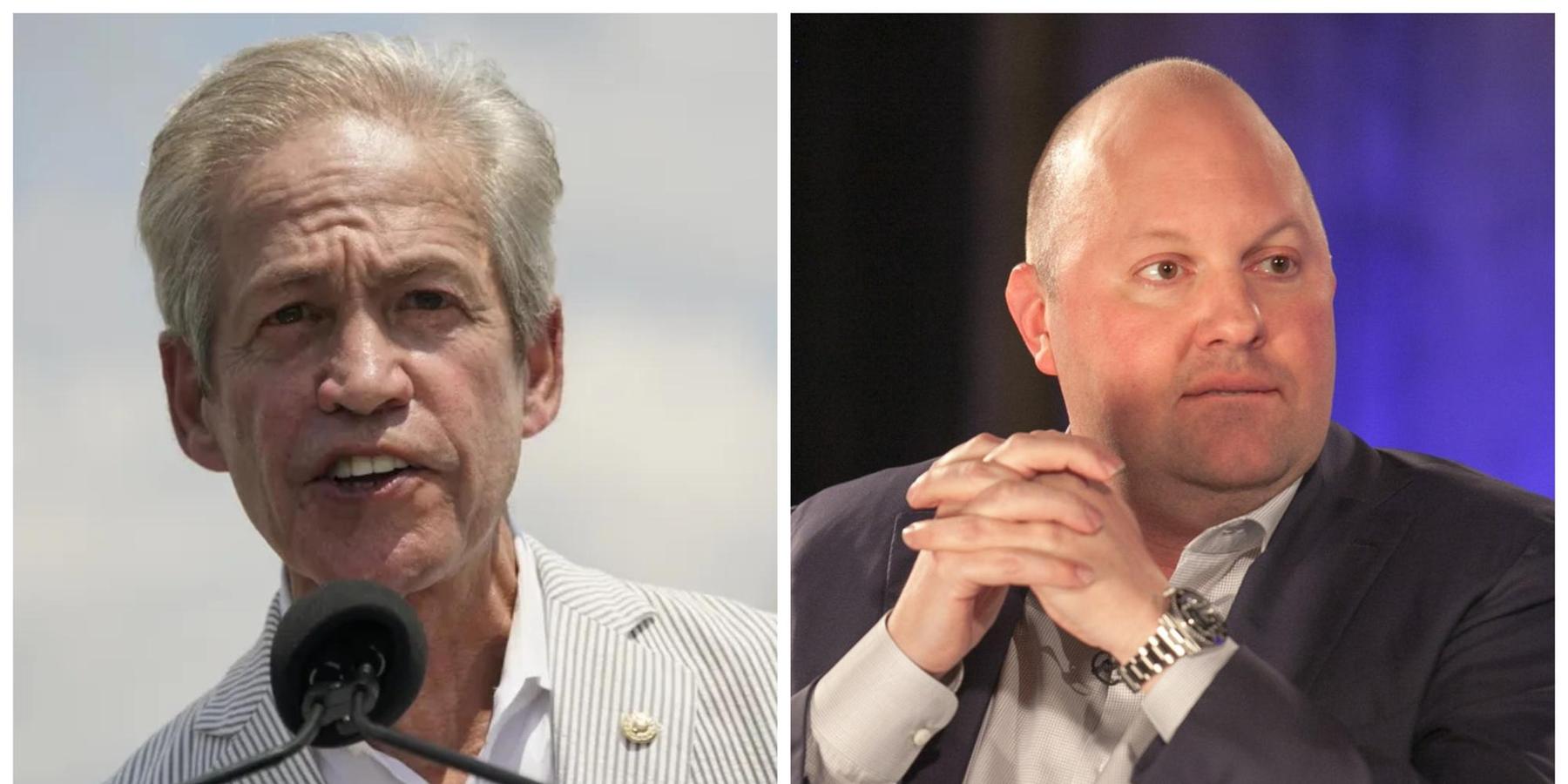
On Monday, the Department of Defense announced a new slate of appointees to the Defense Policy Board, a committee tasked with providing strategic advice and making recommendations to the Pentagon.
Media outlets were quick to highlight the Pentagon’s selection of Marc Andreessen, co-founder of a16z, as further evidence of Silicon Valley’s growing power in Washington. A16z, which claims to have raised 18% of all venture capital dollars invested in the U.S. in 2025, backs military technology startups like Anduril, Saronic, Skydio and Shield AI. All of these companies have contracts with the Pentagon.
But Andreessen is far from the only defense industry-linked member of the advisory board, which helps advise Secretary of Defense Pete Hegseth, Deputy Secretary of Defense Stephen Feinberg, and the Under Secretary of Policy Elbridge Colby. At least eight of the 15 members of the committee have close ties to the defense industry and foreign governments.
The vice-chair of the new committee is former Sen. Norm Coleman (R-Minn.), a lobbyist for the government of Saudi Arabia. Coleman played a central role in rehabilitating Saudi Arabia after the assassination of Washington Post journalist Jamal Khashoggi and the Saudi-led military intervention in Yemen.
Coleman, who also serves as chair for the Republican Jewish Coalition, was pivotal during Hegseth’s approval process, shepherding the controversial nominee around Capitol Hill and whipping votes among his former colleagues. Now, Hegseth appears to be returning the favor, appointing Coleman to the prestigious committee, where he can help direct defense policy at the highest level.
“Lobbyists for abusive foreign governments don’t belong on the Pentagon’s Defense Policy Board,” Raed Jarrar, Advocacy Director for Democracy for the Arab World Now, told RS. “You cannot take a foreign government’s money and give Americans honest advice on their own security,” added Jarrar, whose organization was founded by Khashoggi.
Theo Wold, senior counselor at Palantir, was also appointed to the committee. Palantir sells data analytics software to government agencies like the Department of Defense and CIA, and to Washington-friendly governments like Israel and Ukraine. In the first week of the war on Iran, the U.S. military used Palantir’s Maven system to help it identify and strike more than 3,000 targets.
Blake Masters, a former executive at Palantir co-founder Peter Thiel’s private investment organization, was also appointed to the committee. According to Masters’ website, he now “invest(s) in and advise(s) technology startups” and maintains a role on the board of the Thiel Foundation. Thiel largely bankrolled Masters’ unsuccessful 2022 and 2024 congressional campaigns.
Taken together, these Silicon Valley-centric choices represent a significant victory for the techno-optimists that want to slash regulation for artificial intelligence and autonomous weapons. Andreessen, in his article “Why AI Will Save the World,” argued against regulation in order to beat China. “Rather than allowing ungrounded panics around killer AI, ‘harmful’ AI, job-destroying AI, and inequality-generating AI to put us on our back feet, we in the United States and the West should lean into AI as hard as we possibly can,” he wrote. Andreessen, Thiel, and their acolytes now have another seat at the table.
Other appointees include Tom Feddo, founder of national security consulting firm Rubicon Advisors, and Michael Pillsbury, who joined defense and artificial intelligence-focused consulting firm American Global Strategies as a senior fellow a week ago. Mike Garcia, a former California congressman and Raytheon executive, is also part of the new committee.
To be sure, previous iterations of the Defense Policy Board have similarly included members with potential conflicts of interest. A Center for Public Integrity analysis of the Bush administration’s board in 2003 found that nine of the 30 members had ties to companies that have won more than $76 billion in defense contracts in 2001 and 2002, in the lead-up to the Iraq War.
Hegseth even called on one of the same members of that Iraq War-era board, Christopher A. Williams. Williams now oversees a national security consulting firm that represents a range of clients from “the ‘Top Five’ aerospace & defense prime contractors to mid-tier companies to venture capital-backed technology startups.” Williams’ firm picked up contracts with Boeing and Northrop Grumman while he advised Bush’s Pentagon.
The board is not entirely dominated by defense contractor-linked executives and lobbyists.
Hegseth also appointed Daniel McCarthy, the editor of conservative intellectual magazine Modern Age who has said there was “no reason” for the U.S. to be involved in the 12-day war with Iran last year. Rachel Bovard, vice president of the Conservative Partnership Institute and a former staffer for Senator Rand Paul (R-Ky.), was also appointed to the committee.
Two of the picks come from the America First Policy Institute, including the chair of the new board, former U.S. Trade Representative Robert Lighthizer. Hegseth also selected four fellows and alumni of the Claremont Institute, the California-based incubator for the intellectual right that disavows neoconservatism and liberal internationalism.
If and when the interests of defense contractors and America First compete with one another, the question then becomes which version of the board will win out when advising the Trump Pentagon on the challenges of the day.