

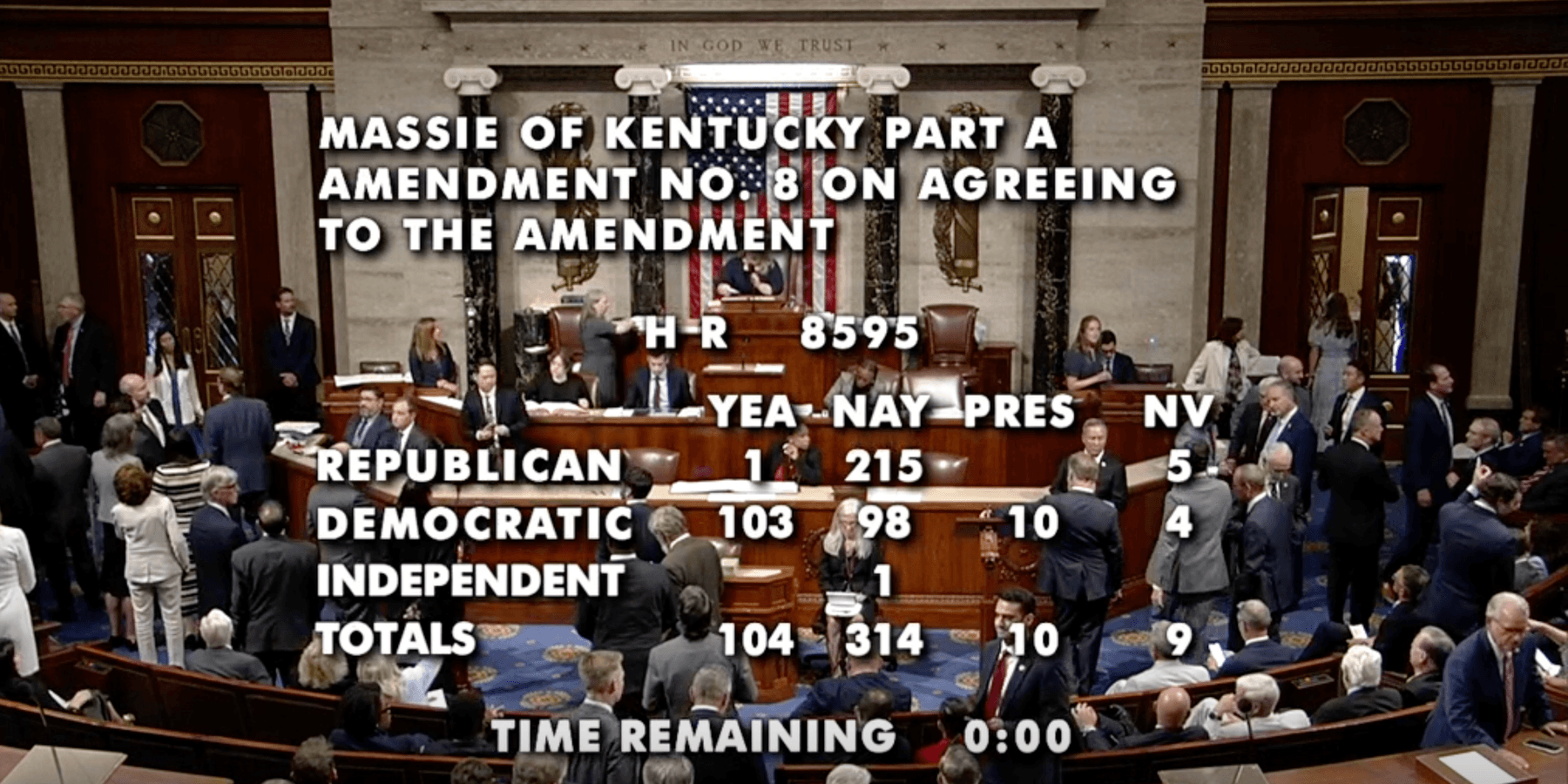
The House of Representatives voted Wednesday to block an amendment to the National Security and State Department appropriations bill that would have struck $3.3 billion in aid to Israel.
The amendment, introduced by outgoing Rep. Thomas Massie (R-Ky.), was never expected to pass given the near-unanimous opposition from Republicans. But the vote was nonetheless closely watched because of what it revealed about a growing rift among Democratic elected officials concerning the U.S-Israel relationship.
In the end, the amendment failed by a vote of 104-314. A slight majority of voting Democrats – 103 out of 201 – voted in favor. Ten Democratic members voted present.
The division among Democrats made it up to party leadership, with Minority Leader Hakeem Jeffries (D-N.Y.) and caucus chair Pete Aguilar (D-Calif.) opposing the measure, while Rep. Katherine Clark (D-Mass.), the minority whip, came out in favor.
In a lengthy statement the day before the vote, Jeffries said that the amendment was “overly broad” because it would limit “funds for longstanding initiatives,” including refugee resettlement and peacebuilding, and that it would “restrict our country’s ability to confront Hamas, Hezbollah and other terrorist organizations.”
Jeffries said he would not whip other members to vote against the amendment and acknowledged that urgent changes were needed to American policy toward Israel.
Hamid Bendaas, the communications director for the Institute for Middle East Understanding policy project, told Responsible Statecraft that, while it was “unfortunate that [Jeffries] wouldn't do what the vast majority of Democrats would want their highest ranking House member to do,” it was nonetheless notable that “he is cognizant of just how dangerous his stance is to to vote against it, and he had to try to explain that as best as he could.”
The Congressional Progressive Caucus endorsed the measure. In a letter Tuesday responding to Jeffries, Rep. Greg Casar (D-Texas), the CPC chair, lamented that “At a time when millions are struggling to make ends meet, we are sending billions of dollars to a military that has killed tens of thousands of civilians in Gaza, the West Bank, and Lebanon, destabilized the region, and helped lead us into war with Iran.” Casar noted that more than 98% of the funds that would have been removed by the Massie amendment was money for the Israeli military.
“The American people are crying out for an end to US tax dollars subsidizing Israel’s military,” he added.
Speaking on the House floor ahead of the vote, Rep. Joaquin Castro (D-Texas) added that "Words are not enough... If we hope to change Israel's behavior, we must use our leverage."
This was the first congressional vote related to U.S. aid to Israel since primary elections in New York and Colorado saw a wave of progressive insurgents defeat incumbents and more establishment-aligned candidates in races that, to varying degrees, centered the future of Washington’s relationship with Israel.
Polls continue to show that strong majorities of Democrats believe the U.S. is too supportive of Israel and oppose “providing additional economic and military support to Israel.”
“More House members are realizing that this is a demand of their voters and not voting the right way on this, in terms of voting to cut the funding to Israel, is something that leaves them vulnerable in future elections to a primary challenge,” Bendaas told RS shortly before the vote. “It's clearly people responding to political necessity, and it just shows how far this issue has moved over the last few years.”
- Congress quietly moves to integrate US and Israeli militaries ›
- Massie moves to strike $3.3B in Israel military aid from the budget ›
- House to universities: Don't you dare boycott Israel ›
- Eisenkot aims to out-hawk Netanyahu ahead of elections | Responsible Statecraft ›