

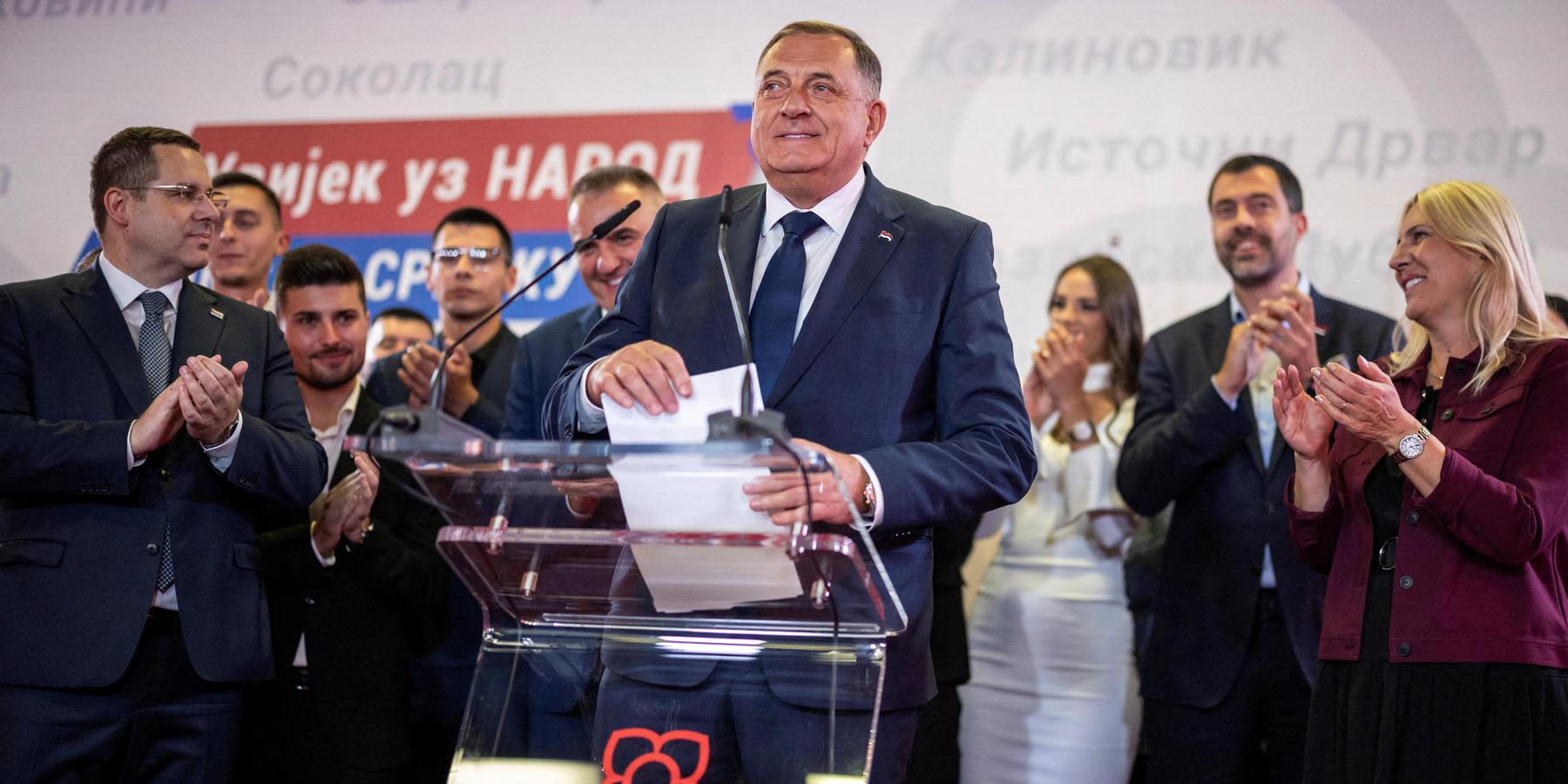
Nationalists came out on top in Bosnia and Herzegovina (BiH)’s October 4 election. Allies of Milorad Dodik, the de facto leader of the country’s Bosnian Serb entity, won decisively in Republika Srpska despite Dodik himself being barred from office, while nationalist Bosniak and Croat parties dominated in the country’s other political entity, the Federation of Bosnia and Herzegovina.
This election offered no real sign of change in a Balkan country long constrained by weak institutions, corruption, and deeply divided ethnic groups. Although BiH’s complex demographics and history necessitate some form of decentralized power-sharing, its political system has also become a vehicle for interests that benefit from continued dysfunction — including some with growing ties to President Donald Trump’s inner circle.
Dodik’s power outlasts the pressure against him
That dysfunction unfolds in a particular international context. U.S. pressure on Dodik has eased, with the Trump administration removing sanctions imposed by the Biden and Obama administrations. Russia continues cultivating its close ties with Republika Srpska, and Brussels struggles to use the prospect of European Union membership to drive reform.
The result is a fraying political order against the backdrop of an increasingly uncertain international environment.
The election also highlighted Dodik’s enduring influence. Although Dodik was prohibited from running, his Alliance of Independent Social Democrats (SNSD) secured a decisive victory.
Leila Bičakčić, the CEO of the Center for Investigative Reporting, explained that Dodik has emerged from the period of U.S. sanctions politically stronger than before, demonstrating his ability to maintain relationships with the U.S., Russia, Israel, and nationalist movements elsewhere in Europe. Therefore, Dodik’s resurgence is illustrative of how much political authority in BiH can reside outside the institutions through which that authority is supposed to be formally exercised.
That informal power has coincided with a fundamental shift in Dodik’s relationship with Washington, including Trump’s decision to lift sanctions on Dodik and his allies, which the U.S. had previously imposed in response to his separatist ambitions and alleged corruption.
Dejan Sajinovic, a Bosnian journalist from Republika Srpska, interprets the new relationship as an example of a more transactional American foreign policy. Indeed, Republika Srpska’s spending on Trump-linked lobbyists and surrogates — spending that has exceeded $4 million since the beginning of 2025 — appears to have played an important role in the Bosnian Serb leader’s efforts to win the White House’s support.
“It is a quid pro quo,” he told RS, arguing that Washington appears willing to support Dodik politically if he can help advance U.S. strategic and commercial interests in the Western Balkans. The precise terms of any understanding between the Trump administration and Dodik remain unclear, though a controversial energy deal is central to it.
The deal involves the proposed Southern Interconnection pipeline, which would connect BiH to Croatia’s gas network and the Krk LNG terminal, allowing BiH to reduce dependence on Russian gas. It is controversial because Bosnian legislation has designated AAFS Infrastructure and Energy (a recently formed Wyoming-based company fronted by Trump allies Jesse Binnall and Joe Flynn) as the project’s lead investor and operator without a competitive tender. Critics have raised concerns about transparency and AAFS’s lack of a relevant track record.
Two of Trump’s political advisers, James Blair and Chris LaCivita, were in Republika Srpska to advise the Bosnian Serb entity’s government shortly before this month’s election. Both received hundreds of thousands of dollars via a DC law firm retained by the government of Republika Srpska to promote Dodik and the SNSD.
After news of their travel to Republika Srpska fueled some controversy, Trump vowed to terminate Blair and LaCivita as his consultants if their political work in the Balkans conflicts with the White House’s interests.
Rewarding dysfunction
This election further exposed the limits of BiH’s political system, which dates back to the 1995 Dayton Accords. The agreement ended BiH’s war by creating an elaborate system of power-sharing between Bosniaks, Serbs, and Croats. But 31 years later, that architecture has become a vehicle for political paralysis, even if it has prevented the country from sliding back into war.
Tanja Topic, a political analyst based in Banja Luka (Republika Srpska’s administrative center), told RS that the Dayton framework has become “too narrow for the normal functioning of BiH,” pointing to years of blockades at the state level and constitutional provisions that discriminate against citizens who do not identify with one of the country’s three constituent peoples.
Yet Sajinovic cautions against treating Dayton as the sole source of the problem. Bosnia’s multiple identities, he argues, make some form of decentralized power-sharing unavoidable. The deeper problem is that political elites have learned to exploit the system’s complexity and veto points to protect their own influence. The election offered little evidence that those incentives are changing.
For the EU, the result tests whether enlargement can still drive political reform. Although BiH gained candidate status in 2022 and approval to open accession negotiations in 2024, talks have stalled over unmet reforms, including judicial oversight and curbing corruption. The EU agenda has faded from political debate, replaced by fears of renewed conflict. The deeper problem, Bičakčić argues, is that political elites lack interest in the rule-of-law reforms, stronger institutions, and rights that EU integration requires. If membership no longer provides a credible incentive for change, the EU risks retaining influence only on paper.
Enter Russia
Dysfunctionality in BiH creates space for Russia, which has long maintained close ties with Republika Srpska. Russian President Vladimir Putin is a close ally of Dodik, who has rejected Western sanctions on Russia and hails the Russian president as “one of the most peace-loving leaders of our time.” Dodik has met with Putin 11 times since Russia’s 2022 invasion of Ukraine, with his latest visit to Moscow only days before the October 4 vote.
Russia’s influence stems from Western failures. “Russia profits without investing any effort” by watching a state created through U.S. policy struggle to function and the EU fail to manage its own neighborhood, said Vuk Vuksanović, a lecturer at King’s College London.
Nonetheless, Moscow’s role in BiH should not be overstated. Igor Novaković, a senior associate at the International and Security Affairs Centre – ISAC Fund, sees Russia as too bogged down in Ukraine to achieve much in BiH. He believes Moscow lacks any real strategy for the Western Balkans.
“My impression is that [the Russians] are focusing on maintaining the current position, supporting, mostly verbally, some of the leaders in the Balkans,” Novaković said. “But in essence they will not go as far as to directly intervene or to do more than, let’s say, disinformation to an extent — maybe using the Western Balkans for some hybrid operations against Western Europe — but not more than that.”
The international consensus behind Dayton is eroding
Ultimately, the election highlights the erosion of the international consensus underpinning Bosnia’s fragile post-1995 order. As Sajinovic notes, BiH has functioned best when major external powers agreed on its direction and struggled when that consensus fractured. Today, divisions within Europe and between Washington and Brussels have created a vacuum that gives BiH’s political actors greater freedom to advance their own agendas.
This does not mean BiH is inevitably headed back to war. But it gives ample cause for concern.
At the same time, one must not read the election as a verdict for deeper ethnic division. Turnout fell eight points from 2022, while economic problems, emigration, and political stagnation remain pressing concerns, and many voters appear increasingly frustrated with a system that encourages ethnic competition rather than effective government or economic opportunity. Bosnia is therefore left with familiar political forces, but a more unsettled international environment marked by Dodik’s continued influence, weaker Western leverage, and Russia’s potential to exploit those divisions.
Whether BiH can move beyond this cycle will depend on whether its political leaders can find a new domestic compromise, and whether the United States and Europe can once again agree on what that compromise should achieve.
- What did Netanyahu know before Oct. 7? ›
- What NATO leaves behind as it pulls back from Kosovo ›
- 30 yrs later: The true story of the US role in the Bosnian 'peace' ›