

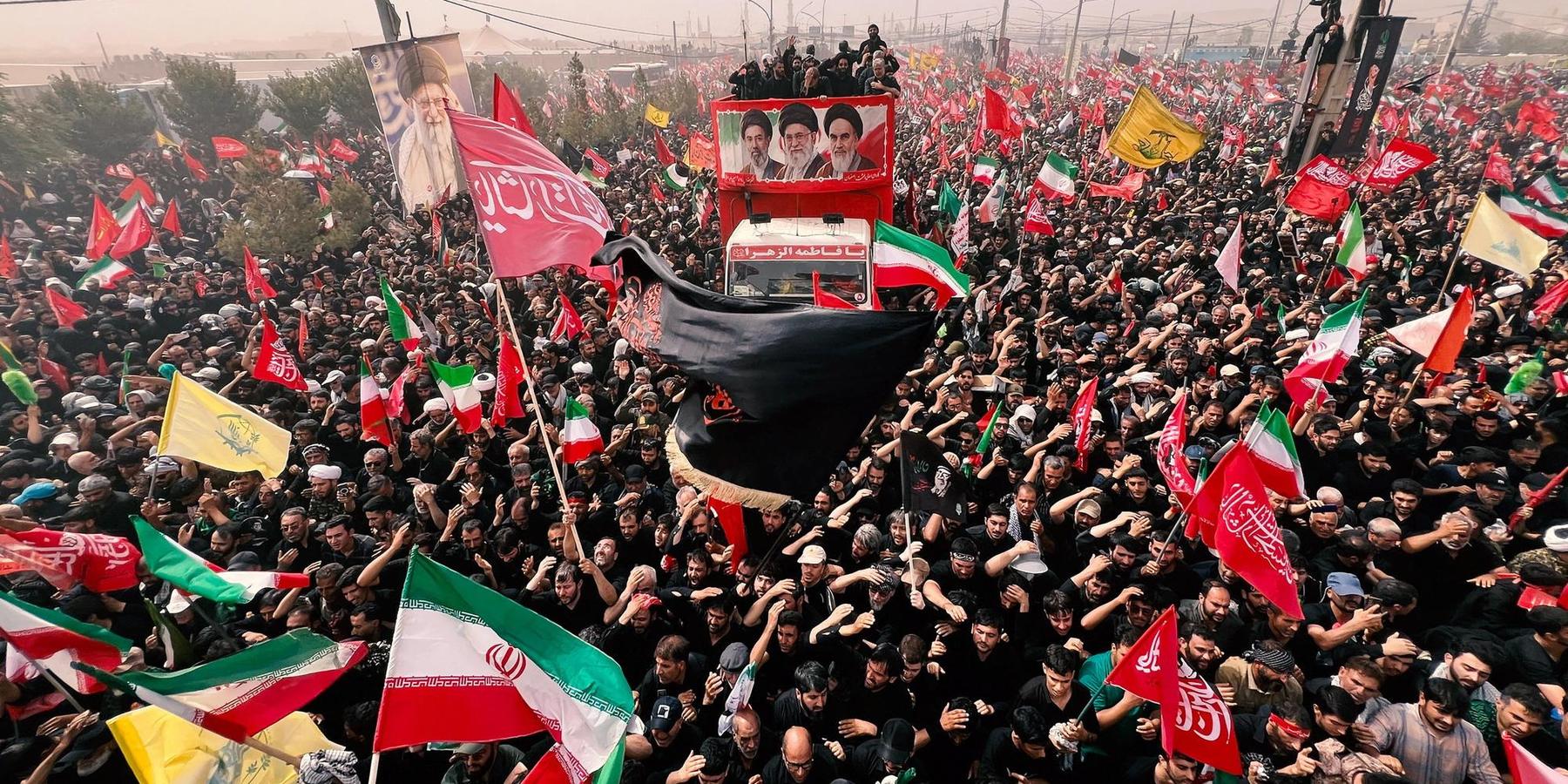
Meticulously choreographed, this week's funeral ceremonies for Ayatollah Ali Khamenei across Iran are honoring the country's highest political and religious authority, while also projecting a carefully calibrated message about Iran’s future.
In essence, Tehran is affirming both the continuity of the Islamic Republic under its new Supreme Leader, Ayatollah Mojtaba Khamenei, and the country’s increasingly pronounced orientation toward a non-Western geopolitical order.
Despite the assassination of Khamenei during this spring's American-Israeli war on Iran — widely referred to by Iranians as the “third imposed war” — the Islamic Republic survived, and efforts to bring about regime change ultimately failed.
“Iran is using the funeral to communicate that the Islamic Republic has survived a historic transition, that the succession has taken place successfully, and that the political system remains intact despite external pressure," said Ghoncheh Tazmini, author of Power Couple: Russian-Iranian Alignment in the Middle East.
“The scale of the funeral also projects national unity and institutional continuity,” she told RS, stressing that these ceremonies (the funeral in Tehran was expected to draw 20 million people) extend beyond commemorating a fallen leader; they serve as a public reaffirmation of loyalty to the Islamic Revolution and the doctrine of velayat-e faqih.
“Iran’s official narratives emphasize that the Revolution is institutional rather than personal and that its legitimacy does not depend on any one individual,” she added. “Official Iranian commentary also frames the large public participation as evidence that decades of sanctions, military pressure, and efforts to isolate Iran have failed to undermine public commitment to the Islamic Republic.”
Domestically, the Iranian leadership seeks to reinforce the government's legitimacy through revolutionary and religious narratives while projecting an image of stability to the broader population. Although the large crowds attending the funeral ceremonies should by no means be taken to represent all or even a strong majority of Iranians in a country of 92 million, the scale of the mobilization nevertheless underscores the state's capacity to maintain an organized and committed support base.
While recognizing the extent to which Iran “remains deeply polarized” and has complicated political realities, Sina Toossi, a senior nonresident fellow at the Washington-based Center of International Policy, told RS that the government’s ability to command public backing and rally its loyalists matters because, “many U.S. assumptions about regime change have rested on the idea that external pressure would produce state collapse or a mass uprising.”
“In many respects, military confrontation and maximum pressure have strengthened the state's security narrative and shifted the domestic balance of power away from homegrown civil society and toward the security establishment,” he noted.
A new Supreme Leader
With Iran’s third Supreme Leader at the helm, the strategic doctrines of his father are likely to be preserved. It is safe to conclude that the institutions surrounding him favor policy continuity, not reform. Yet Ayatollah Mojtaba Khamenei will probably differ from his two predecessors in some significant ways.
The high level of support he gets from the Islamic Revolutionary Guard Corps along with his “security-minded approach” will slightly distinguish him from his father, according to Sina Azodi, assistant professor of Middle East Politics at George Washington University, who also noted that the new leader comes bearing significant personal loss: not only his father, but other family members were killed in the first day of the war too.
Given this, Azodi described Ayatollah Mojtaba Khamenei as seemingly “angry” and “willing to take more risks” than his father.
The younger Khamenei, however, brings to the table significantly less public experience and visibility than his father, who served as president during the Iran-Iraq war before his selection as Supreme Leader. His challenge will be to build legitimacy amid a period of of extremely serious security dilemmas.
The new Ayatollah was conspicuously absent from the funeral ceremonies. Officials say his appearance could expose him to an Israeli attack or reveal intelligence about his whereabouts. But his absence has drawn speculation about his condition. Injured in the attack that killed his father, the Supreme Leader's current health remains unclear.
Embracing Eurasian integration and multipolarity
Irrespective of what comes out of the “Islamabad Memorandum of Understanding” and the U.S.-Iran talks, Iranian foreign policy under Ayatollah Mojtaba Khamenei will place greater emphasis on deterrence and national security, with the leadership in Tehran focused on strengthening ties with non-Western actors amid growing skepticism, if not hostility, toward the United States and Europe.
The roster of foreign delegations attending the funeral ceremonies provides a revealing snapshot of Tehran's regional and international position. The participation of representatives from Iran’s neighbors, including Armenia, Oman, Qatar, Saudi Arabia, Pakistan, and Turkey, alongside China, India, and Russia, contrasted with the conspicuous absence of most Western governments, illustrates the depth of Iran’s diplomatic engagement across the non-Western world.
“The attendance list offers a snapshot of Iran’s geopolitical position after the war," said Negar Mortazavi, a Washington-based journalist, host of The Iran Podcast, and a senior fellow at the Center for International Policy, in an RS interview.
"The presence of regional allies, strategic partners, and countries from the Global South signals that Iran remains an important regional power and is far from internationally isolated,” she added. If anything, it spells out its anchoring to a non-Western global order.
“The absence of European governments is equally telling. From Tehran’s perspective, Europe was not a neutral actor in the war. Iranian officials argue that many European states politically backed the U.S. and Israel, and in some cases provided military or intelligence support," Mortazavi charged. "Their absence therefore reflects not only the continued rupture in Iran-Europe relations, but also Tehran’s view that Europe’s role has shifted from diplomatic interlocutor to political adversary."
More than a funeral
These developments confirm that Iran's leadership transition is reinforcing, as opposing to disrupting, the Islamic Republic's longstanding political and strategic trajectories.
“The martyred Supreme Leader leaves behind not only a political office but a strategic doctrine that shaped Iran’s relations with the U.S., Israel, and the wider region for nearly four decades. Whether one agrees with that doctrine or not, understanding his role requires recognizing that he was not merely a symbolic figure. He was a deeply experienced political strategist whose influence extended far beyond Iran’s borders,” Tazmini told RS.
“Perhaps the most important point is that this funeral should not be viewed simply as a ceremonial event. It represents a moment in which the Islamic Republic is demonstrating continuity at a time of historic transition.”
- 'Regime change' might be biggest failure in Operation Epic Fury ›
- Israel's assassination game: Take all pragmatists off the board ›
- Symposium: What happens after Iran's sudden 'decapitation' ›