

This article is part of an RS series reflecting on the 250th anniversary of American Independence and its impact and meaning for modern U.S. foreign policy, war, and peace.
On the Fourth of July, 1821, the 45th anniversary of the Declaration of Independence, Secretary of State John Quincy Adams stood before his fellow citizens in the House of Representatives. Rather than flatter them, Adams warned them.
America, he said, “goes not abroad, in search of monsters to destroy.” Were she ever to do so, the fundamental maxims of her policy “would insensibly change from liberty to force… and she might become the dictatress of the world. She would be no longer the ruler of her own spirit.”
He chose the anniversary deliberately, treating the country's birthday as a day not only to celebrate America but to warn it. As we mark 250 years of American independence, that habit of self-examination is worth recovering, because Adams described the country we have become.
We usually tell the story as a fall from grace. In the beginning, the founders kept us out of foreign quarrels. Washington's Farewell Address counseled against permanent alliances. Then, somewhere along the way, we went off the path, traded a republic for an empire, and became the restless armed power the world knows today.
It is a comforting story. It is not true. The United States did not drift into intervention. It was born intervening.
The Declaration of Independence was itself an indictment, a list of a king’s abuses grave enough to justify war. Among the charges that its principal author, Thomas Jefferson, laid against King George III was that he “kept among us, in times of peace, Standing Armies without the Consent of our legislatures.” Jefferson would become the nation’s first secretary of state, the founding head of the department we have since hollowed out.
Now consider what the founding generation did, as opposed to what it said. Between 1776 and 1864, the young republic undertook 64 military interventions. Almost none were in Europe, which is where the founders counseled staying out. They were close to home. Nearly half fell on Latin America and the Caribbean. Many more were waged across the continent itself, against sovereign Native nations, in the long campaigns we politely call the Frontier Wars.
We do not usually count those as foreign policy. They happened on land that is now American, so we file them under settlement, or expansion, or national growth. But that land was foreign when the fighting began, and became domestic only because we won.
To classify those wars by today's map is to let the conquest define the crime. The treaties settle the question. Between 1778 and 1868, the United States signed 366 treaties with Native nations, and by the same constitutional act used for treaties with France or Britain. A treaty is the most formal instrument of foreign relations a state possesses; you do not sign one with a people you consider your own. These were sovereign nations, recognized as such, before they were fought, removed, and dispossessed.
The Declaration named Native peoples exactly once, as the “merciless Indian Savages” the king had supposedly loosed upon the frontier. They appear as a threat to be feared, never as nations to be honored, and the republic spent a century making and breaking treaties with them as nations. When Congress ended the practice in 1871, it passed a law declaring that no tribe would any longer be recognized as a power “with whom the United States may contract by treaty,” ending by statute the formal recognition of Native sovereignty that had structured relations for nearly a century.
So the founders both warned and did. Adams himself, who cautioned against hunting “monsters,” helped author the Monroe Doctrine and pressed expansion into Florida. This is the founding pattern. Early America was not isolationist. It was selectively so. It stayed out of Europe, where war was costly and offered little, and was relentlessly forceful in its own neighborhood, where force was cheap and the rewards were land and standing.
The warnings against entanglement were never a doctrine of restraint. They were a doctrine of focus.
Seen this way, the rest of our history is not a fall but a pattern that scales, across the continent to the Caribbean and Pacific to Europe and Asia and, eventually, nearly everywhere else. The geography widened. The reflex held.
What changed in our own time is not the reflex but the rate. From the founding through the Second World War, the United States intervened abroad roughly once a year. During the Cold War, the rate climbed. Then, at the moment we expected the country to rest, it accelerated.
After the Cold War ended, America doubled its Cold War rate, to about 4.6 interventions a year. Dying by the Sword, a project I led alongside international relations scholar Sidita Kushi, documents and confirms every case from 1776 through 2019, and across that whole span the country has not passed a single year without a military intervention since 1974. The total approaches 400. U.S. foreign policy since only extends the line.
The surprise is in the timing. We assume war tracks danger: more threat, more force. But the busiest stretch of American intervention came after the Soviet Union fell, when no rival of comparable strength remained and no enemy threatened our survival. The threat went down. The intervening went up.
US National Interest and Intervention Patterns, 1776–2019
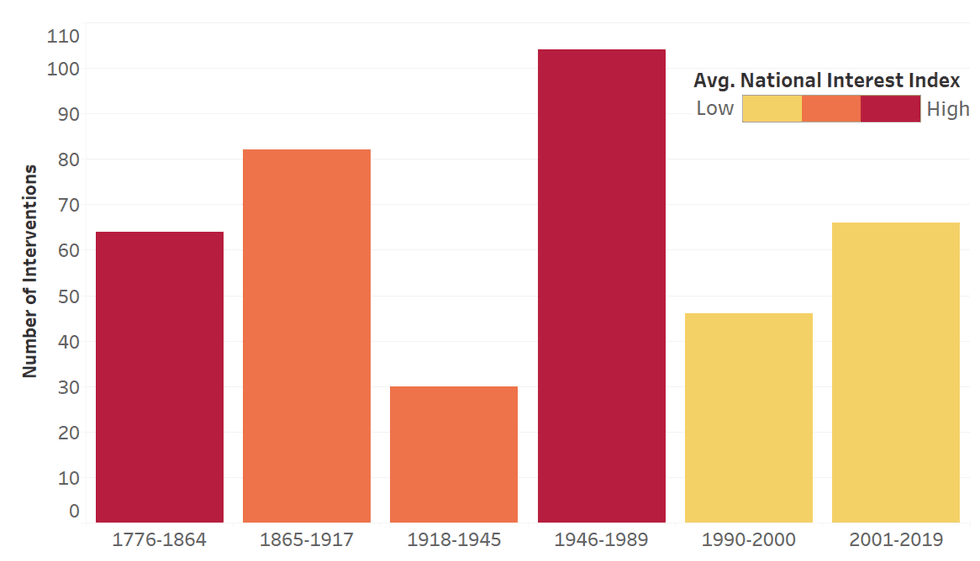 Source: Dying by the Sword: The Militarization of US Foreign Policy, Monica Duffy Toft and Sidita Kushi (Oxford, 2023), p. 25
The evidence cuts deeper. As America escalated after the Cold War, other states did the opposite. They lowered their hostility toward us, and after 2001 they initiated fewer disputes than in any earlier era. We were also intervening over interests that mattered less. By our own measures, the unipolar decades combine the lowest stakes in our history with the highest rate of force. Our adversaries were backing down. We reached for the gun anyway.
A rival disciplines a great power. Every use of force during the Cold War had to be weighed against the risk of confrontation with Moscow, and that weighing imposed a restraint that had nothing to do with virtue. Remove the rival and you remove the discipline. The threshold drops, and a country that once balanced force against diplomacy and trade begins to treat force as the answer to everything.
This is the turn from statecraft to what I have called kinetic diplomacy: diplomacy conducted by armed force, with the secretary of state's old department starved while the Pentagon swells. It is how a superpower slides into the posture of a bully, reaching by reflex for the hammer because it has let its other tools rust.
Here is the hardest part to write. The hammer mostly does not work today. Ivan Arreguín-Toft documented why strong states lose to weak ones, and his finding is plain: when a great power brings overwhelming force against an adversary who refuses to fight on its terms, it tends to bog down, alienate the population it claims to help, and lose over a time span that favors the weak. Force succeeds only when it is limited and tied to a concrete objective it can actually achieve. Unbounded, it fails.
And then there is the water. Since last September, in the Caribbean and the Eastern Pacific, American forces have destroyed scores of small boats allegedly carrying drugs, killing more than 200. Most victims of these strikes were never charged, never tried, never named. What began as a campaign against traffickers became a blockade, and then a war: in January we seized the president of Venezuela and flew him out of his own country.
It is the oldest American habit: use force in the neighborhood, where it is cheap and the victims have no standing to object. And it is the easy victories close to home that breed the confidence to reach farther, to believe the same hammer will land on Iran. Jefferson indicted his king for “depriving us, in many cases, of the benefits of Trial by Jury.” We now deal death at sea with no trial at all, and call the dead unlawful combatants in a war we declared upon them.
We are watching the hammer fail in real time.
Last summer the United States struck Iran's nuclear facilities and declared the program “obliterated.” American intelligence later assessed that the strikes had delayed, not destroyed, Tehran's capabilities. Months later, American aircraft were returning to hit Iran again. Military force had achieved what it often does: a temporary setback mistaken for a permanent solution.
This is what Adams foresaw on America’s 45th anniversary: the maxims changing, insensibly, from liberty to force. Not a single betrayal but a slow drift, each step reasonable, the country at the end of it no longer the ruler of its own spirit.
It need not end there. The founders were not pacifists, and they were not innocent; they built the very pattern this essay traces. But they also left a warning against it, and the warning was right even when they were not. They knew force was finite, that it traded against every other national good — that a republic that spent it carelessly would find it gone when the stakes were real. They said so, and then often did the opposite.
The task now is to honor the warning they failed to honor themselves.
- America's compulsion to intervene is intact and ready for more ›
- America's modern addiction to the big stick ›
- Seeing in real time why founders kicked monarchy to the curb | Responsible Statecraft ›