

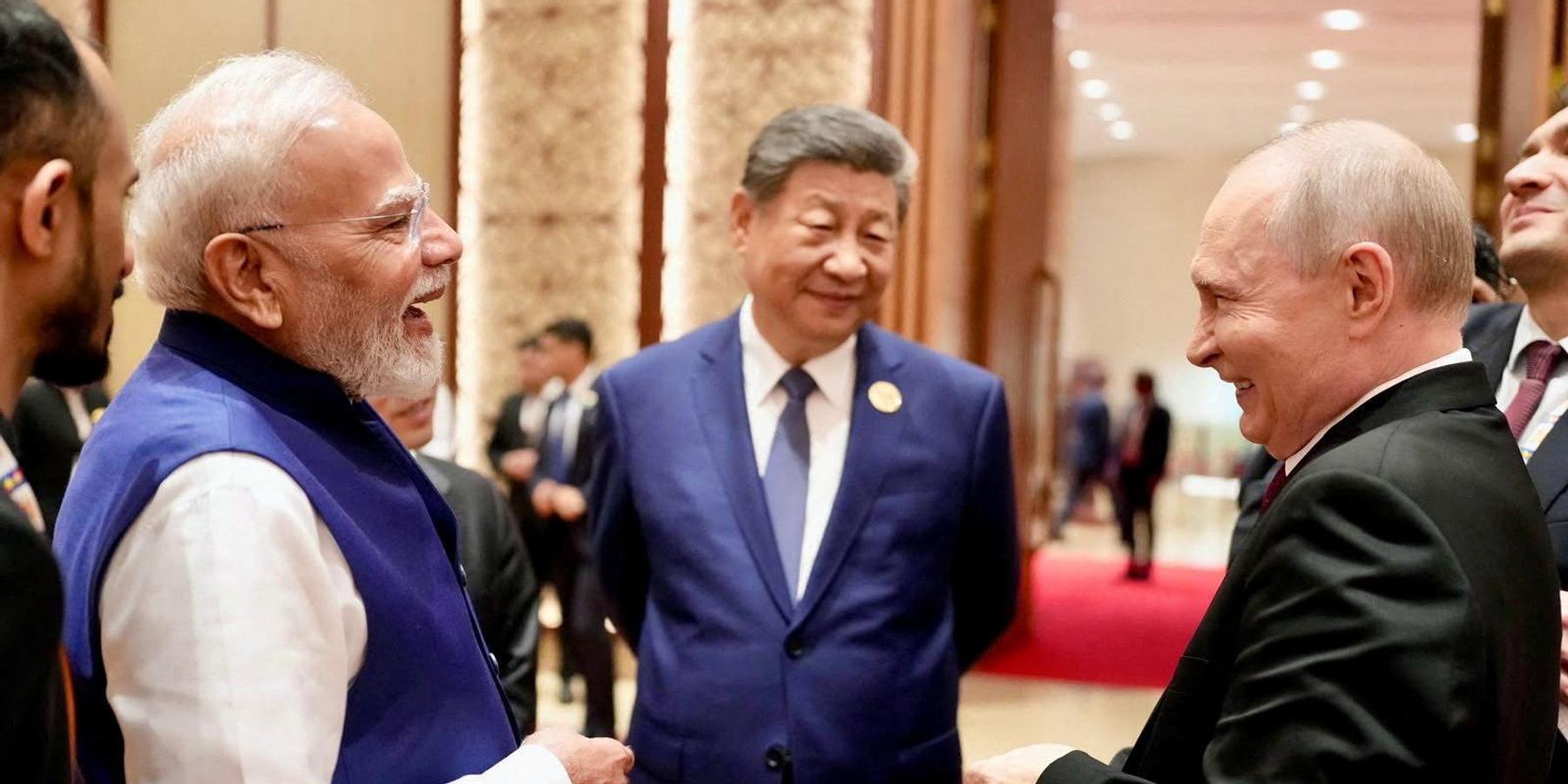
The 18th summit of BRICS, a grouping with ten members including Brazil, China, India, Indonesia, Russia, and South Africa, concluded in New Delhi with a leaders declaration — a clear success for an event that brought together a deeply divided group of countries, including some currently fighting on either side of a war in the Middle East.
Key world leaders attended, including Chinese President Xi Jinping, Russian President Vladimir Putin, Iranian President Masoud Pezeshkian, and Egyptian leader Abdel Fattah el-Sisi. There was, of course, the expected pageantry. Malaysian Prime Minister Anwar Ibrahim even belted out a 1960s Bollywood hit at the leaders’ dinner party to the admiration of his Indian hosts.
This success was not guaranteed. Just a few months previously, BRICS foreign ministers had failed to agree to a joint statement amid acrimonious exchanges between Iran and the United Arab Emirates, which have exchanged missile barrages amid the ongoing war in the Middle East. Despite these serious rifts, host India managed to pull off a declaration that everyone signed on to.
The price of this success, however, was much-watered down language on the Middle East war. The summit declaration in Rio de Janeiro last year had come out swinging, stating that “we condemn the military strikes against the Islamic Republic of Iran since 13 June 2025, which constitute a violation of international law and the Charter of the United Nations.” In New Delhi this past weekend, the grouping merely expressed “deep concern over the continued escalation of tensions in Middle East/West Asia.” It recalled “our respective national positions” and called for “exercising maximum restraint, as well as avoiding actions that could further aggravate the situation.”
Admittedly, India’s task was tougher than Brazil’s had been, with the war having escalated since late February 2026 to include the UAE as a combatant. It is extremely difficult for a club to reach any sort of consensus if two of its members are physically brawling. From this perspective, the New Delhi declaration was a win for India. But it was more a relief than a victory for BRICS as a whole. The grouping did not need the distraction at this critical juncture in its journey.
Beyond the Iran-U.S. war, there were other notable aspects to the declaration. Mysteriously, all references to the Ukraine conflict were dropped. The European war had been consistently mentioned in BRICS declarations since Russia invaded in 2022. Last year, the text had even included language that largely reflected the Russian position on Ukrainian attacks on three sites.
One welcome new feature of the text was a paragraph on Cuba, expressing "deep concern" on the "tightening of unilateral blockade measures (and) their adverse effects on the Cuban economy...and the worrying humanitarian impact on the Cuban people.” U.S. pressure on Cuba has grown manifold since last year. Havana is now a “partner country” within BRICS, a lower tier of membership. The text was clearly a nod to its concerns. But feelings against the embargo and blockade against Cuba run high in the United Nations. Practically all member states have repeatedly gone on record opposing them.
Like last year, Israel was mentioned by name and criticized for its actions in Lebanon. The text also maintained the strong language on Gaza from earlier years. Concern was expressed at "arrangements that may prejudice the inalienable rights of the Palestinian people and legitimize or prolong occupation." There were no references to the U.S.-initiated "Board of Peace" in the text, even though BRICS states Egypt, Indonesia, and UAE are among its members, as are partner countries Kazakhstan and Vietnam.
Finally, the text expressed strong criticism of the “imposition of unilateral coercive measures that are contrary to international law,” emphasizing that “unilateral economic sanctions and secondary sanctions, have far-reaching negative implications for the human rights, including the rights to development, health and food security, of the general population of targeted states.” It further characterized such measures as “undermin(ing) international law and the principles and purposes of the UN Charter.” This language was a clear dig at the United States and its European allies. Many Global South states feel highly vulnerable to the U.S.-led global sanctions regime.
Having launched some successful initiatives like the New Development Bank, and with its major expansion phase now behind it, BRICS finds itself at a crossroads. The growing pains of expansion are manifest, and the outbreak of multiple wars in the world couldn’t have come at a worse time. It will take some time for new members to be adequately socialized in the grouping. Over the next year or two, BRICS will need to take a deep breath and find its footing again if it is not to lose its mojo.