

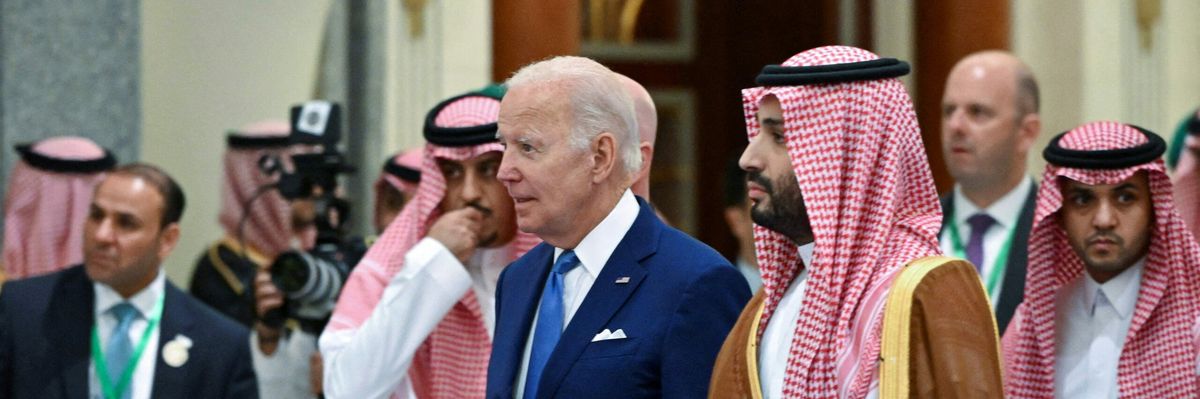
The Biden administration has failed to follow through on any of its threats to hold Saudi Arabia accountable, and according to a new report they have no intention of imposing any costs on their government.
The Wall Street Journal reported last week that the administration was dropping its threats against the kingdom that it made in response to Riyadh’s role in pushing through the OPEC+ oil production cut in October. The White House’s anger over the cut had already cooled shortly after the midterm elections, and since then the administration has been only too quick to cater to Saudi requests.
The administration went so far as to lobby against a new Yemen war powers resolution, which could have forced an end to the remaining U.S. intelligence support for the Saudi government’s campaign. As the Journal report notes, the administration was working with Saudi officials to defeat the measure.
Under Biden, the U.S. not only doesn’t use its leverage to pressure Saudi Arabia to change its behavior, but it also applies pressure on members of Congress to satisfy the Saudis. Far from “recalibrating” the relationship with Saudi Arabia, the U.S. reliably gives in to Saudi pressure and does nothing to respond even when their government acts directly against U.S. interests.
There was a moment last fall when it seemed as if Saudi crown prince Mohammed bin Salman had finally antagonized Biden and Democrats in Congress once too often and might pay some price for it. The production cut directly contradicted a secret agreement that the U.S. and the Saudis had made earlier in the year, it benefited Russia, and it came just before the midterm elections, so it seemed designed to infuriate the administration and its allies.
Despite all that, the administration ended up taking the path of least resistance and allowed Saudi Arabia to get away with doing whatever it wanted. Biden already signaled with his visit last summer that the Saudi government could act with impunity, and the climbdown in the last few months has confirmed that the U.S. will never penalize its Saudi client for anything.
A conveniently timed Saudi warning of an “imminent” Iranian attack in November led to increased U.S.-Saudi cooperation in the weeks after the dispute over the production cut. The attack never took place, and it is possible that there was never going to be one, but the warning served to distract the administration from its earlier disagreements with the Saudi government.
Administration officials now boast that a U.S. show of force in the region prevented the attack. The report quotes Colin Kahl, under secretary of Defense for policy, as saying, “We think the combination of that rapid intelligence sharing and repositioning [of military assets] is what backed the Iranians off.” While this is possible, another explanation is that both the Saudi and U.S. governments exaggerated the potential threat to Saudi Arabia to shift attention away from the rift in the relationship and towards Iran.
Increasing military cooperation with Saudi Arabia is exactly the wrong thing for the U.S. to be doing, whether the target of that cooperation is in Yemen or Iran. The U.S. should be looking for ways to reduce and ultimately end the military assistance it provides to the Saudis, including arms sales. This is important for the U.S. so that it is no longer aiding and abetting Saudi crimes, but it is also essential for correcting U.S. overinvestment of resources in the Middle East. The U.S. should not be embarking on the “new military and intelligence projects” that the report mentions, but should instead be scaling back its military involvement in the region.
Unfortunately, the Saudi government can rest assured that it has nothing to fear from Congress or the Biden administration. No matter what anyone in Washington may say against the Saudi government’s many abuses and war crimes, there are never any practical consequences. Mohammed bin Salman has learned over the course of both the Trump and Biden administrations that he can ride out any backlash because he can count on reliable U.S. backing no matter how many dissidents he kills and no matter how many civilians his forces and proxies kill in Yemen.
Empty threats of punishment have only made the crown prince even more arrogant and contemptuous of the U.S. as our officials hasten to “reassure” him every time he undermines American interests. This is likely to make the crown prince more reckless in the future, and it will become even more difficult to rein in his abuses. The U.S. confronts an increasingly dangerous and repressive Saudi leadership that believes it can ignore Washington’s requests while getting reflexive support.
Saudi Arabia is a principal example of how U.S. enabling produces worse and more destabilizing behavior. Barry Posen has called this “reckless driving”: clients are so sure of U.S. backing that they act irresponsibly and dangerously on the assumption that the U.S. will bail them out and shield them from the consequences of their actions. Few clients have proven to be worse reckless drivers than the Saudis.
As Posen explained it in his book, Restraint, “Secure in the knowledge that the United States will serve as the military lender of last resort, they invest in policies that redound to the political disadvantage if the United States, which can ultimately precipitate real military costs.” The one-sided U.S.-Saudi relationship doesn’t just shortchange American interests, but it also puts the surrounding region in greater jeopardy as the Saudi government is encouraged to act more aggressively.
The favorable treatment accorded to Saudi Arabia might make more sense if the client state that the U.S. accommodates and indulges like this were reliable and useful in advancing American interests, but the Saudi government is neither of those things. Saudi Arabia is a security dependent and a liability, and the war their government has waged for almost eight years against Yemen has been a destabilizing disgrace that implicates the U.S. in their crimes.
The relationship has become almost entirely a one-way affair in which the client expects and demands protection, weapons, and support and the U.S. automatically provides all of it without receiving anything in exchange. The U.S.-Saudi relationship is indeed transactional, but in these transactions the U.S. is always left empty-handed and burdened with additional commitments. A transaction in which only one party benefits is usually called a scam, and that is how the relationship with Riyadh should be viewed.
No one expected Biden to make Saudi Arabia a “pariah” state, but his determination to treat the U.S.-Saudi relationship as business as usual has been one of the biggest mistakes that he has made over the last two years. It makes a mockery of Biden’s democracy and human rights rhetoric, and it is also a grave disservice to U.S. interests. The Biden administration will come to regret its preference for going “back to basics” in the Middle East as the Saudi government continues to take advantage of their overindulgent attitude.