

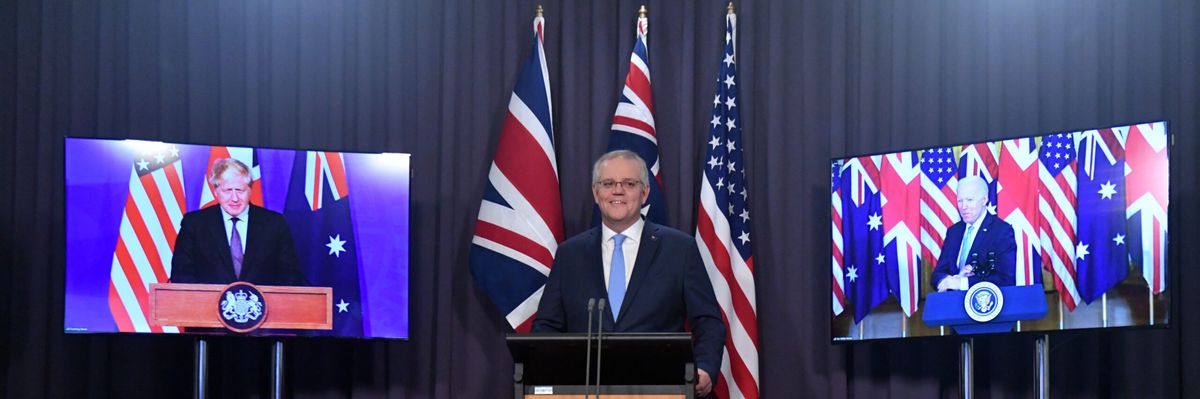
The announcement that the United States and the United Kingdom will help Australia build nuclear submarines, enhance U.S. troop presence, and jointly collaborate on cyber, artificial intelligence, and quantum technologies has been generally hailed in Washington.
However, the new alliance (which the nations have named the awkward-sounding AUKUS), will only add to the dark clouds hovering over Asia. It catapults Australia into the ranks of “frontline states” in a U.S.-led strategy toward China that looks less like balancing and more like containment with every passing year, with attendant arms races and potential for military crises.
Make no mistake, AUKUS is only the latest in an ever-denser web of military interconnections Washington is helping weave around China. The Quad (U.S.-India- Australia-Japan), India-France-Australia, US-Japan-India, and India-Japan-Australia have supplemented the US-Japan-Australia Trilateral Strategic Dialogue that was inaugurated in 2001. The U.K.’s entry into these China-centric minilaterals has however come with a particularly potent edge — the nuclear dimension. This may be because the three Western powers perceive a special civilizational bond with each other, with accompanying anxieties about the rise of an Asian peer.
Except for India, all participants in the Washington-led minilaterals are U.S. treaty allies. The anomalous status of New Delhi is being made up through socialization and opinion-making among elites, along with arms sales and “foundational” defense agreements. Military interoperability and joint war-fighting exercises are at the core of most of these groupings. In fact, the best geometry describing these trilaterals and quadrilaterals is that of a sharp arrow, with its tip aimed straight at Beijing.
A repetitive stream of rhetoric has accompanied these initiatives. We are constantly told they stand for the “rule of law,” “freedom of navigation,”” inclusivity” and so forth. But the irony of the past 20 years of a U.S.-led expansive “war on terror” across the Middle East, with its 900,000 dead, $8 trillion largely wasted, many violations of international law, and severe erosion of America’s own cherished values of liberty and limited government, surely cannot be lost on any objective observer. The fact is that the United States and the United Kingdom are simply in no position to lecture China or anyone else on the norms and values question unless they demonstrate serious accountability and reparations for their destructive actions since 9/11.
In their joint remarks, President Biden and Prime Minister Morrison were at pains to dispel any impression that the submarine project involves nuclear weapons. But AUKUS was justified in terms of “rapidly evolving threats.” Couldn’t further such perceived “evolution” open the door to an Australian nuclear deterrent? The submarine designs in question could easily accommodate such a shift. Any security rival must take this possibility into account. China can logically be expected to take countermeasures.
But it is not just China that will perceive a threat from AUKUS. The Australian defense minister’s assertion of seeking “regional superiority” will alarm its Southeast Asian neighbors, especially Indonesia. Though Jakarta’s ties with Canberra have improved markedly in recent years, the two share a contentious past that could come alive again if a new cold war accelerates in Asia. In its single-minded taking up the cudgels against Beijing, Canberra may have bitten off more than it can chew.
Australia is a non-nuclear state with a historically hawkish stance toward non-proliferation. But as nuclear experts have pointed out, nuclear submarines of the sort that the US and UK will build for Australia are prone to proliferation with Highly Enriched Uranium as fuel. Naval reactors are mostly excluded from international nuclear safeguards. But we should not be surprised that proliferation concerns have taken a backseat to China-containment. In the 1980’s the nuclear ambitions of another “frontline state” — Pakistan — were willfully ignored as Washington embraced a dangerous strategy of arming and training Salafi militants in Afghanistan as a part of the Cold War containment strategy against the Soviet Union.
Such a non-state option is not seen as viable to counter China, which increases Washington’s emphasis on Cold War-style alliance building. But China is no Soviet Union. The two states are similar in terms of their penchant for domestic repression. But Moscow pushed a revolutionary project to remake the global economy and install Marxist-Leninist oriented regimes across the world. China’s excessive maritime claims and assertive actions in its backyard are clearly of concern. But these actions do not threaten the U.S. mainland, which is where most Americans live.
Also, Beijing’s territorial claims do not originate so much from the Chinese Communist Party as from the Chinese nation-state itself, ironically governed back then by the Kuomintang, which later founded the Taiwanese state. Which explains why Taiwan has similar claims and maintains militarized islands in the South China Sea. There is also no evidence that China presents a serious threat to freedom of commerce and travel in its maritime neighborhood, which makes the intent of U.S. FONOPs in Asia questionable at best, and downright provocative at worst.
China is indeed an existential threat to Taiwan and to border regions of India. But other regional powers have varying perceptions on Beijing, with Southeast Asia having a much more benign view. It is difficult to argue Beijing has the conquest of other states in mind, least of all the United States. The economic challenge that China presents cannot be countered with military alliances.
What provokes Washington’s anxieties is the very rise of China itself. The United States fears it will eventually have to give up its global armed dominance and share power in the international system with a non-Western actor, four times its population. But this declinist anxiety is no reason to enmesh the world in another dangerous bipolarity, that too by helping construct what looks like a global China-containing bloc. We barely survived the last time it happened.
It is also ironic that a climate action-hostile leader — Scott Morrison — is being bestowed with nuclear-capable gifts, when by President Biden’s own characterization, climate change is an “existential threat” faced by the world (which China isn’t). If this is true, shouldn’t the United States be forging a fundamentally different approach toward China?
Imagine if, instead of the escalatory step of a nuclear-tipped AUKUS alliance, President Biden had announced a specific security confidence-building step in the region (for example, announcing a time-bound suspension of FONOPs), and dared Beijing to respond in kind? Going even further, imagine if Washington had proposed an alliance, not in the hackneyed style of 20th century containment, but inclusive of Beijing and nonaligned regional powers in Southeast Asia to counter climate threats to fragile nation states and communities in Asia? Now that would have been real leadership worthy of a superpower.