

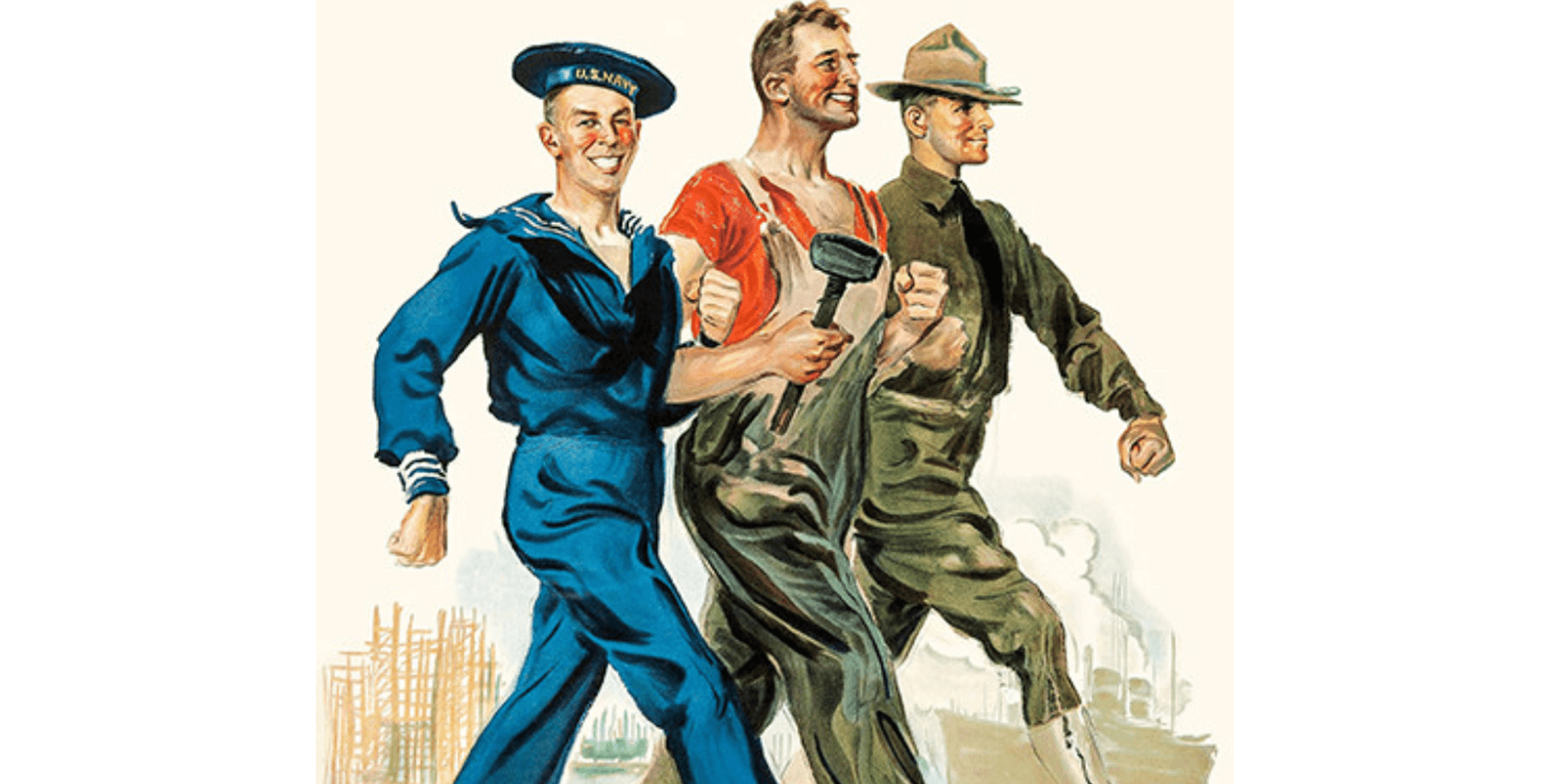
In his message to Congress asking for a declaration of war against Germany and thereby bringing the United States into World War I, President Woodrow Wilson proclaimed “The world must be made safe for democracy.” Yet a war to ostensibly save democracy abroad, resulted in it nearly being snuffed out at home.
As a result of the passage of the Espionage and Sedition Acts, supported by the progressive Democrat Wilson, the freedoms of speech, press, and assembly were heavily restricted. Government-sponsored propaganda efforts sought to boost the war and impugn its critics.
Eric T. Chester’s brisk read, Silencing ‘Fighting Bob’: The Attack on Antiwar Progressives During the First World War, brings to light efforts by government agencies to spy on, harass, and prosecute war critics like the Jewish socialists around the Yiddish “Forverts” newspaper (now known as Forward), the People’s Council of America for Democracy and the Terms of Peace (PCA), Wisconsin’s Robert “Fighting Bob” La Follette, and the Nonpartisan League (NPL).
Despite the title, this is not the biography of one man, but an exposure of wartime state repression.
The Wilson Administration drafted ex-muckraker George Creel to lead the Committee for Public Information (CPI) during the war. The CPI had a dual role. Publicly, it sponsored 75,000 speakers to give four minute-long pro-war speeches. Privately, it subsidized pro-war front groups and worked with the predecessor of the FBI, the Bureau of Investigation (BI), military intelligence, and various nongovernmental organizations to suppress the war’s critics.
Creel remarked to Wilson that the socialist Forverts was the “most dangerous influence” in New York City. In order to avoid the fate of other magazines that continued to criticize the war and were banned from the mail, the Forverts agreed, under government pressure, to no longer oppose the war in its pages. This tepid support was not enough for Creel, and the CPI purchased its own Yiddish newspaper in an effort to supplant the Forverts and more forthrightly promote the war.
To better oppose the war, the Socialist Party sought allies among religious pacifists and the wider progressive movement through the PCA. Some 20,000 people attended the Council’s inaugural meeting in New York. Pro-war union chieftain Samuel Gompers (with ample CPI subsidy) created the competing front group the American Alliance for Labor and Democracy, an association of union bureaucrats, pro-war intellectuals, and ex-Socialists. The ALLD, Chester writes, was “directly controlled by” the CPI. The AALD worked to marginalize the PCA, including pressuring local governments to cancel its Minneapolis meeting in favor of an AALD meeting.
The BI and military intelligence also harried the PCA. The BI raided its San Francisco office and kept chairman Scott Nearing under extensive surveillance, leading to his prosecution for violating the Espionage Act. That San Francisco office was burglarized numerous times, which Chester attributes to military intelligence operating on US soil. By 1918, the PCA was essentially defunct.
Republican Senator Robert La Follette was the most famous elected official to oppose U.S. entry into World War I. Chester describes La Follette as a uniquely dangerous threat to the Wilson administration and pro-war forces given his national stature and appeal to all sections of the peace movement. Had he been more decisive, La Follette could have founded an independent antiwar party in time for the 1918 elections tothreaten the Wilson administration’s congressional allies.
The CPI passed along confidential information to the American Defense Society for activities “which a government agency could not handle,” namely smearing La Follette. The Society was a pro-war organization whose membership included former president Teddy Roosevelt. It pledged to expel La Follette from the Senate, claiming he “preached sedition” and helped “paid spies and agents of Germany” work against the United States
After being subject to what he described as “a campaign of libel and character assassination,” as well as an unsuccessful effort to kick him out of the Senate, La Follette backed down from his explicit criticism of the war. By war’s end, “Fighting Bob” had temporarily hung up his gloves.
Domestic political considerations also influenced the campaign against the National Partisan League. The League’s main appeal was to farmers in the Midwest, which Wilson saw as a threat to the Democrats’ electoral prospects.
The Minnesota NPL ran ex-congressman Charles Lindbergh Sr. for governor in the Republican primary on a platform of public ownership of grain mills, elevators, and other agricultural enterprises. Lindbergh’s patriotism was repeatedly questioned. He was dubbed a “Gopher Bolshevik” by the New York Times, while the Chicago Tribune said his book, “Why is Your Country at War?” should bear “a German trademark.”
To fend off these attacks, Lindbergh scrupulously avoided directly attacking the war during his campaign and withdrew the book from circulation. It did him little good. The BI investigated him and the federal government looked to prosecute him under the Espionage Act for “Why is Your Country at War?” which was published before the Act had even come into effect. This attempt at ex post facto justice was dropped after investigators realized the difficulty of getting a conviction.
The 1918 Minnesota gubernatorial election was conducted under a tense, authoritarian atmosphere. Lindbergh was prevented from campaigning in more than a dozen counties by local governments and physically removed from platforms several times. Lindbergh and NPL campaigners were shot at; some were beaten by vigilantes. Chester disputes NPL claims that Lindbergh lost by fraudulent means, but the election was obviously neither free nor fair.
Notably, the Wilson government made no effort to investigate or prevent these assaults on the civil rights of its political rivals.
By 1919, President Wilson stated publicly what war critics had recently been persecuted for. “This war, in its inception was a commercial and industrial war,” he said in a St. Louis speech. “It was not a political war.” Had Wilson been a soapbox orator in 1917 (or in La Follette’s case a U.S. Senator) rather than the president in 1919, those words would have gotten him in a great deal of trouble.
Indeed, the CPI had recommended Espionage Act charges against the NPL during the war for a pamphlet that blamed wars on “a deadly game for commercial supremacy.”
A brief mention of post-9/11 attacks on civil liberties aside, Chester does not draw many modern connections in this book. Attentive readers, however, can see how Wilson blazed a trail when it comes to cracking down on wartime dissent and using intelligence agencies against domestic political rivals. Succeeding presidents have used these tools often but perhaps not as blatantly.
“Freedom,” as historian William Appleman Williams noted, “is not nurtured by nations preparing for war.” The years since World War I have continued to prove the essential truth of this statement.