

When it comes to propaganda, no weapon is left on the table. Film, radio, the internet, and print have all been enlisted to promote this or that party line. Comic books are no exception to this rule, and the military, State Department, and Central Intelligence Agency have all made ample use of comics over the past 80 years.
The relationship between the national security state and comics began during World War II, a period often considered the Golden Age of Comics. As historian Paul Hirsch details in his masterful “Pulp Empire: the Secret History of Comic Book Imperialism,” the quasi-governmental War Writers Board worked with the Office of War Information to propagandize for the war effort. The results were mixed. Attempts to promote racial tolerance towards African-Americans on the homefront sat uneasily with racist dehumanization of the Japanese enemy abroad, who were always depicted as inherently evil.
Superman was probably the most supportive of the war effort, even encouraging readers to buy war bonds, recycle rubber and scrap iron, and donate blood. Nevertheless, he was investigated by Army Intelligence. Had the Man of Steel turned traitor? Not exactly. After Superman writer Alvin Schwartz used the term “cyclotron” in a story, the War Department became concerned the writer was receiving leaks from the Manhattan Project. In truth, he had simply recalled the term from an old issue of Popular Mechanics.
The Cold War was the most productive period in the relationship. During the war on the Korean peninsula, “Korea My Home” appeared with the blessings of the State Department to explain U.S. war aims to the Korean people and demonize the North. In his “Truth is our Weapon,” Edward W. Barrett of the State Department said that “more than 700,000 copies” of “Korea My Home” were produced.
During the Vietnam War, the Vietnamese were showered with Agent Orange, napalm, and propaganda comics. A comic book by Will Eisner instructed American and South Vietnamese troops on the use of the M-16. Comic books were used to explain American war aims, or even to publicize a guerrilla commander, (Phung Hoang, who) readers should look out for as part of the shadowy Phoenix Program, a CIA and special forces operation to “neutralize” leading South Vietnamese Viet Cong insurgents via capture, torture, and targeted killing.
Contrast this with commercial war comics that presented such a harsh, brutal view of the Vietnam conflict that Naval Intelligence banned them as “designed to undermine morale.” EC Comics, publisher of “Two-Fisted Tales” and “Frontline Combat,” was investigated by Army Intelligence and the FBI because G-Men determined their Korean War comics were “detrimental to the morale of combat soldiers and emphasizes the horrors, hardships, and futility of war.”
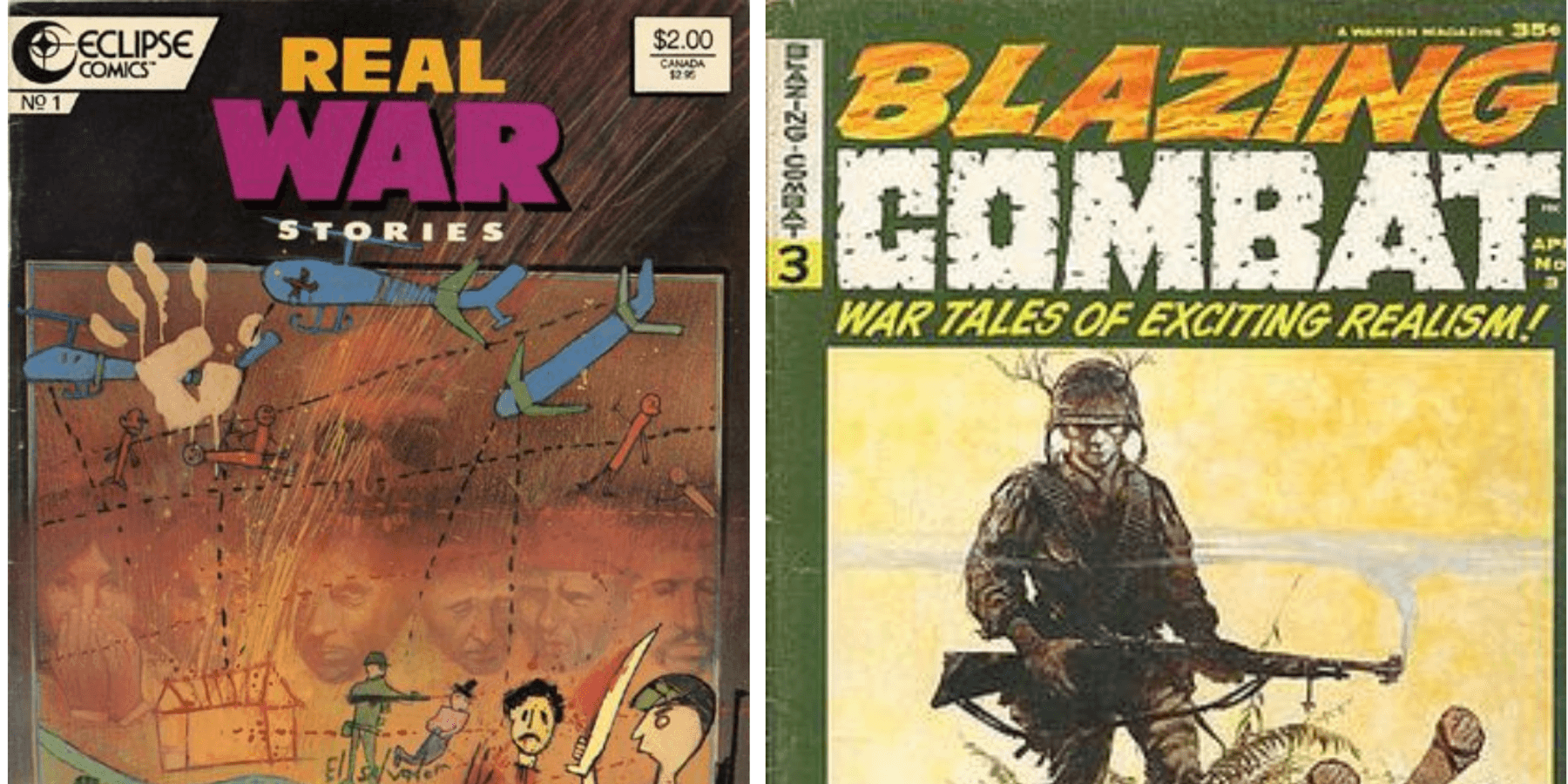
Publisher Jim Warren accused the military of “censorship of the worst kind” after his rendition of “Frontline Combat” and “Two Fisted Tales” titled “Blazing Combat” was banned from being sold on overseas military bases. Will Franz, writer of “The Lonely War of Captain Willie Schultz,” reported that a young man cited him and the title by name when he registered as a conscientious objector during the war. Franz claimed that reports from the draft board made their way back to the serial’s publisher, Charlton Comics, which decided to kill it.
These acts failed to eliminate comics critical of the war. When U.S. troops first arrived, most comics echoed the pro-war line of titles like “Tales of the Green Beret” and “Jungle War Stories,” but that didn’t last. “The Legion of Charlies,” part of the underground comix movement, contrasted the leniency given to the perpetrators of the Mai Lai massacre with the treatment of murderer Charles Manson. Even Iron Man, the superhero born in the conflict, appeared in antiwar stories as opposition to the war increased.
Meanwhile, the Commercial Comics Company was a major contractor with the U.S. for propaganda comics aimed at luring nonaligned nations away from Communism. The title “The Free World Speaks” was aimed at Africans and Asians and showed Stalin as an octopus ready to encircle a helpless globe. The problem was that Commercial Comics also published comics defending segregationist Dixiecrats like George Wallace at home. It was hoped that nonwhite readers would not be able to connect the two.
Commercial Comics reappeared after the 1983 U.S. invasion of Grenada. Using a fictitious cutout (an organization that hides official involvement) the Victims of International Communist Emissaries, the CIA produced “Grenada: Rescued from Rape and Torture.” Smiling Grenadians welcome U.S. troops by declaring, “Thank god! And thanks to President Reagan and our freedom loving neighbors!”
With its appearance coming shortly before the first post-invasion election on the island, the attempt to influence the political process was obvious.
Also during the late Cold War, “the Freedom Fighter’s Manual” targeted the contra forces attempting to overthrow the leftist Sandinistas in Nicaragua. The CIA-produced comic provided instruction on how to undermine the government. Some recommendations were nonviolent, such as faking illness to avoid essential work. Others were decidedly less so: readers were instructed on how to make molotov cocktails and firebombs.
Eclipse Comics counterattacked against the Reagan administration’s support for the contra war with “Brought to Light: Thirty Years of Drug Smuggling, Arms Deals, and Covert Action.” One half, “the Secret Team”, was written by comics legend Alan Moore (V for Vendetta, Watchmen) and illustrated by the equally legendary Bill Sienkiewicz (Daredevil, Elektra).
Eclipse took a risk by publishing “Brought to Light.” An earlier title published with the Central Committee for Conscientious Objectors, “Real War Stories,” attempted to show the downsides of military service. Moore and Sienkiewicz again contributed, but it was the segment “The Elite of the Fleet” that proved most controversial.
An expose of Navy hazing, it showed the process of “greasing,” or sexual assault via the barrel of a submachine gun. The Pentagon sued in order to stop publication, claiming that greasing was a myth. The lawsuit was dropped when the Navy’s own records proved that “greasing” did, in fact, occur.
Comic book propaganda did not cease throughout the post-9/11 forever wars. To sell the U.S. occupation of Iraq to Iraqis, comics were produced with the help of the U.S. Army targeting young people, including a 2008 comic produced by the Lincoln Group — a military contractor since outed for planting favorable stories in Iraqi newspapers — glorifying the U.S.-trained Iraqi special forces.
Marvel produced multiple Iraq War propaganda comics. First was 2004’s “Guard Force,” featuring the Army National Guard rescuing hostages from nebulous foreign terrorists. 2005’s “Combat Zone” was written by Karl Zinsmeister, who became a top policy advisor to George W. Bush. In 2006, Marvel partnered with the DoD to salute “the real heroes, the men and women of the US military” with a special issue of the Avengers.
Even defense contractors have tried getting into the game. A collaboration between Northup Grumman and Marvel was only nixed after widespread public backlash.
Since Pete Hegseth has taken over as Pentagon honcho, a decidedly anti-comics atmosphere reigns. The Pentagon’s official newspaper Stars and Stripes has eliminated its comics section, to much reader dismay. Will this mark the end of comic book propaganda’s seemingly never ending battle to win overseas hearts and minds? To be continued…