

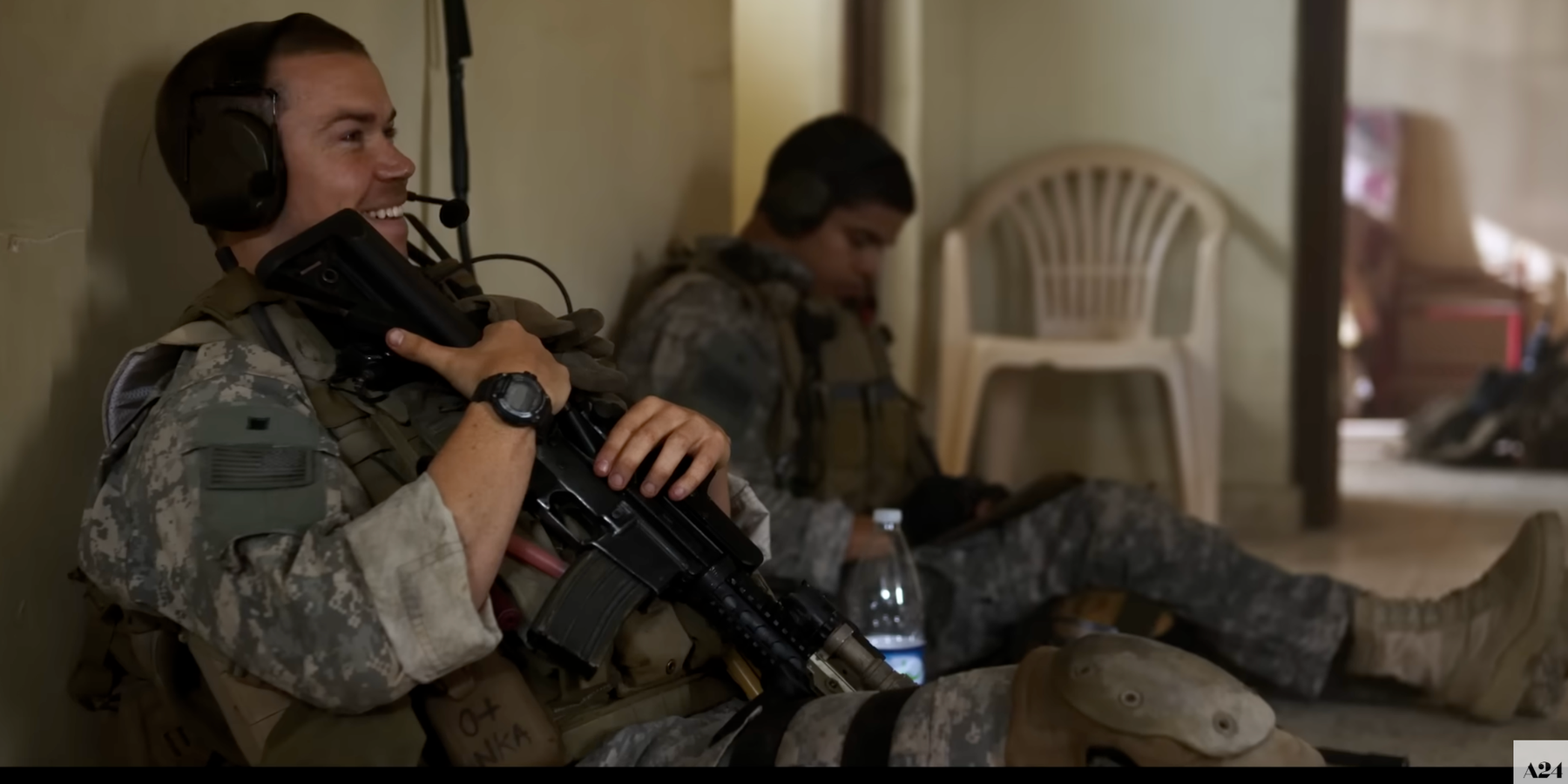
Unlike Alex Garland’s Civil War, his Warfare, co-directed with war vet Ray Mendoza, is not just another attempt at a realistic portrayal of war, in all its blood and gore. Warfare, based on a true story, is really a parable about the overweening ambition and crushing failure of empire, a microcosm of America’s disastrous adventure in Iraq.
A Navy Seal mission reconnoiters a neighborhood in Ramadi. “I like this house,” says the team commander, reflecting the overconfidence of the empire at its unipolar moment. But it soon becomes clear that the mission has underestimated the enemy, that the whole neighborhood has, in fact, been tracking the Seals’ movements. Surprised and scared, the mission requests to be extricated. But extrication becomes a bloody, hellish experience despite the Seals’ technological edge in weapons, IT, and logistics, and it barely succeeds.
For most of the film, the resistance is visible only through the Seal sniper’s lens, but as they emerge from all the neighboring houses after the invaders have been driven out, these faceless folks convey a simple but clear message: Leave, you’re not wanted here. What is notable is how that message is delivered. There is no moralizing or pained explorations of conscience by the combatants. The message is deftly smuggled into a simple story of a platoon that is inserted into an alien environment, entrapped, extricated, and forced into ignominious retreat.
The only film I can compare with a similar indirect, non-didactic approach in delivering an anti-war message—and reaping the rewards in the box office, to boot—was Ridley Scott’s Black Hawk Down, which was also about a mission gone badly awry during the U.S. intervention in Somalia in the early 1990s. Not surprisingly, there’s already a debate about which is the better film.
The larger picture framing Warfare was President George W. Bush’s invasion of Iraq in 2003 to take out Saddam Hussein and remake Iraqi society into an American-style liberal democracy with a neoliberal economy. Although initially welcomed by some sectors, almost all of Iraqi society had turned against the United States by 2007. But the social arrangements in place during Saddam’s rule also crumbled, turning the battle into a four-cornered pitched battle between the United States, Sunnis, Shiites, and the Kurds. The levels of violence against U.S. troops reached unprecedented levels, with only the so-called Green Zone in Baghdad under secure U.S. control.
Top U.S. officials, both military and civilian, recommended disengagement from Iraq. A strategy called “the Surge,” was adopted under Gen. David Petraeus, the key elements of which were temporarily raising the number of U.S. troops, shifting the focus from military tactics to political efforts to reconcile warring Iraqi groups, and setting a firm date for withdrawal. This was meant to buy something like the “peace with honor” the United States negotiated with North Vietnam that went into effect in 1973 to allow an “honorable” withdrawal of American forces. By December 2011, most U.S. troops had left Iraq, forced out by the realities of resistance that are sketched in microcosm in Warfare, having accomplished nothing but to leave a society in ruins, hundreds of thousands dead, and a government solidly aligned with U.S. adversary Iran.
There have been a number of films about the Iraq War, the most notable of which were Kathryn Bigelow’s The Hurt Locker and Clint Eastwood’s American Sniper. Both are gripping stories, and both do a good job depicting the stresses veterans face in adjusting back to civilian life. But both largely evade the bigger picture, meaning what the Americans were doing in Iraq in the first place. (Moreover, Eastwood’s reputation as a director was nearly ruined by that scene that most remember from American Sniper: Brad Cooper manipulating the hand of the doll that Eastwood inexplicably substituted for a real baby.)
As for films about the war in Afghanistan, America’s longest war, there are hardly any worth watching, except perhaps documentaries like HBO’s Escape from Kabul and BBC’s Leaving Afghanistan.
It is perhaps coincidental that Warfare was released in April 2025, 50 years after the devastating defeat of the United States in Vietnam, symbolized by the frantic clawing by U.S. collaborators onto a helicopter on the rooftop of the U.S. Embassy in Saigon. Looking back, the debacle in Vietnam was the decisive defeat of American arms from which the United States never really recovered. The empire did seem to have a second wind with the invasion of Afghanistan and Iraq in 2001 and 2003, respectively, but that illusion was shattered by the panicked withdrawal from Kabul in 2021, which was visually almost a replay of the retreat from Saigon decades earlier.
The disastrous adventures in Vietnam and the Middle East have been instrumental in creating a significant isolationist sector in the so-called MAGA movement that Donald Trump appealed to successfully in his three quests for the presidency. Despite his aggressive rhetoric and his penchant for trade war, Trump is gun-shy, knowing that nothing could better undermine his presidency than his unleashing the dogs of war. Still, given the well-known short memory of the American public, it is by no means certain that the era of Western imperial interventionism is over. Let’s hope that Warfare will contribute to underlining the foolishness and recklessness of the bipartisan elite that has dominated U.S. foreign policy over the last eight decades.
Story was republished with permission from Foreign Policy in Focus.