

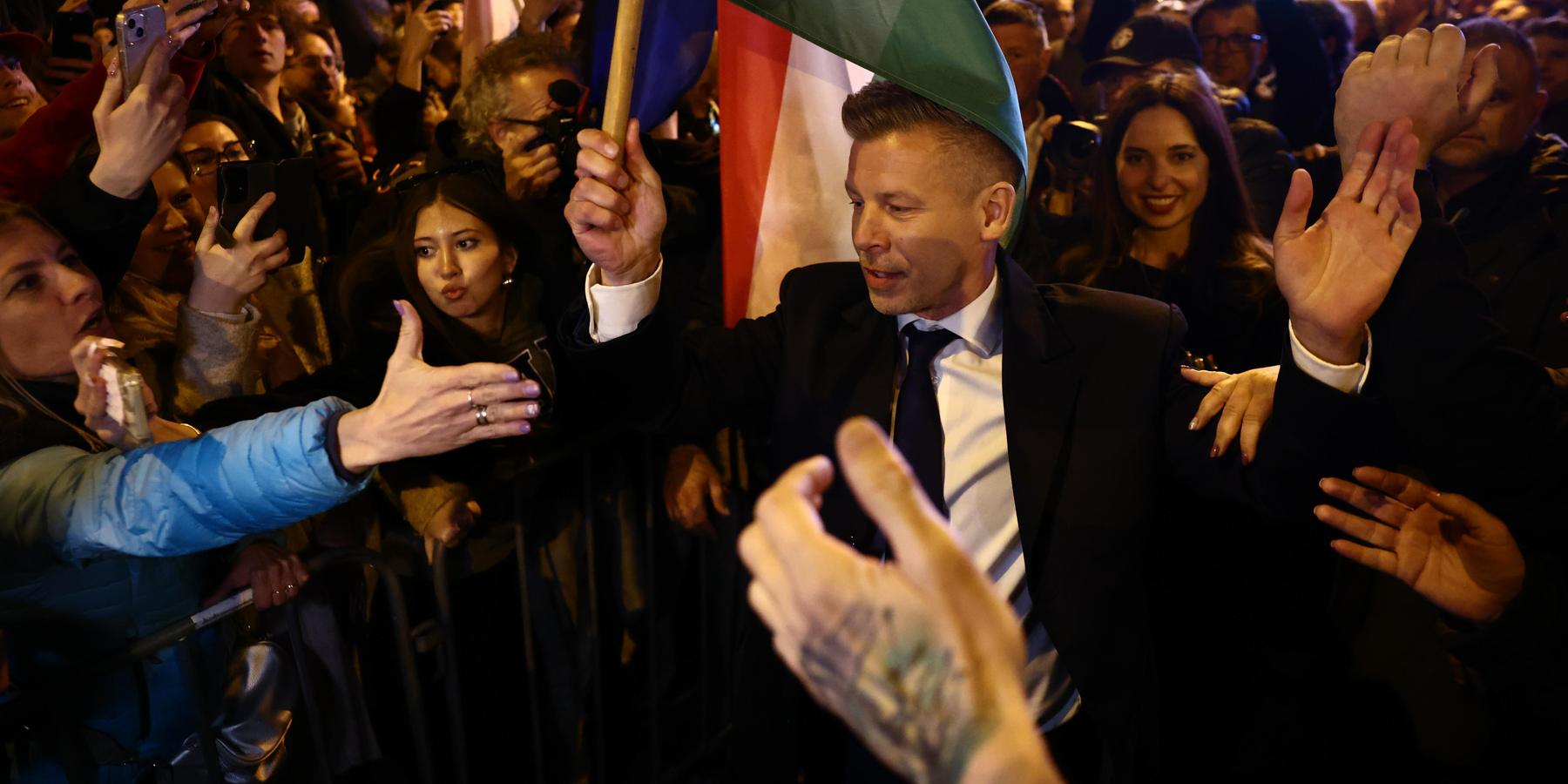
After holding power for 16 years, Hungary’s Prime Minister Viktor Orbán and his Fidesz party suffered a crushing defeat in Sunday’s parliamentary election.
The Tisza party is on course for a two-thirds super-majority in the incoming parliament, with its leader Peter Magyar as the new prime minister. With more than 80% of the votes counted, Tisza has won 137 of the 199 seats in a voter turnout of more than 77% — a record for post-communist Hungary.
This result vindicates the polls that consistently showed Tisza with a strong lead among voters. The margin of victory clearly swept away the pro-incumbent electoral reforms that Fidesz had enacted to make such a resounding defeat improbable and to potentially keep Orbán in office.
A setback for Europe's populist nationalists
As dean and standard bearer of the populist right in Europe, Viktor Orbán’s defeat sets back prospects for coming contests in France, Poland, and elsewhere between populist right and mainstream parties.
It is also arguably a rebuke of President Donald Trump and a reflection of his waning prestige, even among conservative nationalist constituencies in Europe. The visit by Vice President JD Vance last week in support of Orbán seems to have had no impact on the clear dissatisfaction of much of the electorate and the anti-incumbent landslide.
Moreover, populist nationalist leaders such as France’s Marine Le Pen and Germany’s Alice Weidel have opposed the U.S. war against Iran, a clear indication that their former close alignment with the Trump Administration has become a potential liability.
Bread and butter triumphs
Orbán’s early concession was unexpected and could point to some relaxation in the polarized atmosphere of the bitterly contested campaign. Orban said “the responsibility and opportunity to govern “were not given to us,” but pledged to his voters “never to give up.”
Orbán staked his campaign on foreign and security policy, attempting to portray Magyar as a creature of the allegedly hostile EU leadership, above all Commission President Ursula von der Leyen, and as someone risking Hungary’s security by pandering to Ukraine’s president Volodymyr Zelensky. Magyar was accused of having conspired with Ukraine in closing off Hungary’s supply of Russian oil.
Magyar’s strategy was to avoid confrontation directly on these issues, and instead to focus his critique of Orbán on the popular themes of corruption, cronyism, and a weak economy. This has proven to be even more effective than the opinion polls had predicted in producing a decisive rebuke of Orbán’s leadership.
Magyar promised better relations with the EU, and it is likely that the EU will quickly unblock some, if not all, of the several billion euros withheld from Hungary because of failure to comply with EU standards on human rights, press freedoms and democratic governance.
However, Magyar did not promise to reverse Orbán’s opposition to arming or funding Ukraine. He did agree to gradually reduce Hungary’s reliance on Russian oil delivered by the Druzhba pipeline and Russian gas delivered by pipeline through Turkey. While Magyar can be expected quickly to reverse Orbán’s opposition to the disbursement of the €90 billion EU loan to Ukraine, it is not clear whether Magyar will acquiesce in the permanent elimination of Hungary’s oil supply through the Druzhba pipeline.
Magyar has also given no indication that he will support Ukraine’s early accession to the EU.
Even so, his campaign apparently struck a sympathetic chord among voters who deplored Orbán’s friendly stance toward Russia. This may be the sole clear advantage of Magyar’s campaign against Orbán in the strategic or diplomatic field.
What happens next?
A former senior diplomat and official of Fidesz, Magyar was able to attract votes from Hungary’s liberal, urban, and younger voters without differing very markedly from Orbán on many issues of substance. He made the election about Orbán’s probity and competence and not about Orbán’s conservative nationalist worldview.
In fact, Magyar was a member of Fidesz until 2024 when he left to build Tisza, which is part of the center-right European People’s Party grouping in the European Parliament, occupying the place formerly held by Fidesz.
After a deeply acrimonious campaign, the fact that Orbán conceded his defeat earlier than expected means that risks to social peace and security are not as great as might have been feared in the case of a closer race. However, in claiming to have “liberated” the country from Orbán’s rule, Magyar hints at prosecutions of Fidesz officials, possibly to include Orbán himself.
With a commanding majority in the parliament, Magyar plans to launch a major overhaul of the institutions, laws, and norms that have supported Orbán’s rule. The challenges from Fidesz loyalists entrenched in positions outside of parliament may place obstacles in his way. It is far from clear that Orbán will fade into retirement or obscurity, since he has pledged to make the most of Fidesz’s new role as principal parliamentary opposition to Magyar and Tisza.
- Could this be the election that brings Hungary's Orban down? ›
- VP Vance rushes to Hungary to save Viktor Orban's political life ›