

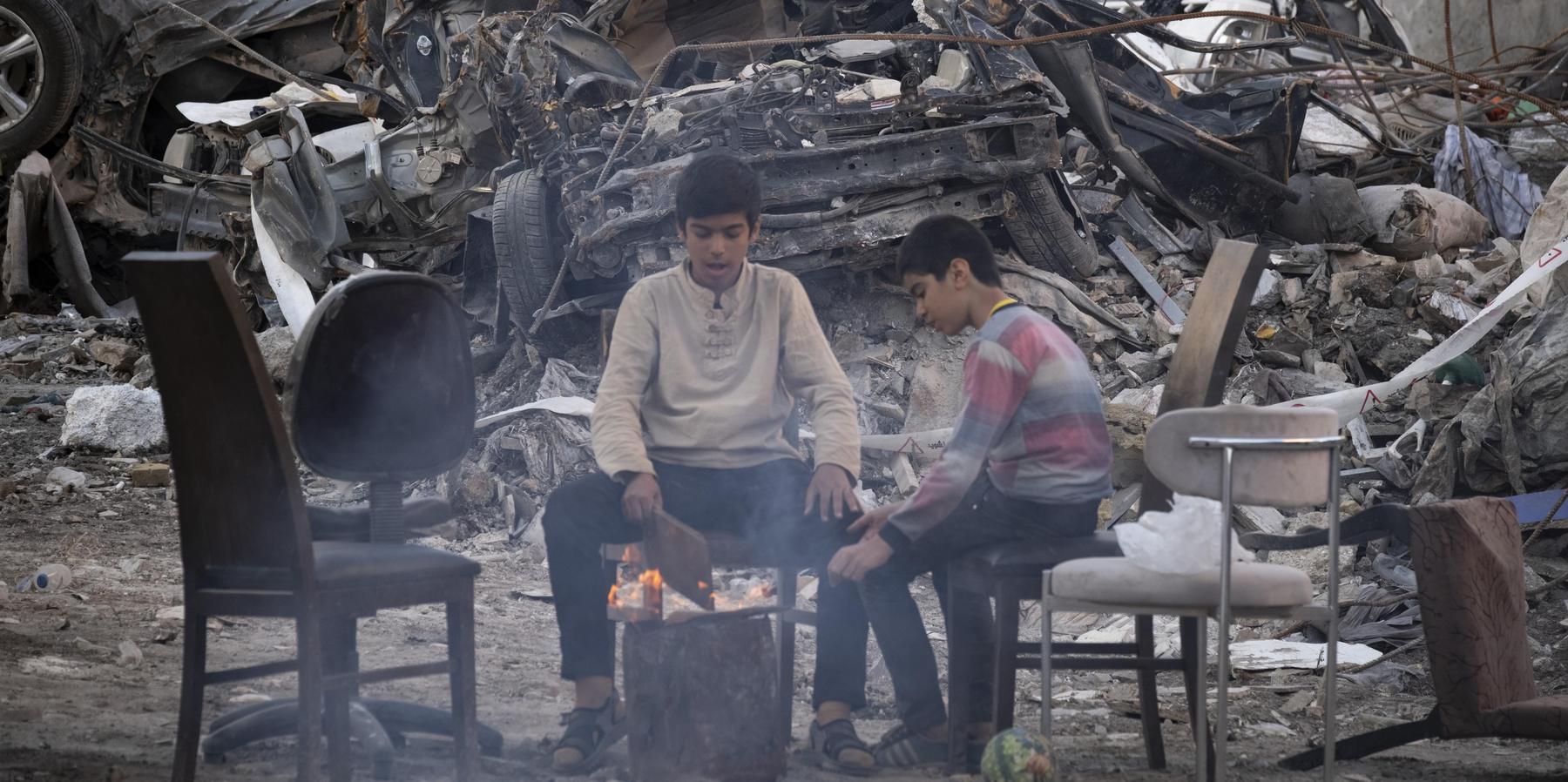
For ordinary Iranians, the tenuous ceasefire that began last week has offered a desperately needed reprieve from death and displacement. For analysts, it has provided an opportunity to evaluate the damage that this war has wrought.
The conclusion is clear: In six weeks of fighting, the U.S. and Israel have dealt a devastating blow to Iran’s economy, placing 50% of Iranian jobs at risk and pushing an additional 5% of the population into poverty.
President Donald Trump marketed the war at the outset as a campaign to support the Iranian people. “America is with you. I made a promise to you, and I fulfilled that promise,” Trump said at the outset. But that rhetoric soon hardened into menace. Trump later described Iranians as “a nation of terror and hate” and threatened to strike civilian infrastructure, including bridges and power plants, warning that a “whole civilization” could die, “never to be brought back again.”
In practice, the war has destroyed the lives and livelihoods of ordinary citizens with little influence over the Islamic Republic’s policies. Those supposedly meant to benefit from the war ended up bearing its heaviest human and economic costs. The latest Iranian official estimates put the death toll at 3,370.
The pattern of Israeli and U.S. attacks suggests that they have intentionally targeted the core pillars of Iranian livelihoods, as well as the state’s ability to deliver services. More than 125,000 residential and civilian buildings have reportedly been damaged, roughly comparable to the number of buildings damaged during the eight-year Iran-Iraq War.
Among the damaged facilities were 339 health facilities, 32 universities, 857 schools, tens of police and fire stations, 20 Red Crescent centers, and 120 museums and historical monuments. If a citizen in Tehran needs emergency medical assistance, wants to report a car accident or house fire, or simply needs to renew documents, they may be unable to reach the police or emergency services because stations and offices have been bombed or evacuated to avoid casualties.
More than 23,000 factories and firms have been directly hit, with many neighboring businesses also forced to shut down. Critical infrastructure — including ports, aviation, and transportation networks, which are essential for moving food, medicine, raw materials, and workers — has also been heavily affected. Iranian officials have estimated the cost of reconstruction at approximately $300 billion in damages to civilian infrastructure, excluding military sites and broader economic losses from unemployment, business closures, supply disruptions, inflation, and lost investments.
This trail of destruction represents a deliberate strike at the core of Iran’s labor market. By hitting steel, petrochemicals, pharmaceuticals, and transportation, the war disrupted supply chains that sustain millions of jobs. Many dairy factories, for example, have suspended operations because of shortages of essential packaging materials. Long market shutdowns, liquidity constraints, weak demand, and deep uncertainty have also reduced private consumption and damaged wholesale and retail activity.
By my estimate, 10 to 12 million jobs, the primary source of income for nearly half of Iran’s workforce, are now at risk. The burden falls most heavily on informal workers and on low- and middle-skilled workers in the formal sector, who have the least protection and the least political influence. Public sector employees and highly skilled workers in the formal sector, by contrast, remain relatively better insulated.
Iran’s economy, according to the World Bank estimates, contracted by 2.7% during the fiscal year that ended on March 20. Among the factors driving this stagflation before the latest escalation were last year’s 12-day war, a suspicious explosion at the economically important Rajai Port last April, U.S. sanctions, and a severe drought.
Between March 2025 and March 2026, the national currency lost almost half its value, more than 750,000 jobs were eliminated, and inflation reached a 70-year high. Last month, Iran's inflation rate and the cost of its staple food basket reached record highs of 72% and 134%, respectively, compared with March 2025. The rial’s collapse has intensified inflationary pressure, while lost income, layoffs, and business shutdowns are pushing more households into poverty.
The war has turned these already dire conditions into something far worse. According to a new estimate from the United Nations Development Programme, the war could contract Iran’s economy by 8.8 to 10.4% relative to a no-war baseline in the Iranian year 1405 (ending 20 March 2027). Even if the 40-day war has ended, according to the UNDP, 3.5 to 4.1 million Iranians have already been dragged below the poverty line. In that context, an expected 3-4 million layoffs with a three-digit inflation rate will drive millions of already vulnerable Iranians deeper into poverty.
The Islamic Republic's war plan includes supplying essential goods, providing subsidized loans, offering tax incentives and exemptions for damaged factories and firms, providing unemployment benefits, and subsidizing food staples. However, absorbing and covering the costs of war is beyond the government's capacity. Providing food staples and unemployment benefits for one year would require nearly 5 quadrillion rials, or 45 to 50% of Iran's public budget, which has already faced a high deficit.
However, the Islamic Republic’s decision to enter into negotiations was not a simple response to the war’s economic costs, nor was it necessarily a sign of weakness or strategic defeat. Iran’s leadership is now seeking to contain an increasingly dangerous escalation, reassert control over the tempo of the conflict, and test who truly holds the final say in whether this war continues or stops.
In a war where Trump has publicly described ending the conflict as a “mutual” decision with Israeli Prime Minister Benjamin Netanyahu, Tehran is explicitly testing whether the United States is the actual decision‑maker and whether pre‑war calculations in Washington have changed, with short-term pain for the U.S. and the global economy yielding long-term gains.
If Washington reads the pause as proof that economic pressure alone can force Iran into submission, it will misunderstand both the regime and the society living under it. The war has already devastated ordinary Iranians far more than it has weakened the state’s determination to preserve control over escalation.
Another round of fighting will not clarify the conflict or produce a cleaner strategic outcome. It will deepen the destruction, widen the humanitarian disaster, and increase the chances of another miscalculation that neither side may be able to control. That is why this fragile ceasefire must hold, and why it must not be mistaken for either peace or surrender.
- The Iran war's early lessons ›
- Israel and US have chosen war, unleashing fresh economic pain ›
- More Iran war? There goes the neighborhood, and global economy. | Responsible Statecraft ›
- Trump is losing control of the Iran war | Responsible Statecraft ›