

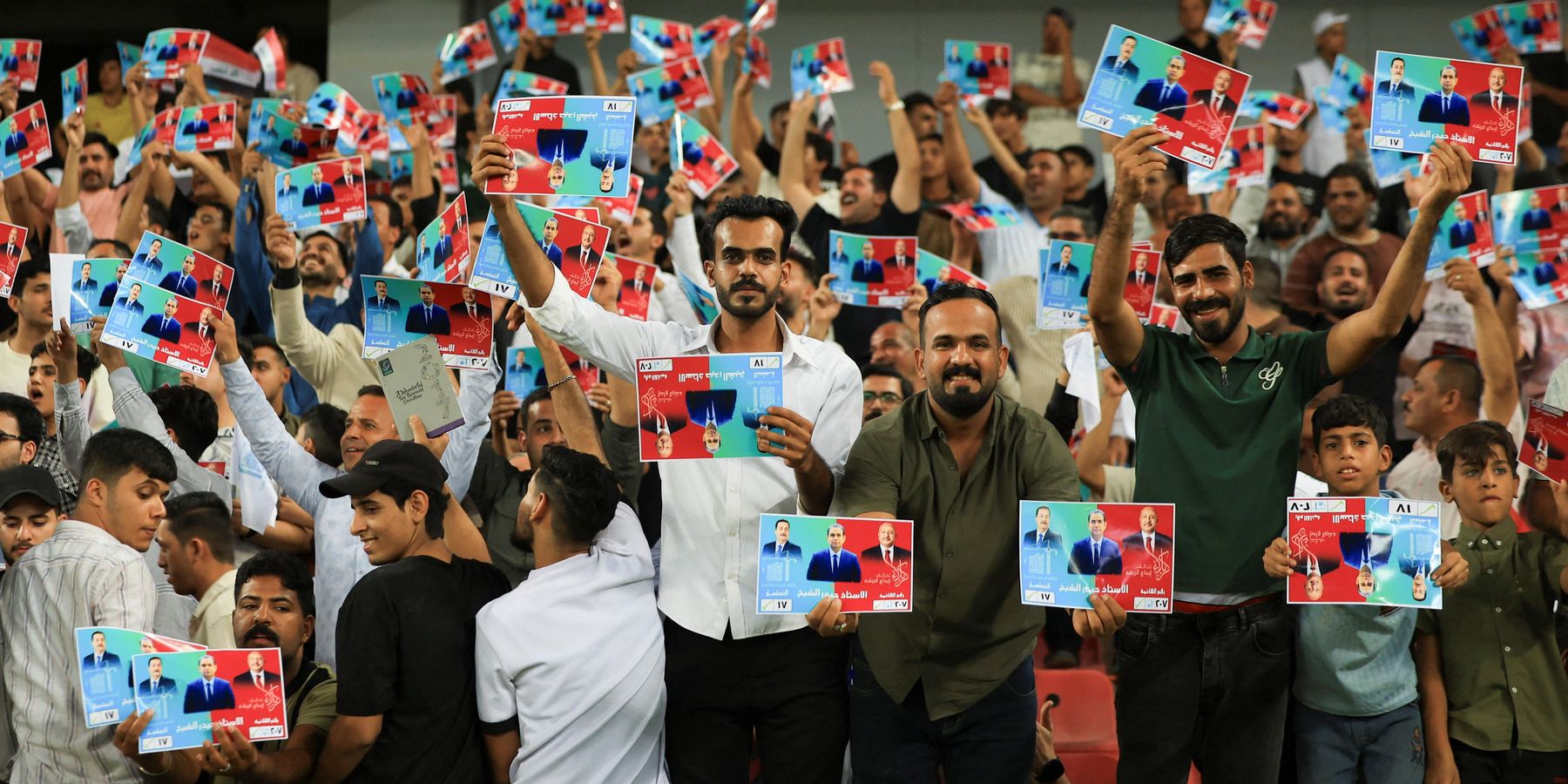
Iraqis head to the polls on November 11 for parliamentary elections, however surveys predict record-low turnout, which may complicate creation of a government.
This election differs from those before: Muqtada al-Sadr has withdrawn from politics; Hadi al-Ameri’s Badr Organization is contesting the vote independently; and Hezbollah — Iran’s ally in Lebanon — is weakened. Though regional unrest persists, Iraq itself is comparatively stable.
Prime Minister Mohammed Shia' al-Sudani’s tenure was quieter than his predecessors’ (see here, here, here, and here), ending without scandal or disappointment, but electricity shortages have harried his administration which has announced ambitious infrastructure projects. (Iraq currently produces between 24,000 and 28,000 megawatts of electricity, and Iraq recently inked a contract with U.S.-based General Electric to add another 24,000 megawatts by 2028.)
Recently, U.S. energy giants Chevron and ExxonMobil signed exploration and development deals. Simon Watkins of OilPrice.com, called ExxonMobil’s comeback in Iraq “a major geopolitical shift, signaling renewed Western engagement.” These developments likely please U.S. President Donald Trump, who has yet to meet Sudani formally in Baghdad or Washington, D.C.
Whoever becomes Iraq’s next prime minister faces three major challenges: the water crisis, U.S. relations, and regional entanglement with Iran.
Managing the water crisis
Iraq’s most immediate problem is water scarcity. It depends on Turkey and Iran for nearly 75% of its freshwater through the Tigris and Euphrates rivers, which originate upstream. Torhan al-Mufti, Sudani’s adviser on water affairs, warns that Iraq’s vulnerability stems from these transboundary flows.
There is some good news: according to Mufti, water inflows from Turkey to the Tigris have doubled in two years. In October 2025, Baghdad and Ankara reached a draft water-sharing agreement that includes infrastructure rehabilitation, implemented by Turkish companies, and a permanent consultation group to coordinate future water-sharing decisions.
Nevertheless, 2025 has been Iraq’s driest year since 1933. Rainfall shortages, and Turkish and Iranian dam projects, reduced Tigris, and Euphrates water levels by up to 27%. Reservoirs now hold less than 8 billion cubic meters, their lowest volume in over eight decades.
In September, the government suspended wheat planting due to insufficient water. Southern Iraq, particularly Basra, home to 3.5 million people, faces a growing humanitarian crisis as residents rely on trucked-in water. The once-vast Mesopotamian marshes, a UNESCO World Heritage site, are retreating, threatening biodiversity, and displacing communities.
Increasing water salinity is hurting farmers and livestock. The International Organization for Migration reports saltwater intrusion is destroying farmland, palm groves, and citrus orchards. This ecological decline risks economic instability and social unrest, especially in rural regions.
One solution may be to lease farmland abroad, following the example of Saudi Arabia and the UAE, which cultivate crops in Africa to preserve domestic water. However, this could deepen Iraq’s internal dislocation, displacing struggling agricultural communities.
Balancing US relations
U.S. troops withdrew from Iraq in 2011, but returned in 2014 to fight the Islamic State. Washington pledged to achieve the “enduring defeat” of ISIS — a mission to justify a long-term presence.
Under a recent agreement, U.S. combat forces began withdrawing in September 2025, with a full exit expected by September 2026. However, small contingents will remain in Iraqi Kurdistan and at Ain al-Asad Air Base to assist in counterterrorism operations.
In October, U.S. Secretary of State Marco Rubio urged Sudani to “disarm” the Popular Mobilization Forces (PMF) — a 240,000-strong force formed to fight ISIS with an annual budget of roughly $3.5 billion. The U.S. pressured Iraqi lawmakers to withdraw legislation that would place the PMF fully under government control, though internal disagreements also helped doom the bill. Sudani recently declared the armed groups have two options: join the official security institutions or transition to [unarmed] political work.
The invasion and occupation of Iraq cost the Americans over 4,400 dead and over $3 trillion. The U.S. now faces “the Meddler’s Trap” — a self-inflicted cycle in which intervention creates new problems that policymakers feel compelled to manage indefinitely. Iraq remains caught in this dynamic: Washington wants to leave but cannot bear the risks of doing so.
Keeping Iraq out of the US–Iran conflict
A third challenge for Iraq’s next government is avoiding entanglement in the long-running U.S.–Iran rivalry. Since the 1979 Islamic Revolution, Washington has sought to reverse what it sees as a national humiliation: the overthrow of its ally, the Shah of Iran, and the 444-day hostage crisis that followed, that may have swayed the 1980 presidential election.
Over the decades, both sides have waged a shadow war — from sanctions and cyberattacks to assassinations and economic sanctions. Iran’s ballistic missile, drone, and nuclear programs are now American justifications for continued containment.
In June 2025, U.S. airstrikes targeted three Iranian nuclear facilities. President Trump claimed the operation “obliterated” Iran’s nuclear program, though American military intelligence wasn’t so sure. Meanwhile, Israel, America’s closest ally in the region, has reportedly continued assassinations and covert operations against Iranian scientists and facilities.
Iraq risks becoming a battleground by proxy. In May 2025, U.S. Reps. Joe Wilson (R-S.C.) and Greg Steube (R-Fla.) advocated sanctioning Iraq as part of the “maximum pressure” campaign on Iran. They advocated sweeping penalties on the PMF, much of Iraq’s banking and oil sectors, the minister of finance, “Iran’s facilitators in Iraq,” the chief justice of Iraq’s Federal Supreme Court, and former prime ministers — a decapitation attack on Iraq’s economy and sovereignty.
The slogan of Sudani’s political project is "Iraq First," but to Washington, Iraq is a tool for pressuring Iran, all the money and dead soldiers provide the justification for America’s droit du seigneur; but this dynamic threatens Iraq’s national stability. The next prime minister must navigate between the U.S. and neighboring Iran to preserve Iraq’s fragile independence. The PMF’s status will be the most contentious issue between America and Iraq, as the Americans have forgotten what happens when you suddenly demobilize a large group of well-armed men.
Despite relative quiet and significant new foreign investment under Sudani’s tenure, Iraq still faces water shortages, unfinished security reforms, and the constant danger of being drawn into foreign conflicts, mostly the legacy of Saddam Hussein’s repression, and Western sanctions and military attacks.
Balancing domestic needs with foreign pressures — especially from the United States and Iran — will define Iraq’s future far more than the election’s immediate outcome.