

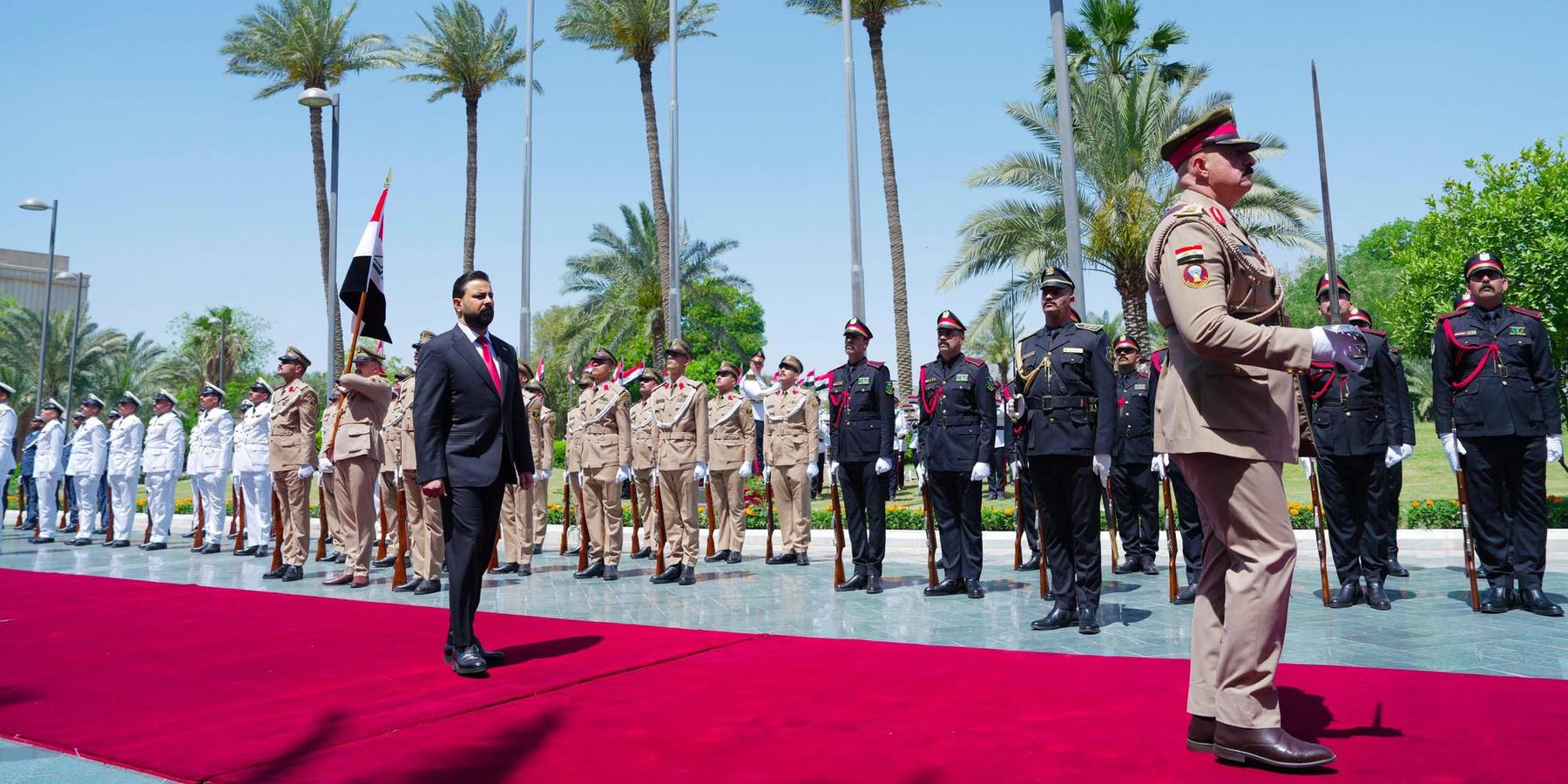
Iraqi billionaire Ali al-Zaidi was confirmed as Iraq’s new prime minister on May 14, a full six months after elections. His emergence reflects his unique appeal to Washington, Tehran and Iraq’s bitterly divided political establishment.
Alongside fiscal and social challenges, Zaidi faces a far more daunting test. He will need to appease three centers of power with diametrically opposed visions for the future of Iran-backed militias operating outside of government control. Tehran wants them elevated; Washington wants them eliminated; and Baghdad wants them accommodated. Meeting the demands of all three constituencies is Mission Improbable.
There is no easy path to fixing Iraq's militia problem. Many of the militias emerged from the fight against ISIS, when the Iraqi state itself appeared on the verge of collapse. That history still grants them national legitimacy in the eyes of many Iraqis, who see them not as rogue insurgents but as forces that helped prevent the country from disintegrating.
Yet over time, many of these groups evolved far beyond their original battlefield role. They command weapons and fighters, but now also business networks, border crossings, logistics routes and political blocs embedded within parliament and state institutions, obscuring the lines between official and unofficial authority.
For Tehran, these groups represent a pillar of Iranian influence in the Arab world. Tehran’s anxieties have been underscored by the repeated visits of Islamic Revolutionary Guard Corps Quds Force commander Esmail Qaani to Baghdad in recent weeks, as Iran seeks to influence the emerging political order and prevent any erosion of militia influence. During meetings with leaders of the Shiite Coordination Framework (Iraq’s leading political bloc) and armed factions, Qaani reportedly said that any moves to disarm the militias or restructure the Popular Mobilization Forces (PMF), which is the official umbrella organization of the groups, would be “red lines for the Axis of Resistance”. From Tehran’s perspective, the militias remain a critical deterrent force and a necessary counterweight to American pressure in Iraq and across the region.
Washington’s position couldn’t be further from Tehran’s. Support for Zaidi is best understood as conditional rather than enthusiastic. U.S. President Donald Trump quickly endorsed him and invited him to Washington, viewing the Iraqi billionaire and political novice as a more pragmatic and potentially less ideological alternative to overtly pro-Tehran figures such as former Prime Minister Nouri al-Maliki. American backing of Zaidi came with demands to marginalize Iran-backed militias and tighter controls on the financial networks and patronage systems that allow the armed groups to entrench and enrich themselves.
For the U.S., the militias represent armed extensions of Iranian power that must be dismantled, subordinated to the state or stripped of meaningful autonomy. The militias demonstrate tangible Iranian influence on the ground in Iraq. Since the 16th century, the area has been considered the “eastern flank” of the Arab world, separating the Sunni Ottomans and the Shia Safavid Empire of Persia to its east. This flank became even more significant after the 1979 Iranian Revolution as Gulf allies of Sadaam Hussein poured billions into Iraq to protect that flank against Iranian expansionism. The Iran-Iraq war of 1980-1988 was largely financed by $37 billion in war loans from Iraq’s neighbors.
Yet, since the 2003 U.S. invasion of Iraq, the script has been flipped. Iraq is no longer the flank of the Arab world but is now a strategic buffer for Iran. It protects Iran against regional rivals, military aggression and political pressure from Western powers, and brings it closer to proxies in Lebanon and Yemen.
Iranian-backed militias and the IRGC’s Quds Force have been at war with the U.S. for decades. The Pentagon reports at least 603 U.S. personnel killed in Iraq between 2013-2019 alone, and, in the past two and a half years, these militias have attacked U.S. troops and diplomats more than 250 times.
The militias have achieved political representation in the parliament, maintained well-equipped military units and, like in Iran and Lebanon, set up companies whose profits have paid the salaries of fighters and turned many militia leaders into multi-millionaires. The government-sponsored Muhandis General Company, for example, is controlled by Abu Fadak, the U.S.-sanctioned leader of Kata’ib Hizballah and the PMF’s chief of staff. The company’s articles of incorporation were signed by the top PMF leader in Iraq, Falah al-Fayaad.
Nevertheless, Iraq’s cautious political class largely wants to minimize the issue. Former Prime Minister Haider al-Abadi’s advice to Zaidi counseled against any direct or kinetic confrontation with the militias, warning that an aggressive attempt to dismantle them could fracture the state itself. Instead, Abadi advocates dialogue, containment and gradual integration through political channels rather than force. That includes working through intermediaries within the Shiite Coordination Framework and, where necessary, engaging Tehran directly over factions closely aligned with Iran.
According to Hamzeh Hadad, adjunct fellow at the D.C.-based Center for a New American Security, “The Iraqi state has to dismantle the armed groups that are uncooperative, primarily those that are part of the umbrella group called the Islamic Resistance in Iraq, because they have been going against the state’s positions. As for the paramilitaries that make up the PMF, that are not affiliated with the Axis of Resistance, they have tens of thousands of members and so their institutionalization needs to happen because there is no other way to address the issue.”
Hadad notes that many of these fighters “took up arms to defend the country” and continue to rely on militia structures for salaries and livelihoods, making gradual integration more realistic than abrupt disarmament, particularly while regional tensions remain high.
His view reflects the prevailing preference within Iraq’s political establishment for accommodation. Iraq’s political class understands that many of these armed groups are too deeply entrenched to simply uproot. They are intertwined throughout parliament, ministries, security structures and economic networks. Any abrupt confrontation risks triggering political paralysis, internal fragmentation or even renewed violence. While not necessarily supportive of militia dominance, Iraq’s political class fears the consequences of trying to reverse it.
Zaidi sits at the convergence of three irreconcilable agendas. As a businessman and political novice, he is not a seasoned ideological operator but an outsider entering a system shaped by armed networks, foreign leverage and institutional paralysis. While he may not be naïve, there will be hard limits to his room for maneuver.
His success depends on whether he can satisfy three actors demanding mutually exclusive outcomes. It is a zero-sum game; every concession he grants risks alienating one of the three pillars of his precarious support. Zaidi’s margin for error is narrow, and Hadad warns that both Washington and Tehran will have “little patience” with the new government, even though “being acceptable to American and Iranian officials should not be the only criteria for Iraq’s prime minister.”
Zaidi may have been the only candidate all sides could accept, but the question remains whether Iraq has now placed an unachievable mandate on the only man willing to accept it. For the 40-year-old premier, getting selected was the easy part. Triangulating between the Iranians, the U.S. and Iraq’s own governance system will require skills unlikely to have been learned in his business careers. Success is not impossible — but the odds are certainly not in his favor.
- Iraq faces first quiet election in decades. Don't let that fool you. ›
- Iraq can't hold off Gaza's spillover much longer ›
- Iraq PM embraces his inner Michael Corleone — for the best of reasons | Responsible Statecraft ›
- As Baghdad tries to please Trump, Iran tells Iraqi militias not to disarm | Responsible Statecraft ›